
Introduction
Proximal humerus fractures (PHFs) account for approximately 5–6% of all adult fractures and represent the third most common fracture type following those of the hip and distal radius particularly in older women.1–3 The typical mechanism is a low-energy fall from standing height, although high-energy trauma remains a concern in younger patients and can produce more complex fracture morphologies.4–6 These injuries exhibit a wide spectrum of severity, ranging from simple impacted two-part surgical-neck fractures to highly comminuted patterns with articular involvement and dislocation.7–10
Treatment remains controversial and spans non-operative management, internal fixation, and arthroplasty (hemiarthroplasty, or reverse total shoulder arthroplasty). The treatment strategy is based on the patient’s age, bone quality, functional demands, and fracture type.11–14
In young people, internal fixation is the most common surgical procedure. One of the most challenging complications after internal fixation is the fracture non-union that is associated with the risk of the dreaded implant breakage. In such a situation, the treatment depends on patient’s age, bone quality, the presence of infection, and patient functional demands.8,9,15
The treatment options consist of hardware removal, revision open reduction and internal fixation employing autologous bone grafting, or in selected cases, conversion to shoulder arthroplasty. Revision open reduction with bone grafting is preferred in young people, however, for fracture sequelae in the presence of collapse from avascular necrosis and severe stiffness, and particularly if these present for a long time, shoulder arthroplasty can address these limitations and represent salvage surgery (even in young people).16,17
We present the case of conversion reverse shoulder arthroplasty following failed non-union intramedullary fixation of an unstable extra-articular proximal humeral fracture complicated by non-union with hardware breakage.
Case Presentation
A 38-year-old female patient presented to our outpatient clinic with persistent pain and functional limitation of the right shoulder 36 months after surgical fixation for a proximal humeral fracture. The initial injury had occurred following a high-energy fall and had been managed elsewhere with elastic stable intramedullary nailing (ESIN).
Initial Injury and Fixation
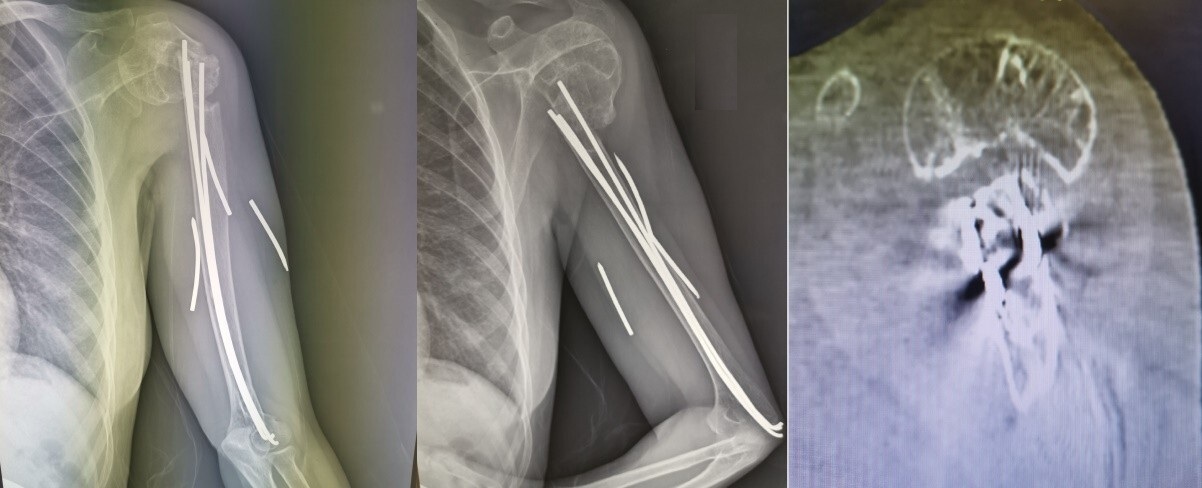
Post-operative radiographs from the index procedure showed fixation of a proximal humerus fracture with multiple elastic nails. The fracture involved the surgical neck with metaphyseal comminution and varus displacement, but without articular surface involvement. The early post-operative course was reportedly uneventful, though progressive varus collapse and radiographic signs of loss of fixation were later observed.
Clinical Course and Presentation
At the time of presentation to our unit, the patient complained of continuous deep shoulder pain, weakness, and restriction of active range of motion (elevation 20°, abduction 10°). There were no signs of infection. Radiographs and a CT scan revealed hardware breakage and migration, varus deformity, and radiolucent changes at the humeral head suggestive of avascular necrosis and non-union. The patient was classified as having failed osteosynthesis after ESIN (Figure 1).

Surgical Management
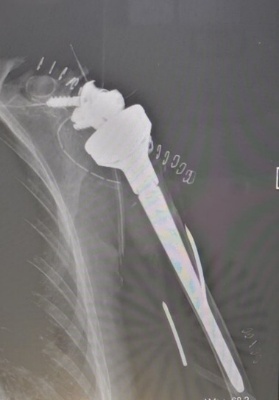
After thorough evaluation and discussion of treatment options, the decision was made to perform conversion to reverse shoulder arthroplasty (RSA). The previous elastic nails were removed; intra-operatively, the humeral head was found to be partially necrotic with subchondral collapse, consistent with the radiographic suspicion. The humeral canal was prepared, and a cementless long-stem reverse prosthesis was implanted to bypass the metaphyseal defect. Intra-operative stability and range of motion were satisfactory.
Post-operative Outcome
Post-operative radiographs confirmed appropriate implant positioning and restoration of length and version (Figure 2). The patient was placed in an abduction sling and followed a standardized rehabilitation protocol: passive assisted motion began at two weeks, with active exercises at six weeks and strengthening at three months. At three-month follow-up, pain had significantly improved, and active forward elevation reached 100°, with external rotation of 20°. There were no radiographic signs of loosening or migration.

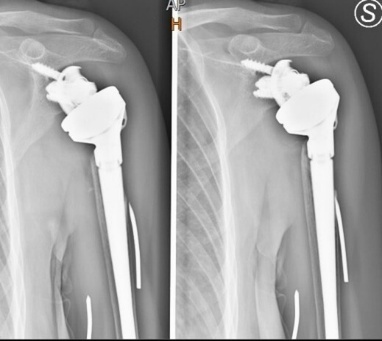
At four-year follow-up, the patient showed excellent functional recovery and a stable implant on plain radiographs with no sign of loosening (Figure 3).

Discussion
Non-union with hardware breakage is a rare condition after open fixation for proximal humerus fracture. The revision surgery strategy for this challenging complication is based on a thorough clinical evaluation, laboratory tests to rule out infections, imaging examination including radiological assessment and CT scan with particular attention to the type and location of the non-union, the evaluation of implant breakage or loosening, the bone stock, head viability, and the presence of avascular necrosis.11–14
In the case of failed internal fixation of a proximal humerus fracture, complications such non-union, stiffness, compromised bone stock of the humeral head with avascular necrosis, and hardware breakage lead to altered joint anatomy with biological and mechanical compromission. These factors make revision osteosynthesis technically demanding and with poor outcomes. In such cases, RSA offers a biomechanical advantage by relying on the deltoid muscle to restore shoulder elevation, providing more consistent pain relief and functional recovery.15–17
Reverse shoulder arthroplasty is a reliable solution for elderly patients with poor bone quality or irreparable rotator cuff dysfunction, however, its role in younger, more active individuals remains controversial due to concerns about implant longevity, elevate functional demands, and the risk of future revision surgery. Furthermore, several studies have demonstrated that RSA, when used as a salvage procedure after failed internal fixation, can yield satisfactory pain relief and acceptable range of motion.15–18 However, concern remains about the management in young patients due to the fact that outcomes in younger patients are generally inferior compared to primary RSA for acute fractures or elective cases in older patient.
Despite these limitations, RSA may still represent a reliable reconstructive option in select young patients where other alternatives, such as revision fixation or hemiarthroplasty, are unlikely to achieve satisfactory outcomes. The decision to proceed with RSA should be individualized, taking into account bone quality, rotator cuff status, humeral and glenoid bone stock, and the patient’s functional expectations.15–19
Post-operative rehabilitation after RSA with long stem in young people needs to be carefully managed.20 Although early passive motion is usually allowed to avoid stiffness, it is essential to gradually strengthen the deltoid and periscapular muscles in order to improve shoulder function.
Our case highlights that reverse shoulder arthroplasty in young patients after failed internal fixation, nail breakage and humerus head necrosis remains a valuable salvage procedure, as alternative reconstructive strategies are not feasible. Further prospective studies with longer follow-ups are necessary to better define the indications, refine surgical techniques, and evaluate implant survivorship in this challenging complication.
This case exemplifies the mechanical and biological challenges of managing proximal humeral fractures where fracture morphology, surgery and post-operative rehabilitation plays a decisive role in shoulder recovery. Extra-articular multifragmenting fractures have limited metaphyseal bone contact and a high risk of secondary varus collapse. The use of elastic intramedullary nailing (ESIN) in this population is controversial. While minimally invasive and preserving periosteal blood supply, ESIN offers limited stability in osteoporotic bone and provides poor control of rotational forces.12–14 These limitations often result in loss of reduction, delayed union, or avascular necrosis - findings consistent with the present case.
Once fixation fails and the humeral head becomes non-viable, conversion to RSA represents the most reliable salvage procedure.9–11 Reverse arthroplasty restores function by transferring the centre of rotation medially and distally, allowing the deltoid to compensate for deficient rotator cuff mechanics.10–13 Several series have reported substantial improvements in pain and functional scores after RSA for fracture sequelae, with outcomes approaching those of primary RSA for acute fractures, albeit with slightly higher complication rates.
This case also underlines the importance of early identification of fixation failure. In young patients with progressive pain and varus deformity, timely revision with removal of implant, debridement of fibrous tissue at the non-union site, freshening of bone ends to stimulate healing, autologous bone grafting and rigid fixation with a locking plate can lead to fracture healing, avoid further complications, such as hardware breakage, stiffness and necrosis, where the only solution is the conversion to RSA. From a technical standpoint, conversion cases pose additional challenges: distorted anatomy, poor bone stock, and altered humeral version. Proper implant selection, often with a long stem to bypass the zone of failed osteosynthesis is essential for restoring biomechanics and reducing instability risk.16,17
Conclusions
This report describes the successful conversion to reverse total shoulder arthroplasty following failed intramedullary fixation of a proximal humeral fracture in a young female patient. The case highlights how initial treatment must balance surgical invasiveness with mechanical stability, as insufficient fixation can lead to secondary collapse and head necrosis. Reverse shoulder arthroplasty proved to be an effective salvage solution, providing pain relief, functional recovery, and radiographic stability.
Author Contributions
Conceptualization, M.S.; methodology, D.A.R. and H.Z.; software, D.A.R.; validation, M.M., M.D.; resources, M.S.; data curation, M.S.; writing original draft preparation D.A.R.; writing, review and editing, H.Z.; supervision, H.Z.
Funding
There was no funding source for the manuscript.
Conflict of Interest
The authors declared no conflict of interest.