


Introduction
The participation in sports continues to increase in prevalence worldwide as the general public have become more aware of the benefits of physical activity. These benefits range from increased muscle strength to improved cardiovascular fitness and an overall improved level of physical fitness.1 Increased participation comes with increased risk of injury. Using the National Electronic Injury Surveillance System (NEISS), numerous studies report on injuries associated with volleyball,2 track and field,3 swimming,4 soccer,5,6 martial arts,7 rugby,8 and even archery.9 This rise in the participation of sports has also been met with the burden of injuries related to sports, affecting both professional and recreational athletes across all ages and demographics. One study involving prospective injury surveillance has shown significant rates of injury in both amateur and professional adolescent athletes, which emphasizes that prevention strategies are required regardless of the competitive level of the athlete.10 In fact, it is estimated that from 2011-2014, there were 8.6 million injuries on average yearly, relating to sports or recreational activities. When adjusting for differences in age, these injuries have been shown to impact 3-4% of the U.S. population each year.11 These injuries not only result in immediate impairment but can also result in a reduced quality of life, mental health effects, and an increase in healthcare costs, especially when injuries develop into chronic conditions.
Despite some injuries allowing players to return back to their sport within a few weeks, many injuries result in extended amounts of playing time being lost. Furthermore, some of the most common issues can develop into long-term chronic conditions for the athletes they affect. For example, a common injury from the participation of recreational sports are lateral ankle sprains, and although a majority of these injuries tend to heal on their own, it has been seen that a large proportion of those who have obtained a large ankle sprain also develop long-term symptoms which can even contribute to the development of chronic ankle instability.12 Studies have also found that those who have experienced joint-related sports injuries may be at risk of developing osteoarthritis at an increased rate and that when treating sports injuries, certain types of surgery, especially those pertaining to the knee, are also associated with an increased risk of developing osteoarthritis.13
Athletes are also especially susceptible to mental health issues, including depression, anxiety, and other related mental health disorders, which can all be exacerbated when they are impacted by a sports-related injury.14 Furthermore, many athletes who have a prolonged absence from their sport do not feel psychologically ready to return to their sport due to the fear of reinjury.15 These psychological challenges may be particularly heightened in athletes with brain-related injuries. For instance, traumatic brain injury (TBI) and repetitive head impacts are believed to worsen emotional and behavior issues and can even cause personality changes when moderate and severe.16 This is especially of concern when addressing adolescent athletes as many of these developing young athletes consider their sport as a large part of their identity and social relationships.
The economic burden of sports injuries is also an issue that has significantly impacted both athletes and healthcare providers. In addition to the costs of inpatient visits, athletes are also impacted by the costs of rehabilitation and even indirect costs, like time being spent away from school or work. Costs of $24 million in inpatient healthcare and $87 million for emergency department expenditures, with the average cost of inpatient hospitalization of $6038 for an inpatient visit, have been seen to be caused by sports injuries in Florida youth aged 5-18 over the span of 5 years from 2010-2014.17 More importantly, many of these athletes were thought to have potentially benefited from the implementation of targeted prevention programs. These findings demonstrate the substantial financial burden that many preventable sports injuries can impose on healthcare systems and how by simply implementing simple injury prevention programs, this burden could be lifted to provide economic benefits for both athletes and providers. This paper reviews the global landscape of injury prevention research as it relates to sports.
Methods
A quantitative research technique known as bibliometric analysis was used to identify characteristics and trends in scientific literature.18 The Web of Science database was chosen for this analysis due to its extensive and reputable coverage of publications. The search terms that were utilized in this analysis were: “injury prevention” (topic) AND “sport” (topic). These search terms were chosen to get a broad overview of all publications that connected to injury prevention across all sports contexts and all the document types that arose from the search were used in this analysis.
To create a map based on bibliographic data, the software VOSviewer was utilized.19 In this software, a co-authorship analysis was conducted, which is utilized to demonstrate how related authors are based on their number of co-authored documents. The researchers that were studied using this analysis had a minimum of 15 documents. In addition, Microsoft® Excel (Redmond, WA) was utilized to import data obtained from the search on Web of Science in order to create visuals to analyze trends in the journals in which articles were published, publication rates over time, and which countries output the most publications relating to these issues.
Results
The initial search resulted in a total of 10,070 papers. The majority of these publications, 9,542 (94.8%), were written in English, followed by German, Spanish, Portuguese, and French. In addition, funding from these publications spanned approximately 3,400 different funding agencies.
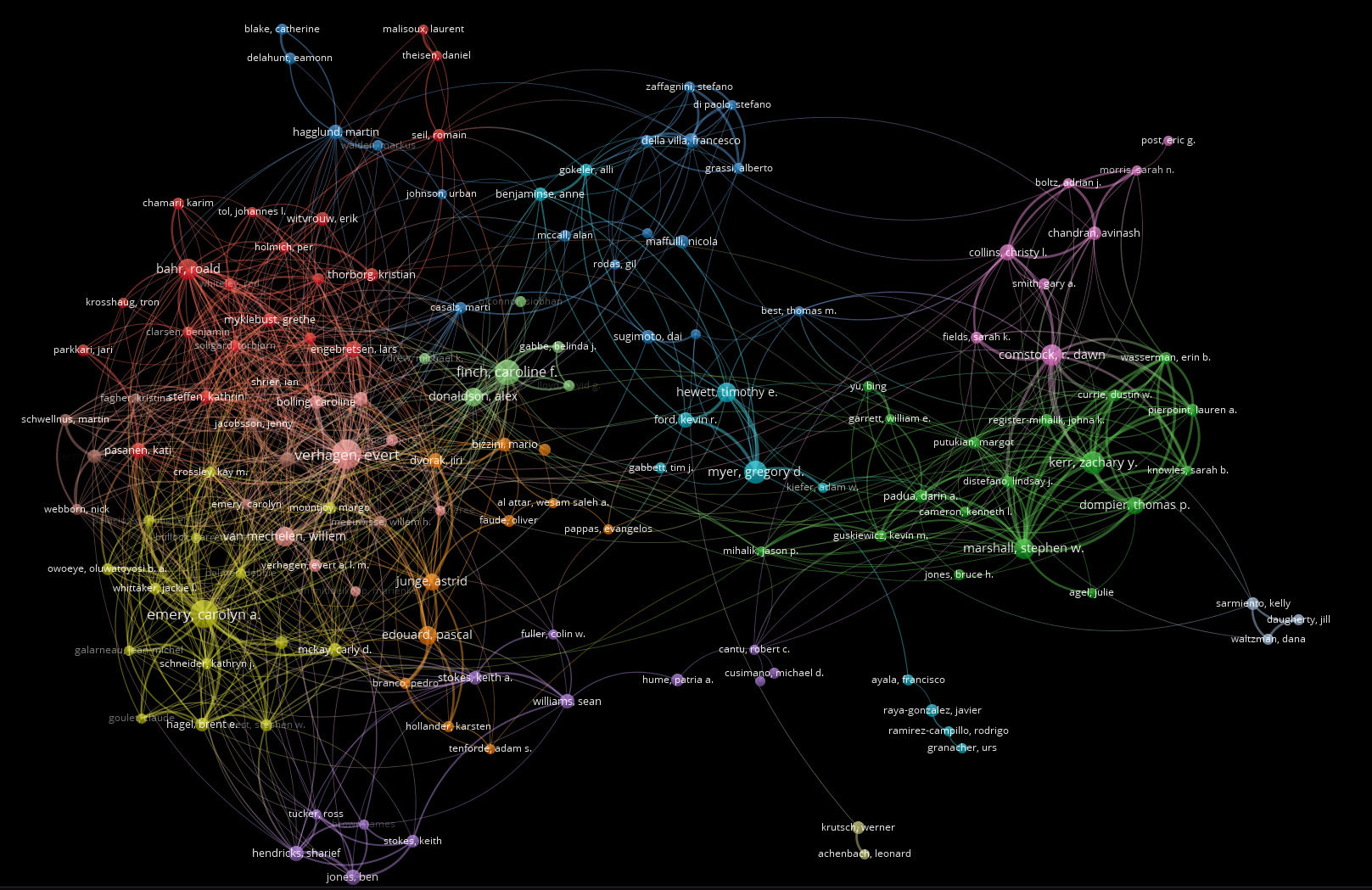
Dr. Carolyn Emery was found to have the strongest collaboration network with the highest total link strength of 249, followed by Dr. Evert Verhagen (193), Dr. Zachary Kerr (191), and Dr. Stephen Marshall (191). The bibliometric map below displays the relationship network between authors who have at least 15 documents. Larger circles represent a larger number of documents for an author and thicker lines represent a more significant or frequent collaboration between authors (Figure 1).
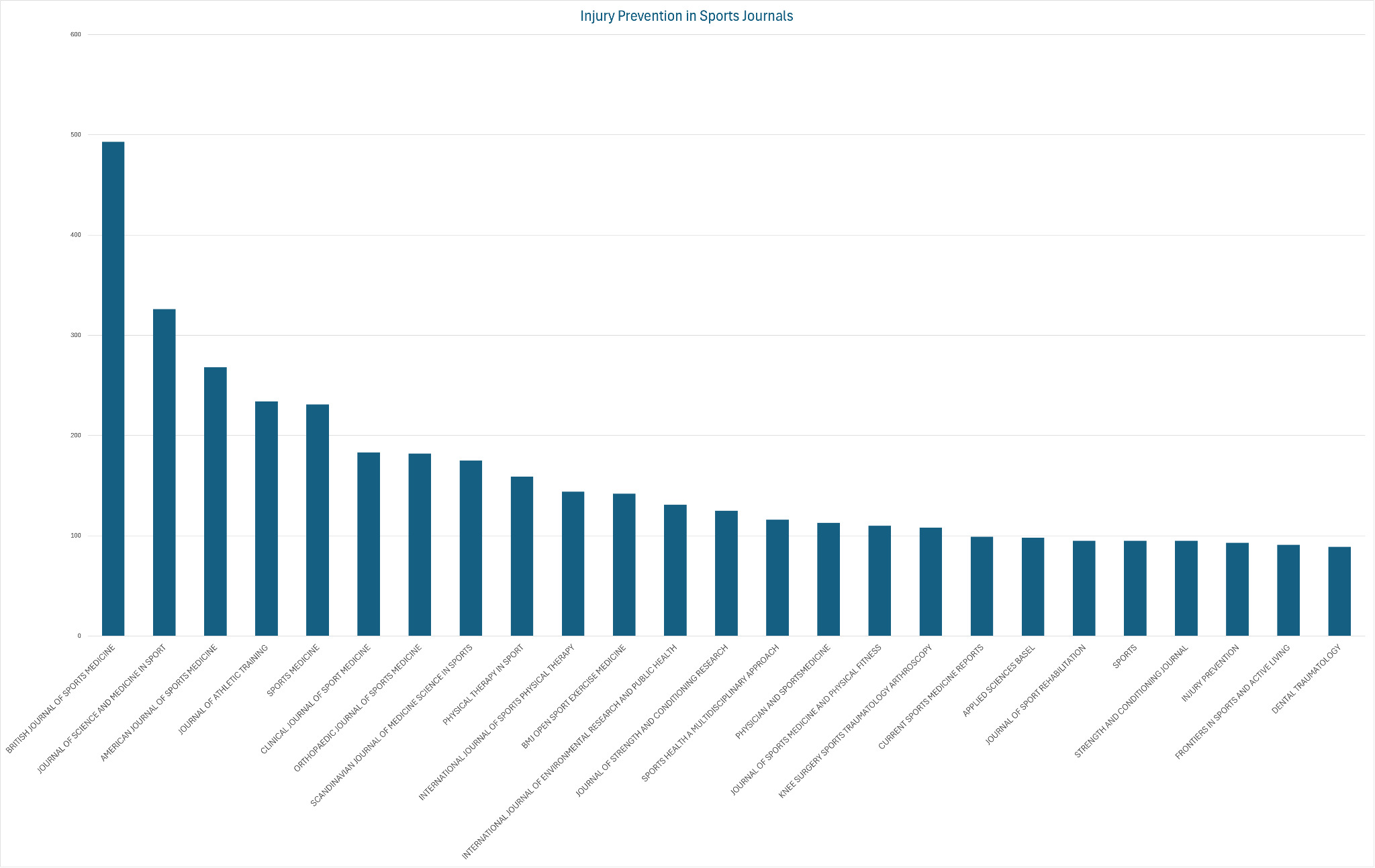
A total of 1,674 journals were found to have published documents related to injury prevention in sports. The British Journal of Sports Medicine was found to have the highest number of publications on this topic, 493 (4.9%), followed by the Journal of Science and Medicine in Sport and the American Journal of Sports Medicine (Figure 2).
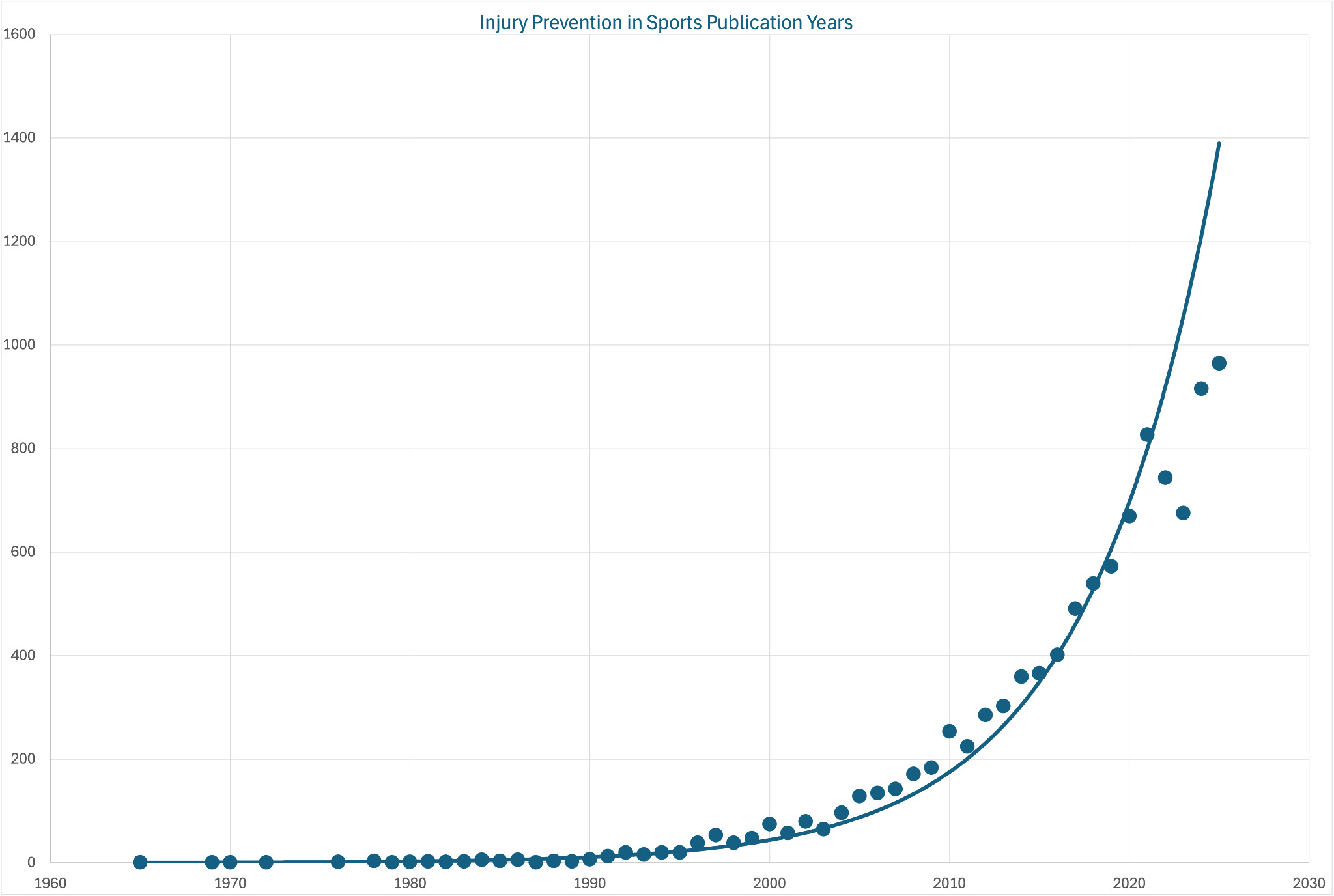
The number of yearly publications were also analyzed over a 60-year period from 1965-2025. These data points were plotted on a scatterplot with an exponential trendline used to better visualize the data (Figure 3). Over 40% of all publications on this topic were seen to have been published in the last 5 years (2021-2025) with about 9.6% of all publications arising in 2025.
The countries and regions in which the most publications on injury prevention in sports were visualized on a map. The USA leads the world in publications for injury prevention in sports and accounts for 32.9% (3313) of all publications worldwide followed by Australia, England, and Canada. Darker countries represent more publications arising from that country (Figure 4).
_of_publications_i.png)
All in all, the bibliometric trends demonstrate a growing interest in injury prevention in sports as it comes to research and publications. Publications seem to be widespread across journals and countries, although the United States seems to be at the forefront of this research area.
Discussion
This bibliometric analysis underscores the rapidly expanding field of research on sports injury prevention. As shown by the exponential rise in publications on injury prevention in sports over the last few decades, sports-related injuries are now widely acknowledged as a public health issue that requires prevention efforts and further research. This is especially shown through 40% of all documents on injury prevention in sports being published within the last five years. This surge in interest on this issue is likely due to an increase in the participation and sports as well as advancements in our knowledge of the long-term physical, mental, and economic impacts that sports injuries can result in. This is especially seen with certain studies that highlight the risk factors associated with sport participation and how future methods can be adapted to drive more research and prevention strategies in the field.20
By analyzing the bibliometric map, it can be seen that there are many interconnected teams of researchers that are responsible for expanding this field of research. Key authors like Dr. Carolyn Emery and Dr. Evert Verhagen, who have been especially prominent in this field, have shown how interdisciplinary research in this area can be. One such interdisciplinary collaboration involved Dr. Carolyn Emery and Dr. Willem Meeuwisse who used a cluster-randomized control trial to analyze the injury rates amongst soccer clubs when using a soccer-specific neuromuscular training program.21 Through collaborations like these, it can be seen that prevention strategies can arise anywhere from a public health perspective to a psychological perspective and how research in this field greatly benefits from knowledge of epidemiology and clinical sciences. Although this map has shown the strength of connections between researchers, there are a select few researchers who seem to have a disproportionate total link strength, which may limit the different perspectives available when analyzing research in this area.
When analyzing the distribution of publications amongst journals, it seems that a majority of injury prevention research in this area has been published in sports medicine-related journals, like the British Journal of Sports Medicine. One previous bibliometric analysis of the 100 most-cited articles on soccer injuries have also shown the prevalence of articles being published in sports medicine journals between 1990 and 2017.22 The growing amount of publications in this journal and other related journals have highlighted the growing applications of injury prevention research to sports science. However, documents being published in these journals may also suggest that research in this field is less focused towards education or policy change.
The prominence of publications amongst countries such as the United States, Australia, and England could possibly suggest a correlation between the increased funding and research infrastructure available in these countries and the number of publications outputted. These trends have also been seen with a previous bibliometric analysis of sport-related concussion research, which found that sport-related concussion research has made great advances and has progressively increased in the twenty-first century with the United States leading the world in this field.23 However, this could also suggest the possibility of a disparity between lower income countries who may not prioritize research in this field. Therefore, this especially stresses the need to develop global preventative strategies as sport injuries are prominent across all countries and demographic groups. Additionally, there seems to be a lack of implementation of injury prevention strategies and despite some minimal implementation, these strategies are often not generalizable and real-world implementation and sustained use continue to be major challenges when it comes to this body of research.24 This is likely due to research in this field being focused on higher-level athletes. Since sports injuries are not limited to professional athletes, the need for assessing the efficacy of long-term injury prevention programs is further emphasized.
This bibliometric analysis did present with some limitations. Web of Science was the only database used for the analysis of publications in this field. Therefore, if there were any publications indexed elsewhere, they were not included in this analysis. In addition, the search terms “injury prevention” and “sport” yielded a very broad search with several publications being minimally relevant to the topic at hand. Overall, the trends shown in this bibliometric analysis suggest that injury prevention in sports is a growing field of research that should continue to be of high priority as effective implementation programs are studied.
Conclusions
This bibliometric analysis shows that there is a growing amount of scientific interest related to injury prevention in sports, demonstrated by the exponential growth in the number of publications and the extensive amounts of collaboration networks between researchers in this area. Despite the rapid growth of this field of research, researchers from countries who seem to have more funding and infrastructure in place seem to have a larger influence on the broader area of work. This has likely led to a deficiency in proper global representation and the successful implementation of injury prevention programs. Consequently, this suggests that it is of greater importance to further spread the knowledge of injury prevention in this field and to start expanding research focus to include more underrepresented populations. These efforts could lead to not only the longevity of the performance of athletes in sports but could also lower the costs of healthcare costs and improve public health.