
Introduction
High-energy tibial plateau and tibial pilon fractures often result in comminution at the articular surface and soft tissue disruption, often requiring temporary external fixation to allow soft tissue healing or soft tissue coverage via grafts or flaps. The key with an external fixator, particularly with articular involvement, is the stability of the joint along with the construct. The second stage involves removal of the external metalwork and open reduction internal fixation.
This staged approach is used because immediate post-trauma definitive internal fixation through a compromised soft-tissue envelope can increase wound complications and increase the risk of deep infections and osteomyelitis, which in the context of trauma becomes increasingly difficult to manage. This two-staged management has therefore become a widely used strategy for complex injuries around the knee and ankle.1,2
There is an ongoing debate regarding the placement of these external fixator pins. Proponents of the ‘zone of injury’ and ‘zone of fixation’ concepts disagree over whether external fixator pins should lie outside the planned zone of plate fixation to decrease the risk of metalwork-associated infections.
Pin sites breach the skin and risk becoming colonised with skin flora, and local pin-tract infection is a recognised complication of external fixation.3 Furthermore, in the post-operative period for the external-fixator, patients risk poor hygiene around the pin sites, allowing bacterial tracking deep into the lower leg.
If the definitive plate then crosses a previous pin tract, bacteria or devitalised tissue at that site could increase the risk of deep fracture-related infection. Deep infection after fracture fixation often requires repeated debridement and prolonged antimicrobial treatment, with possible implant retention, exchange or removal, increasing morbidity and costs to the healthcare system.4
The clinical literature has been inconsistent. Laible et al. reported no clear association in high-energy tibial plateau fractures, whereas Shah et al. observed a higher infection rate in a combined plateau and pilon cohort.5,6 Subsequent pilon-specific studies found little evidence to show that overlap or pin-to-plate distance increased infection risk,7–9 while Haase et al. showed in a multicentre cohort study of plateau fractures that overlap is an independent risk factor.10 These apparently conflicting findings may be due to differences in fracture site, open-fracture burden, overlap definitions and follow-up time periods.
This meta-analysis aims to assess whether the combined outcomes from these papers give a clearer understanding of the relationship between pin site placement and deep infection for lower leg fractures with an articular element. The primary aim of this systematic review and meta-analysis was therefore to estimate the association between pin–plate overlap and deep infection after staged fixation of tibial plateau or pilon fractures. Secondary aims were to compare plateau and pilon groups and to evaluate whether fracture site, at either the distal or proximal end of the lower leg, affected infection rates.
Materials and Methods
Ethical Considerations
This systematic review and meta-analysis used aggregate data from previously published studies. No participants were recruited, and no identifiable patient data were accessed. Therefore, ethical approval and individual informed consent were not required for this review.
Reporting and protocol
Reporting was guided by the Preferred Reporting Items for Systematic Reviews and Meta-Analyses (PRISMA) 2020 statement and the Meta-analysis Of Observational Studies in Epidemiology (MOOSE) recommendations.11,12
The review was not prospectively registered.
Eligibility criteria
Studies were eligible if they (1) included skeletally mature patients aged 16 years or older with tibial plateau or tibial pilon/distal tibial fractures treated by temporary spanning external fixation followed by definitive plate fixation; (2) reported radiographic overlap between a previous external-fixator pin site or tract and the definitive plate; and (3) reported deep postoperative infection separately from superficial infection, wound dehiscence or cellulitis, with extractable overlap and non-overlap comparison groups. Isolated pin-site infection was not counted as a primary outcome. Case reports, technical notes, letters, non-comparative series and reports without separable overlap and deep-infection outcomes were excluded.
Information sources and search strategy
PubMed was searched from database inception to 15 August 2026. Ovid Embase was searched on 6 September 2026, with database coverage from 1974 to 3 September 2026. No publication-date, language, age or study-design filters were applied to either database. Reference lists of included articles and relevant reviews were also screened. The age and deep-infection criteria were applied during screening rather than as electronic limits.
PubMed search strategy: ((“external fixator”[Title/Abstract] OR “external fixation”[Title/Abstract]) AND (“pin site”[Title/Abstract] OR “pin tract”[Title/Abstract] OR “pin-plate”[Title/Abstract] OR overlap[Title/Abstract] OR proximity[Title/Abstract]) AND (plate[Title/Abstract] OR plating[Title/Abstract] OR “internal fixation”[Title/Abstract]) AND (infection[Title/Abstract] OR “deep infection”[Title/Abstract]) AND (“tibial plateau”[Title/Abstract] OR pilon[Title/Abstract] OR “tibial plafond”[Title/Abstract]))
Ovid Embase search strategy: (((external adj2 fixat*) or (spanning adj2 fixat*) or (temporary adj2 external adj2 fixat*)).ti,ab,kw.) and (((pin adj2 site*) or (pin adj2 tract*) or (pin adj2 plate*) or overlap* or proximit* or distance*).ti,ab,kw.) and ((plate* or plating or (internal adj2 fixat*) or ORIF or (definitive adj2 fixat*)).ti,ab,kw.) and (((tibial adj2 plateau) or pilon or (tibial adj2 plafond) or (distal adj2 tibia*)).ti,ab,kw.)
The Embase strategy did not include an infection term; deep infection was required at eligibility screening.
Study selection
Three reviewers independently screened records in Rayyan and assessed potentially eligible full texts. Differences in eligibility judgments were resolved by discussion, including whether reliable overlap-versus-deep-infection data could be extracted.
Duplicate reports were identified using author, institution, recruitment period and sample characteristics; where multiple reports described the same cohort, only the report providing the most relevant or reliable overlap-versus-infection data was retained and used in this meta-analysis.
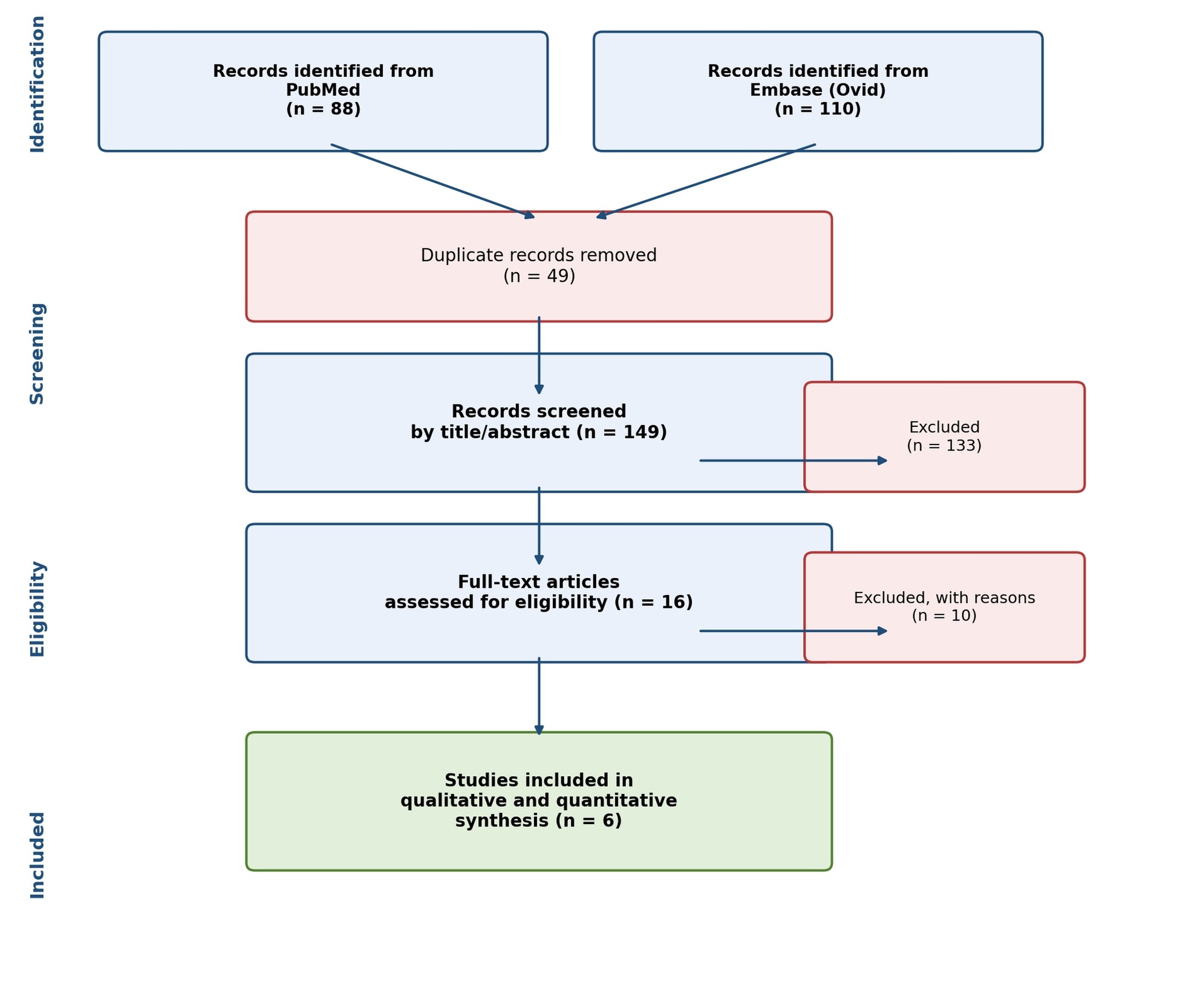
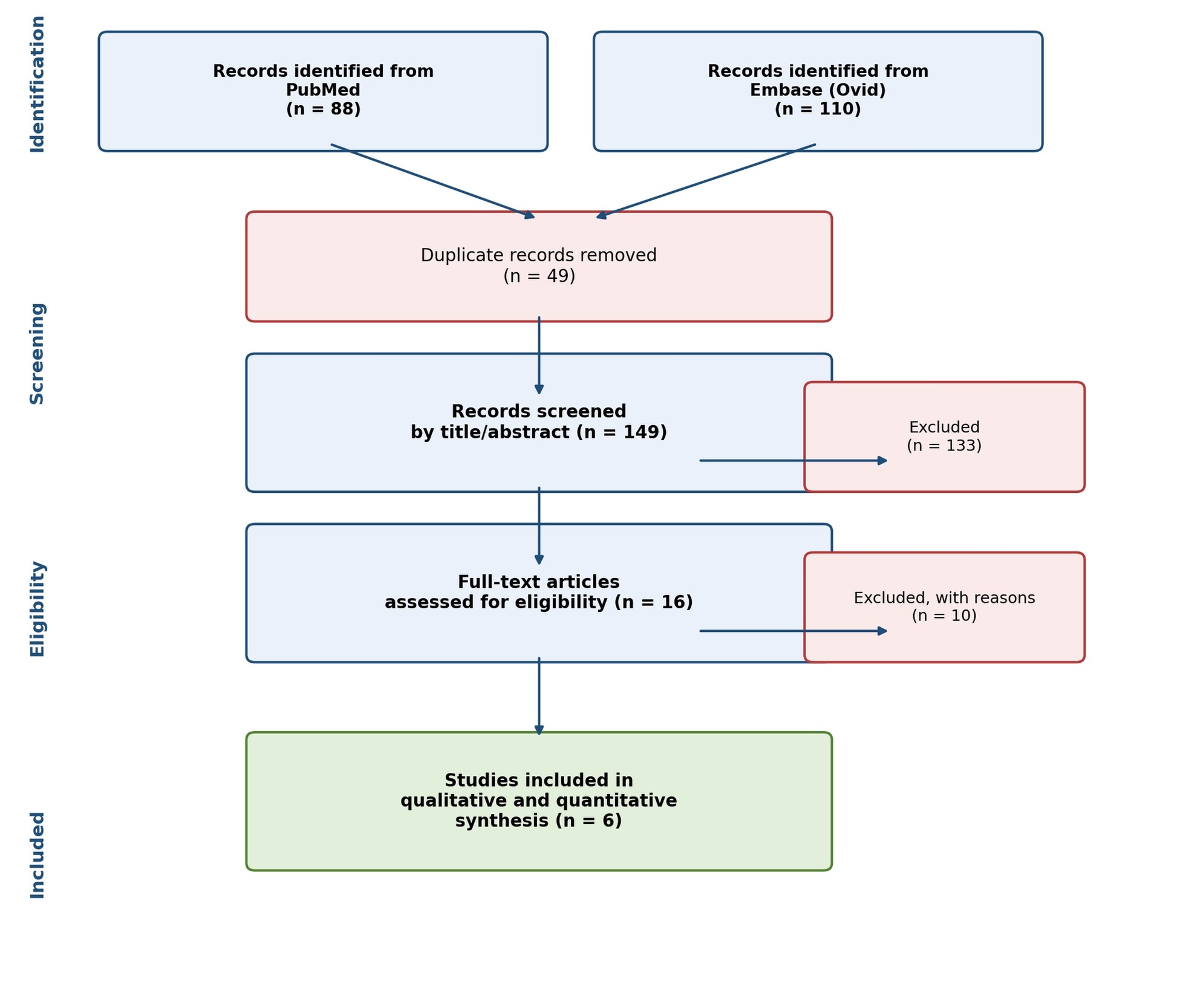
The database searches initially identified 198 records: 88 records from PubMed and 110 from Embase. Complete citation and abstract data were exported and duplicates were screened and removed before the second stage of screening.
The second stage involved title and abstract screening in Rayyan. After removal of 49 duplicate records, 149 papers underwent title and abstract screening, of which 133 were excluded. The Embase search contributed 61 unique records beyond those already identified in PubMed. During the initial screening, all 61 were excluded during title and abstract screening.
Records were excluded during title and abstract screening if they were narrative, non-clinical studies, technical reports without comparative clinical data, or investigated an ineligible fracture population; if external fixation was used as definitive treatment rather than there being a second-stage definitive plating; if treatment did not involve temporary external fixation followed by definitive plate fixation; if no comparison was made between pin–plate overlap or proximity and non-overlap; or if a report did not clearly distinguish superficial or cellulitic changes from deep infection.
Sixteen reports underwent full-text assessment; ten were excluded because overlap, deep infection or cohort characteristics were insufficiently defined; the necessary data could not be extracted; or the report combined patients treated definitively with external fixation and patients who underwent subsequent plating without separable results. Figure 1 shows study selection.
Data extraction and outcome definition
A structured password-protected Excel sheet was created with the following subheadings: fracture site, design, recruitment period, number of centres, sample size, follow-up, open-fracture burden, overlap definition, deep-infection definition, pin-site infection at conversion, the number of infected and non-infected patients within the overlap and no-overlap groups, adjusted estimates and covariates. All six reports were assessed from full text. Numerical inconsistencies were reconciled against complete cohort totals and the source tables.
One correction was needed. In the paper by Potter et al., the overlap total in the results text does not reconcile with the infection counts. The internally consistent fracture-level table — 17/55 with overlap and 50/225 without overlap — was used instead, because it accounts for all 280 fractures.
Risk-of-bias assessment
Risk of bias was assessed using the cohort version of the Newcastle–Ottawa Scale (NOS).13 The NOS was evaluated by each independent reviewer and decided upon at the final discussion panel. Open-fracture status was defined as the principal confounder; an additional comparability star was awarded for adjustment for at least one further relevant variable, such as smoking, diabetes, fracture severity, compartment syndrome or operative factors. A mean or median follow-up of at least 12 months was considered sufficient for the follow-up-duration.
Statistical analysis
The effect measure was the crude risk ratio (RR) for deep infection comparing overlap with no overlap. Study-specific log RRs and sampling variances were calculated from the extracted 2×2 tables for each of the six included studies separately.
Crude estimates were selected for the initial analysis because adjusted estimates were not available in three studies and were expressed using different models and measures (risk ratio and hazard ratio), preventing an adjusted-effect meta-analysis.
Study effects were combined using a random-effects model with between-study variance estimated by restricted maximum likelihood (REML). Hartung–Knapp t-based confidence intervals were used to account for potentially high heterogeneity between the studies.14 Statistical heterogeneity was summarised using τ,2 I2 and Cochran’s Q.15 A 95% prediction interval was calculated to describe the range in which the true effect of a comparable future study might plausibly lie.16
Separate REML heterogeneity estimates were used for subgroup summaries. A common-τ2 meta-regression provided the exploratory interaction test.
Leave-one-out analyses refitted the complete model after removal of each study.
Two-sided p values <0.05 were considered statistically significant. Analyses were performed in R (version 4.6.1; R Foundation for Statistical Computing, Vienna, Austria) using the metafor package17 for random-effects meta-analysis (REML estimation of τ,2 Hartung–Knapp-adjusted confidence intervals), meta-regression and leave-one-out sensitivity analysis.
Results
Newcastle–Ottawa Scale scores ranged from 4 to 8 out of 9 across the six studies. Haase 2022 and Potter 2019 scored highest (8/9 and 7/9) and were rated higher quality. The other four studies were rated moderate quality. Hadeed 2019 and Shah 2014 both scored 6/9, mainly for unadjusted analyses — Hadeed did not account for open fractures, and Shah did not fully quantify attrition. Dombrowsky 2021 also scored 6/9, adjusting only for open fracture and with a median follow-up under 12 months. Laible 2012 scored lowest at 4/9, having excluded 27 of 106 eligible patients and also using unadjusted analysis.
Study characteristics
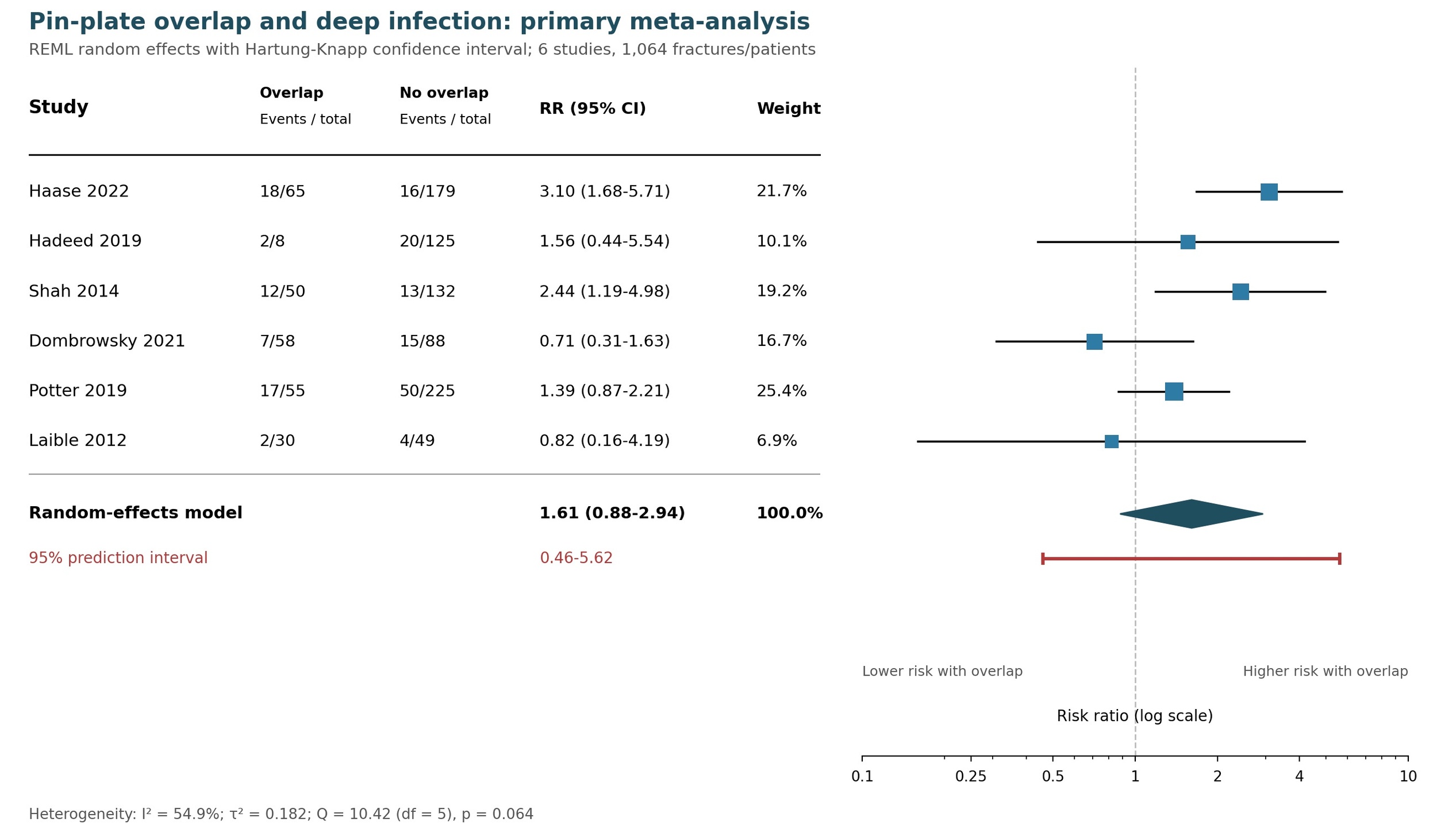
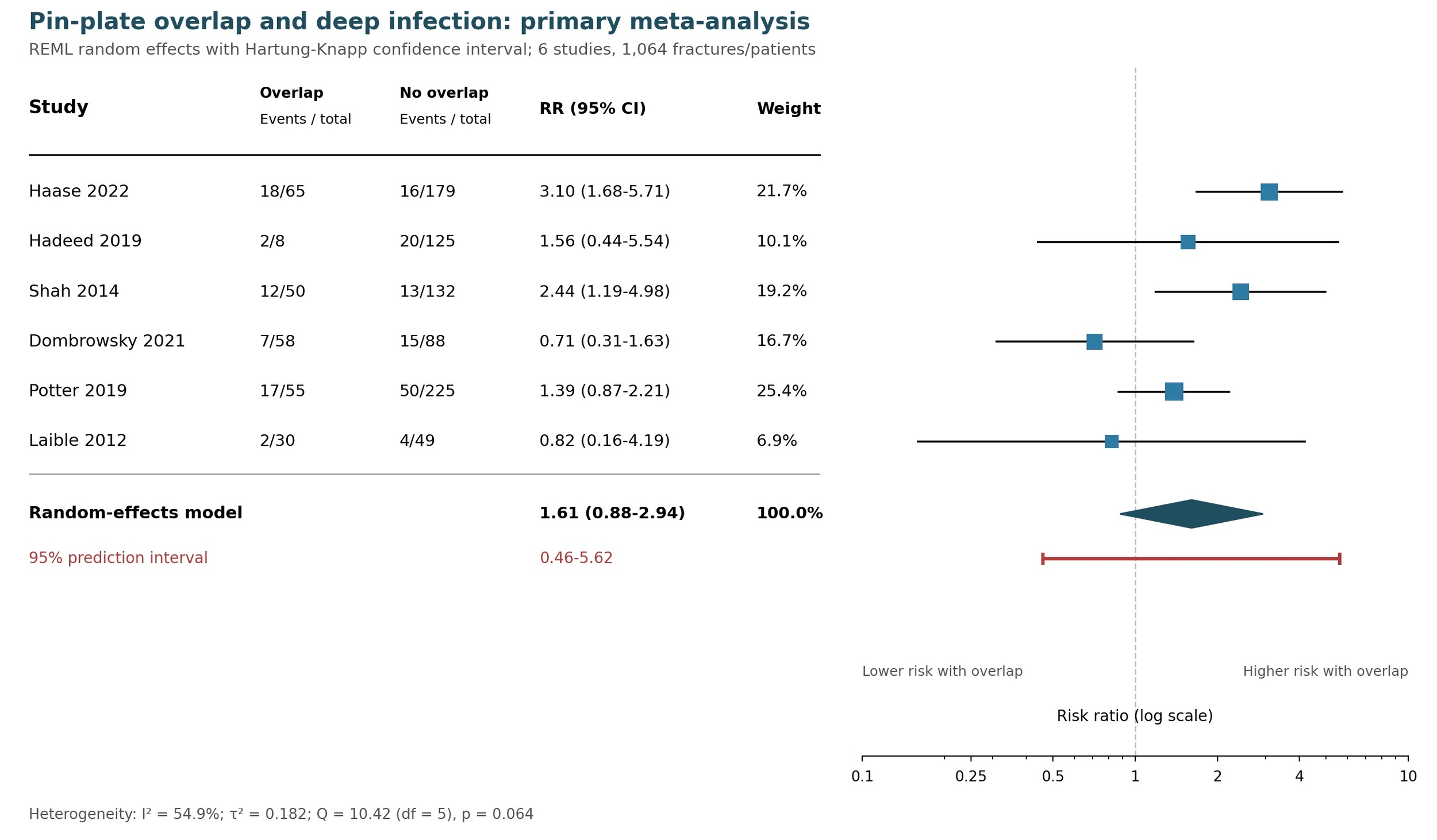
The six studies were published between 2012 and 2022 and included 1,064 total observations (Table 1). Three cohorts were confined to pilon fractures,7–9 two to tibial plateau fractures,5,10 and one included both fracture sites.6 Four studies were single-centre and two were done at two Level I trauma centres. Radiographs were used to determine whether a definitive plate crossed or overlapped a previous external-fixator pin site/tract. Definitions of deep infection generally required operative irrigation and debridement. Across all studies, 58 of 266 patients/fractures with overlap developed deep infection (21.8%) compared with 118 of 798 without overlap (14.8%). The characteristics of all six studies are detailed in Table 1.
Primary meta-analysis
The individual crude RRs ranged from 0.71 to 3.10 (Table 2; Figure 2). The REML random-effects pooled estimate suggested a higher risk of deep infection with overlap (RR 1.61, 95% CI 0.88–2.94; Hartung–Knapp p = 0.100). Heterogeneity was moderate (I2 = 54.9%; τ2 = 0.182), with Cochran’s Q = 10.42 (5 degrees of freedom; p = 0.064).
Fracture-site subgroup analysis
When Shah et al. was separated into its plateau and pilon strata, the pooled RR was 2.66 (95% CI 0.81–8.74; p = 0.072; I2 = 0%; τ2 = 0) across three plateau strata and 1.36 (95% CI 0.63–2.94; p = 0.298; I2 = 24.9%; τ2 = 0.057) across four pilon strata (Table 3).
The numerical difference did not reach statistical significance in the interaction analysis (ratio of RRs for pilon versus plateau 0.52, 95% CI 0.20–1.39; p = 0.150).
Leave-one-out analysis
Pooled RRs ranged from 1.36 after omission of Haase et al. to 1.91 after omission of Dombrowsky et al. The leave-one-out estimates are provided in Supplementary Table S1. Confidence intervals crossed 1 in five of six analyses. The direction of the pooled estimate remained above 1 in every leave-one-out analysis.
Discussion
Principal findings
This meta-analysis of six retrospective cohorts found that deep infection was more frequent among cases with radiographic pin–plate overlap, and estimates suggested a 61% relative increase.
However, the confidence intervals were wide and crossed 1, the p value was 0.100. The appropriate interpretation is therefore a clinically concerning but statistically inconclusive association.
The apparently conflicting literature is reflected in the heterogeneity. Shah et al. and Haase et al. reported substantially higher infection risks with overlap.6,10 In contrast, Laible et al., Hadeed et al., Dombrowsky et al. and Potter et al. did not identify a significant overlap effect.5,7–9
Differences in fracture site may contribute: the pooled plateau estimate was larger than the pilon estimate. Nevertheless, only three plateau and four pilon cohorts were available, the interaction test was not significant, and the shared parent study for the two Shah strata limits certainty.
The data do not establish fracture site as a clear differentiator of deep infection risk associated with pin–plate overlap. This suggests that, in principle, the same approach to pin placement is reasonable in both plateau and pilon fractures, rather than treating one fracture site differently from the other during surgical planning.
Potential mechanisms and confounding
Several biological mechanisms may support a true association between overlap and deep infection risk. A previous pin tract containing colonised tissue and plate passage through that tract could introduce bacteria to the implant surface. Bacteria that have the ability to form biofilms in particular may increase the risk further as they have innate mechanisms to adhere to the metalwork.
Mahan et al. studied the cultures of external-fixator pins at removal and found 74.8% to be culture-positive, most frequently growing Staphylococcus epidermidis (90.6%), Staphylococcus aureus (37.5%) and Escherichia coli (9.4%).18 In a separate study Clasper et al. demonstrated in an animal model that pin-tract infection produced a 100% rate of seeding of the adjacent medullary canal.19 These findings demonstrate that colonised pin tracts are plausible sources of deep infection.
Overlap may also coincide with surgical approaches through damaged or vulnerable soft tissue, greater dissection or longer plates: in this dataset, Haase et al. found that overlapping tibial plateau constructs used significantly longer plates than non-overlapping constructs (mean 200 mm versus 136 mm) and that three-or-more-plate constructs were an independent risk factor for infection10; Morris et al. similarly linked two-incision, two-plate fixation of bicondylar plateau fractures to elevated infection risk.20 These operative factors may confound the observed relationship between overlap and deep infection.
Colman et al. identified prolonged operative time itself as an independent risk factor, reporting 2.8 hours in infected patients versus 2.2 hours in uninfected patients.21 Longer plates theoretically take longer to insert and overlap with the pin sites may indicate that a longer plate was needed, therefore this relationship may reflect operative time rather than overlap itself as a risk factor. This also suggests that the initial fracture pattern, and the extent to which the diaphysis is involved, plays a role in determining the risk of deep infection. Fractures with proximal or distal extension, greater comminution, open wounds or more severe soft-tissue injury may require longer plates and more complex constructs, increasing both the probability of overlap and the baseline infection risk. Molina et al., in a cohort of 355 pilon fractures, confirmed open fracture as an independent predictor of deep infection,22 consistent as an identified risk factor across the pilon-specific studies included in this paper.
The distal tibia has less soft-tissue coverage than the proximal tibia. Anatomical differences may affect infection risk, but comparisons across fracture sites are confounded by injury severity and treatment. Giannoudis et al. reported an 11% deep-infection rate after primary plating of severe open tibial fractures,23 whereas Nowotarski et al. reported a 1.7% infection rate after conversion to intramedullary nailing in femoral shaft fractures.24 These populations and procedures differ substantially, so their rates cannot isolate the effect of soft-tissue coverage.
Duration of external fixation prior to definitive plate fixation is also worth exploring. Parameswaran et al. and Antoci et al., in fracture fixation and limb lengthening, respectively, reported that pin-tract infection rates rise substantially once a fixator has been in place for approximately three months,25,26 well beyond the 10–20 day durations typical of the staged fixation protocols reviewed here.
Wilson et al. studied 349 patients undergoing surgical fixation of pilon fractures at a single Level I trauma centre and examined predictors of revision surgery needed.27 Fracture-related infections emerged as the strongest independent predictor of needing revision and although plate–pin site overlap was more common among patients who went on to need repeat surgery, it was not independently a risk factor once multivariate analysis was done. This supports the idea that overlap may often be a marker of fracture severity and infection risk rather than an independent causal factor by its own merit.
Clinical implications
The findings support a pragmatic approach. When safe and technically feasible, temporary tibial pins should be placed outside anticipated definitive plate trajectories and away from planned incisions. Preoperative planning of fracture pattern and likely definitive constructs may reduce avoidable overlap. However, pin position should not compromise reduction, length, alignment, rotation or the stability of the spanning fixator. The evidence is insufficient to impose revision of an otherwise satisfactory temporary construct due to potential overlap or indeed to change a suitable plate to a shorter construct.
Implications for research
Future work should use prospective multicentre registries with the use of comparative cohorts with a prespecified radiographic definition of overlap with the inclusion of degree of overlap, documentation of pin-site condition at the second stage and the latest definition of deep infection to study the effects in a single fracture type population through multivariate analyses.
Strengths
This review has several strengths. The full text of all six included studies was read, rather than relying on abstracts, and any inconsistencies were checked against each study’s own reported numbers. Shah et al. was split into separate plateau and pilon groups, so they did not overlap in the subgroup analysis. A random-effects model was used with the more cautious Hartung–Knapp method and whether any single study was driving the results was systematically checked by leaving each one out in turn. Every pooled result was also independently recalculated using a second, separate statistical approach to confirm the figures were correct.
Limitations
All six studies were retrospective, which leaves them open to selection bias. Several cohorts did not report follow-up length or completeness clearly. In Potter et al., 280 fractures came from only 277 patients, meaning a handful of patients contributed more than one fracture to the data; this clustering could not be accounted for in the analysis. Because each study adjusted for different variables and used different effect measures, only the crude (unadjusted) risk ratios could be pooled, not the adjusted ones. The degree of overlap was not consistently quantified, so a dose–response relationship could not be assessed.
Formal assessment of selective reporting or publication bias and a structured certainty-of-evidence rating were not performed. With only six retrospective cohorts and heterogeneous adjustment, confidence in the pooled association remains limited.
Conclusion
Pin–plate overlap after staged fixation of tibial plateau or pilon fractures was associated with a higher pooled point estimate for deep infection, but the evidence was not statistically conclusive. The signal appeared numerically stronger in plateau fractures, although fracture-site interaction was not established. Surgeons should pragmatically avoid preventable overlap when doing so does not compromise temporary fixation, while recognising that the current literature cannot isolate overlap as a concluded independent risk factor for deep infection.
Acknowledgments
Claude (Anthropic) was consulted for editorial suggestions. Claude and ChatGPT (OpenAI) assisted with citation and cross-reference checks, and table and figure formatting. The authors reviewed the final manuscript and take responsibility for its content.
Author contributions and disclosures
Author contributions: Surya Prasad: conception, screening, data extraction, risk of bias assessment, analysis, drafting. Marcus Cox: screening, data extraction, risk of bias assessment, analysis, drafting. Babajide Obidigbo: screening, data extraction, risk of bias assessment, analysis, drafting and revision
Conflicts of interest
None declared
Funding and sponsor role
This review received no external funding.
Previous presentation
None
Data availability
The extracted dataset and analysis code are available from the corresponding author upon reasonable request.