1. Introduction
1.1. Long-Term Outcomes and Increasing Demand for THA
Total hip arthroplasty (THA) has demonstrated outstanding long-term survivorship and therapeutic benefit.1
Projections indicate that the annual demand for THA in the United States will exceed 500,000 procedures by the year 2030, with revision arthroplasty rates anticipated to surpass 95,000 cases per annum.2 Although major and minor complications after primary THA are relatively rare, such events may be catastrophic and result in substantial morbidity. Revision hip arthroplasty is associated with increased mortality and a higher incidence of surgical and medical complications compared to primary procedures.3 Furthermore, the prevalence of obesity has escalated significantly, particularly in developed nations.4
1.2. Trends in Obesity and Implications for THA
The proportion of patients presenting with a body mass index (BMI) ≥ 40 kg/m2 has increased by 50% per year, indicating rapid growth within the most obese subgroups.5,6 Presently, it is estimated that 40.3% of Americans are classified as obese.7 Obesity is positively correlated with elevated risk of osteoarthritis and increased utilization of total joint replacement procedures.8
A substantial body of literature has identified higher rates of serious complications, component malposition, prolonged operative times, postoperative infections, inferior component survival, and diminished clinical outcome scores among patients with elevated BMI undergoing THA.9,10 Additionally, obese individuals experience increased frequency of revision surgeries and perioperative complications following total joint arthroplasty.11,12
1.3. Complication Profile and Limitations in Prior Reviews
Several systematic reviews have shown that obesity is associated with a heightened risk of postoperative complications after THA. Ponnusamy et al. reported that patients categorized as severely, morbidly, and super-obese faced substantially increased risks of all-cause and septic revision, even as their functional outcomes were comparable to those of non-obese patients.13 Onggo et al., in a meta-analysis including more than two million individuals, observed higher incidences of postoperative infection, dislocation, revision, and hospital readmission among obese and morbidly obese cohorts.14 Liu et al. noted more severe overall complications, increased risk of dislocation, reduced functional scores, and extended operative times among obese individuals.15 Furthermore, Bialaszewski et al. underscored elevated risks of venous thromboembolism and earlier need for THA in this population.16
Nevertheless, these reviews are subject to several methodological limitations. Many failed to uniformly stratify patients by BMI, often grouping disparate obesity typologies. Direct comparison between narrative and quantitative findings was infrequent, revision-specific analyses were sometimes omitted, and the inclusion of contemporary data was lacking, thereby limiting the representativeness of recent clinical practice.
1.4. Objectives of the Present Study
To address existing gaps, this study endeavors to provide a modern, comprehensive, and well-delineated synthesis of postoperative complication rates following THA. This will be achieved by incorporating both narrative interpretation and meta-analytical methodologies to elucidate the impact of obesity on THA outcomes.
1.4.1. Infection rate
In total hip arthroplasty, patients with BMI >30 had a significantly higher risk of postoperative infection than those with BMI <30. Across seven studies, the random-effects meta-analysis showed an OR of 0.39 (95% CI 0.26–0.58), indicating 61% lower odds of infection in patients with BMI <30. Despite high heterogeneity (I² = 98%) from differences in infection definitions and populations, the effect direction was consistent across studies (Figure 2).
1.4.2. Dislocation
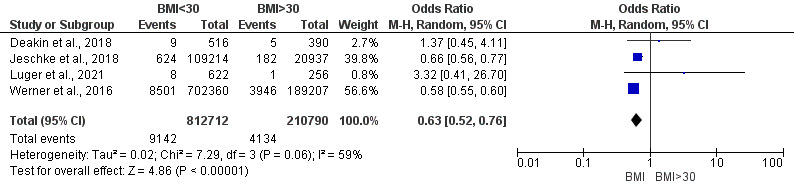
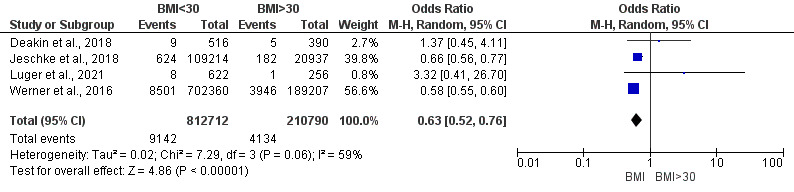
In total hip arthroplasty, patients with BMI <30 had significantly lower odds of postoperative dislocation than those with BMI >30. The random-effects meta-analysis showed a 37% reduction in dislocation risk (OR 0.63, 95% CI 0.52–0.76, P < 0.00001). Despite moderate heterogeneity (I² = 59%), the effect consistently favored the non-obese group, indicating that obesity substantially increases dislocation risk (Supplementary Figure 3).
1.4.3. Thromboembolic events
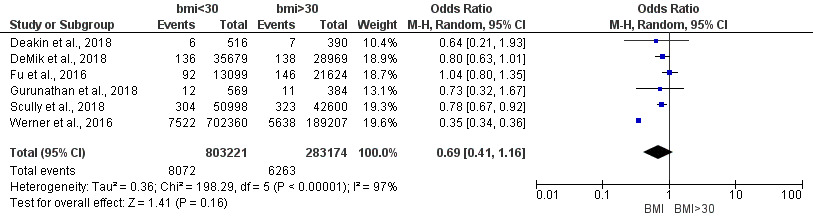
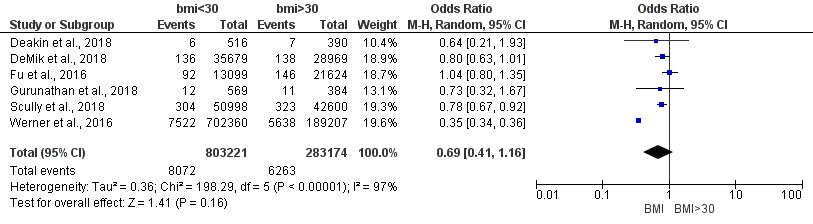
In the pooled analysis of thromboembolic events after total hip arthroplasty, no significant difference was observed between patients with BMI <30 and >30 (OR 0.69, 95% CI 0.41–1.16; P = 0.16). Across six studies, substantial heterogeneity was present (I² = 97%), likely due to differences in study size, populations, and thromboprophylaxis, with inconsistent effect directions with some studies showing a slight protective effect and others showing a modestly increased risk in obese patients. (Supplementary Figure 4).
1.4.4. Postoperative mortality
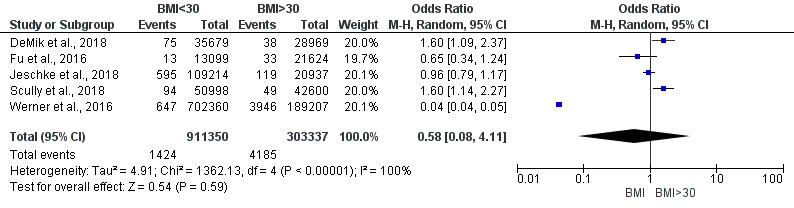
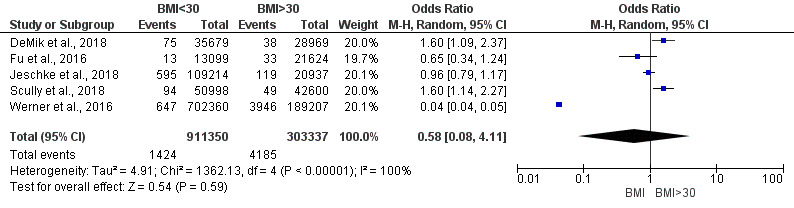
In the pooled analysis of five large cohort studies, obesity did not demonstrate a significant association with postoperative mortality following total hip arthroplasty. The combined odds ratio comparing patients with BMI >30 kg/m² to those with BMI <30 kg/m² was 0.58 (95% CI: 0.08–4.11; p = 0.59), indicating no statistically meaningful difference in mortality risk between obese and nonobese groups. While individual studies showed wide variability in effect estimates, the extremely high heterogeneity (I² = 100%) reflects substantial differences in study population size, event rates, and methodology (Supplementary Figure 5).
1.4.5. Revision
In total hip arthroplasty, patients with BMI <30 had a significantly lower risk of revision than those with BMI >30. Across all studies, individual ORs favored the non-obese group, and the random-effects meta-analysis showed an OR of 0.60 (95% CI 0.56–0.64), indicating a 40% lower revision risk. Heterogeneity was low (I² = 41%), suggesting a stable effect across studies (Figure 3).
1.5. Narrative Synthesis
1.5.1. Trends in the Association Between Obesity and Postoperative THA Outcomes
Across the included studies, obesity consistently emerged as a significant predictor of postoperative complications following total hip arthroplasty (THA). Multiple large database analyses demonstrated a clear dose–response relationship, with complication rates escalating progressively with higher BMI categories.2,17 The strength of this association intensified particularly among morbidly obese (≥40 kg/m²) and super-obese (≥50 kg/m²) patients, who showed markedly elevated risks of wound complications, prosthetic joint infection (PJI), revision, and readmission.18–20
1.5.2. Surgical and Wound Complications
A clear pattern emerged showing that surgical complications increased with rising BMI. Matar et al. found significantly higher rates of major surgical complications (3.6% vs 1.5%) and deep infection (2.8% vs 0.7%) among morbidly obese patients, with hazard ratios exceeding 2.5 for infection and revision.18 In large NSQIP datasets, obese and morbidly obese groups had markedly higher wound complication rates, demonstrating a graded increase from non-obese to obese to morbidly obese categories.21 Fu et al. similarly showed that wound complications rose from 0.8% in non-obese patients to 3.2% in obese class III.22
Studies focusing on extreme obesity showed disproportionate increases in early complications. Luger et al. reported extraordinarily high odds of periprosthetic joint infection (OR 21.7 for BMI ≥35 and OR 57.7 for BMI ≥40), identifying BMI ≥35 as a threshold for substantially higher surgical risk.23 Werner et al. also confirmed that super-obese patients (BMI >50) had significantly higher risks of infection, transfusion, and medical complications compared to all lower BMI groups.19
1.5.3. Risk of Revision Surgery
Most studies consistently found higher revision rates in obese patients. Matar et al. reported a 2.6-fold increased risk of revision in morbid obesity.18 Jeschke et al. demonstrated a dose–response pattern: patients with BMI ≥40 had a more than twofold increase in 1-year revision risk compared with BMI <30.17 Luger et al. noted particularly high early revision odds at BMI ≥35 and ≥40 (OR 8.8 and 20.7, respectively).23 Long-term functional studies further support this trend. Issa et al. found that super-obese patients (BMI ≥50) had lower implant survivorship (89.6% vs 97.8%) and increased need for revision.20
1.5.4. Infectious Complications and Periprosthetic Joint Infection (PJI)
Obesity was a strong and consistent risk factor for PJI. Luger et al. reported some of the highest PJI odds in the literature, with risk increasing over 20-fold at BMI ≥35 and more than 50-fold at BMI ≥40.23 Jeschke et al. also showed a progressive increase in early surgical infections across BMI categories, with the highest risk observed in patients with BMI ≥40.17 DeMik et al. and Fu et al. reinforced this pattern, demonstrating increasing deep infection rates across obesity categories in large national datasets.21,22
1.5.5. Medical Complications and Readmissions
Higher BMI was associated not only with surgical problems but also with increased medical complications and hospital readmissions. Super-obese patients had significantly higher rates of venous thromboembolism, medical complications, and readmissions compared to non-obese and obese counterparts.19 Hanly et al. found markedly higher 30-day readmission rates in morbidly obese patients (12.8% vs 2.7%) and greater inpatient bed-days.24
Scully et al. identified a J-shaped relationship between BMI and complications such as reoperation, infection, and sepsis, with risk rising at both low and high extremes of BMI. Mortality also displayed a reverse J-shaped association, lowest among overweight patients and higher in both underweight and morbidly obese individuals.25
1.5.6. Threshold Effects and Nonlinear Associations
Several studies identified critical BMI thresholds beyond which complications increased sharply. Adhikary et al. showed that complication rates rose exponentially in THA patients with BMI ≥45, indicating a nonlinear effect rather than a gradual progression.26 Luger et al. similarly proposed BMI ≥35 as a practical cutoff for predicting markedly elevated risks.23 J-shaped association in which complication risk was lowest at BMI ~28 and increased at both low and high extremes.25 Gurunathan et al. uniquely found a U-shaped pattern, with overweight and moderate obesity associated with lower odds of perioperative complications, but BMI ≥40 significantly increasing infectious risk and operative time.27 This nuance suggests that mild-to-moderate obesity may not always worsen outcomes, but severe obesity consistently does.
2. Methodology
2.1. Study Design
This systematic review and meta-analysis evaluated the impact of preoperative obesity on postoperative complications following total hip arthroplasty (THA). The study adhered to the Preferred Reporting Items for Systematic Reviews and Meta-Analyses (PRISMA) guidelines to ensure methodological transparency and reproducibility.
2.2. Search Strategy
A comprehensive literature search was conducted across PubMed/MEDLINE, the Cochrane Library, and Google Scholar for studies published between 2015 and 2025. Search terms included “obesity,” “BMI,” “total hip arthroplasty (THA),” and “postoperative complications,” combined using Boolean operators to maximize sensitivity. The main search string was: (obesity OR obese OR body mass index OR BMI) AND (total hip arthroplasty OR hip replacement OR hip prosthesis) AND (postoperative complication OR infection OR revision OR dislocation OR thromboembolism OR wound complication OR mortality). For Google Scholar, the first 400 results were screened using these terms, followed by title, abstract, and full-text filtering where available. Reference lists of included articles and relevant reviews were manually checked to identify additional eligible studies. Multi-database searches and manual cross-checks are essential to minimize publication bias and ensure exhaustive coverage and are recommended for future systematic reviews in this field.
2.3. Eligibility Criteria
Eligible studies included adult patients undergoing primary THA with postoperative complications reported by BMI or obesity status. Appropriate study designs were cohort studies, case-control studies, and registry analyses. Exclusion criteria comprised case reports, editorials, conference abstracts, and studies lacking relevant outcome data.
2.4. Study Selection
All identified records were imported into a reference management system, and duplicates were removed. Study selection followed a two-step process: first, two reviewers independently screened titles and abstracts to exclude irrelevant studies; second, full texts of potentially eligible articles were reviewed using predefined inclusion and exclusion criteria. Discrepancies were resolved by consensus or consultation with a third reviewer. Independent screening by multiple reviewers enhances objectivity and reduces the risk of selection bias.
2.5. Data Extraction
A standardized data extraction form was used. Two reviewers independently collected information on: study characteristics (author, year, country, design, sample size); patient demographics (age, gender, BMI); BMI details (means, groupings, thresholds); surgical factors (approach, prosthesis type); and comorbidities (e.g., diabetes, hypertension, cardiovascular disease). Outcomes extracted included wound complications, superficial/deep infections, dislocations, thromboembolic events (DVT/PE), reoperation/revision, mortality, and other medical/surgical complications. Effect measures (adjusted/unadjusted OR, RR, HR with 95% CIs) and follow-up duration were recorded. For studies with multiple BMI thresholds, data were collected separately for standard obesity (BMI ≥30 kg/m²) and severe/morbid obesity (BMI ≥35 or ≥40 kg/m²).
2.6. Quality Assessment
The methodological quality of included studies was assessed using the Newcastle–Ottawa Scale (NOS) for cohort studies. The NOS evaluates three domains: selection of study groups, comparability of groups, and ascertainment of outcomes, including adequacy of follow-up. Studies scoring 7 or higher were deemed high quality, 5–6 moderate quality, and 4 or lower low quality. The choice of the NOS is justified by its widespread acceptance and its structured approach to evaluating observational studies. Two reviewers independently performed quality assessments to ensure rigor and reduce subjective bias.
2.7. Data Synthesis and Statistical Analysis
Quantitative findings were synthesized using meta-analytic techniques designed to accommodate clinical and methodological heterogeneity. Effect sizes were calculated as odds ratios (ORs) with 95% confidence intervals (CIs). A random-effects model was selected for meta-analysis due to anticipated variability in study designs, BMI classifications, outcome definitions, and follow-up durations. The random-effects model provides more conservative and generalizable estimates when heterogeneity is present. Heterogeneity was quantified using the I² statistic, and potential sources of substantial heterogeneity (I² >75%) were explored, such as differences in population characteristics, BMI cut-offs, and outcome definitions.
3. Results
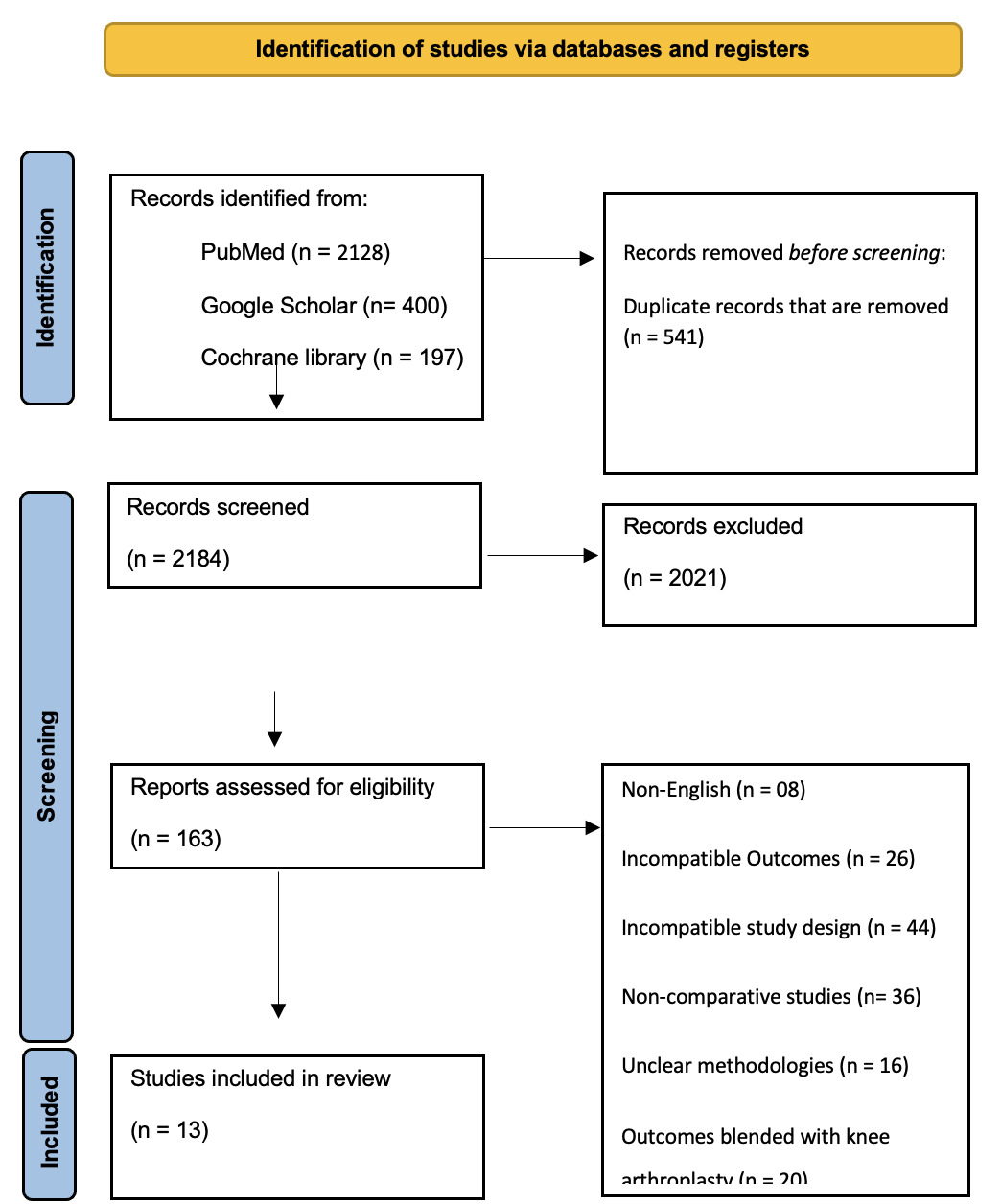
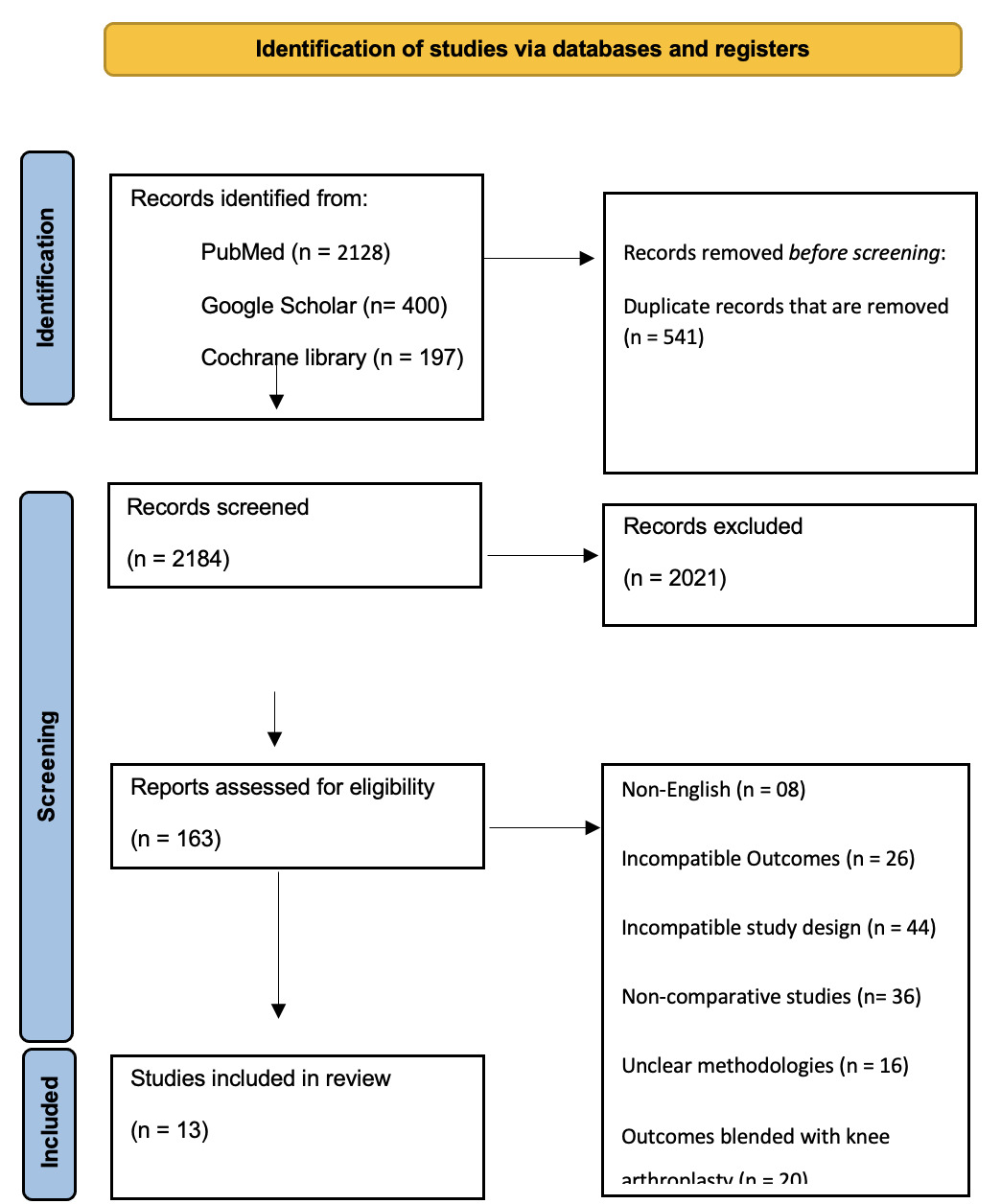
The sequence of study selection is presented in the PRISMA flow diagram (Supplementary Figure 1).
We initially identified 2,725 records from PubMed (n=2,128), Google Scholar (n=400), and the Cochrane Library (n=197). After removing 541 duplicates, 2,184 studies remained for screening by title and abstract. Of these, 2,021 were excluded based on relevance. The remaining 163 articles underwent full-text assessment, resulting in 150 exclusions according to our criteria. Ultimately, 13 studies met all inclusion criteria and were included in the qualitative and quantitative synthesis. The exclusion criteria included studies lacking original data, those not addressing the research question, and articles with insufficient methodological quality.
Study Characteristics
Thirteen primarily retrospective cohort studies were reviewed, with sample sizes ranging from 180 to 131,576 total hip arthroplasties. Most involved adults undergoing primary hip replacement for osteoarthritis; some compared hip to knee procedures. Obesity classifications varied (BMI ≥30, ≥40, ≥50 kg/m²). Follow-up ranged from 30 days to several years. Data included demographics, BMI, comorbidities, surgical approaches, prosthesis types, and postoperative outcomes. Table 1 and Supplementary Table 2.
Quality assessment
Most studies used retrospective designs or national databases. Seven were high-quality, showing strong selection and outcome assessment, three were moderate-to-high, and three moderate-quality had some comparability or assessment limitations. Refer to Supplementary Table 2 for full details.
Meta-analysis
Total complications in patients with BMI < vs. BMI 30–40
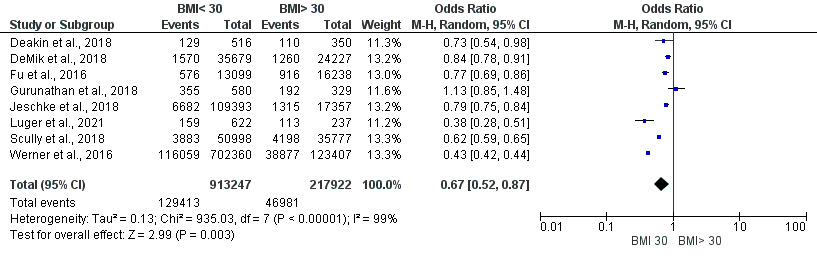
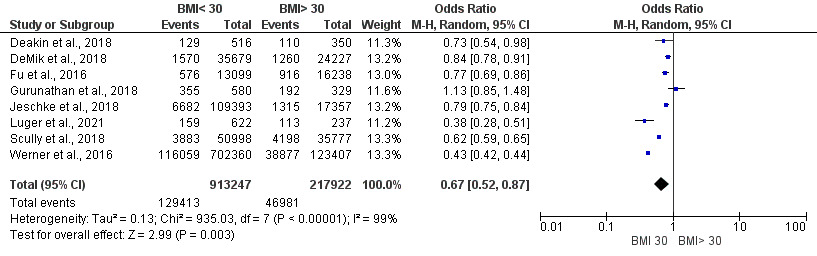
Patients with BMI 30–40 undergoing hip arthroplasty faced a higher postoperative complication risk than those with BMI <30 (OR 0.67, 95% CI 0.52–0.87). Despite notable heterogeneity (I² = 99%), the direction of effect was consistent across eight studies (Figure 1).
Total complications of patients with BMI < versus BMI >40
Patients with BMI >40 had significantly higher postoperative complication rates after total hip arthroplasty compared to those with BMI <30. Meta-analysis across eight studies found an OR of 0.39 (95% CI 0.27–0.57), indicating a 61% lower risk in patients with BMI <30 compared to those with BMI >40. Despite high heterogeneity (I² = 99%), the direction of effect was consistent across studies (Figure 1).
4. Discussion
This review highlights the significant and progressive impact of obesity on total hip arthroplasty (THA), revealing a dose-dependent increase in risk associated with higher body mass index (BMI). While THA remains an effective procedure across all BMI categories, patients classified as obese, particularly those with a BMI of 40 or greater, face higher perioperative and postoperative morbidity. Specifically, the risk of major surgical complications, infections, revisions, and readmissions is markedly elevated in morbidly and super-obese patients, with hazard ratios ranging from 2.4 to 7.7 across various cohorts.18–20 These findings are consistent with earlier systematic reviews and meta-analyses.
For instance, Onggo et al. analyzed 67 studies involving over 2 million patients and found that obese and morbidly obese individuals exhibited significantly higher rates of major complications, infections, dislocations, reoperations, revisions, and readmissions.2 Similarly, Liu et al. pooled data from 15 prospective cohort studies, revealing the negative impact of obesity on overall complications, dislocation rates, functional outcomes, and operative times, although both obese and non-obese groups had comparable lengths of hospital stay.15 Kuroda et al. further demonstrated that obesity was linked to poorer patient-reported outcome scores, a higher likelihood of conversion to THA, and an increased risk of postoperative complications in hip arthroscopy patients, suggesting that the adverse effects of obesity extend across different types of hip surgeries.28
These previous reviews support the dose-response and threshold effects observed in our analysis. A key finding among the prospective studies included in this review is that obesity presents a stepwise, non-linear association with surgical risk rather than a simple binary relationship. Notably, complication rates begin to rise in individuals with a BMI of 30–35,17,23,26 and this trend continues to worsen for those with a BMI of 40 or higher. This threshold effect illustrates that beyond a certain BMI, physiological reserves, soft tissue integrity, and immune function decline, adversely affecting surgical outcomes.
Significant increases in adverse events—such as venous thromboembolism, dislocation, infection, and early revision THA—are noted in both registry-based and single-center cohorts among patients with the highest BMI. While obesity correlates with an overall increase in risk, it is important to recognize that not all outcome domains are equally impacted. For instance, while surgical-site and mechanical complications are consistently prevalent in obese patients, outcomes like mortality and thromboembolic events appear to be comparable to those in non-obese cohorts. This discrepancy may be attributed to advancements in perioperative protocols, such as standardized thromboprophylaxis and enhanced recovery pathways, which help mitigate the systemic complications associated with obesity.
The modest relationship between BMI and mortality observed in most databases suggests that contemporary perioperative interventions are effective in addressing acute complications at the systemic level.22,24,25 Moreover, the interplay between U- and J-shaped relationships in other analyses underscores the complexity of interpreting BMI in the context of surgical risk assessment. Some literature indicates that moderately high BMI may not be associated with increased risk,25 and paradoxically, certain complications were found to occur less frequently in individuals with elevated BMI who followed similar trends.22,27 However, these protective signals diminish as BMI rises, emphasizing the detrimental impact of obesity on soft-tissue management, immune sensitivity, surgical exposure, and implant biomechanics.19,22,23
Several limitations must be acknowledged in this review. Most included studies were retrospective, posing potential selection bias and limiting causal inferences. Additionally, significant variations in BMI classification, outcome definitions, follow-up durations, and surgical procedures were present. Differences in perioperative care and complication reporting may also have affected pooled estimates. Furthermore, the lack of direct assessment for publication bias through funnel plots, along with a limited number of publications per outcome and the exclusion of non-English articles from the past decade, may have restricted the inclusion of relevant studies and introduced language and temporal biases.
Future research should focus on conducting large, multicenter prospective studies with predefined BMI categories and standardized definitions for postoperative complications. Such studies could clarify the relationship between obesity and THA outcomes, ultimately guiding the perioperative optimization of obese and morbidly obese patients.
5. Conclusion
Obesity is associated with a significantly higher risk of postoperative complications following total hip arthroplasty, including increased rates of infection, dislocation, and revision surgery. While overall mortality and thromboembolic events do not appear significantly affected by BMI, patients with severe and morbid obesity experience greater surgical challenges, longer operative times, and lower functional outcomes. These findings highlight the importance of preoperative risk assessment, careful surgical planning, and targeted perioperative optimization for obese patients to improve outcomes and reduce complication rates after THA.
Declaration of Conflicting Interests
The authors declared no potential conflicts of interest with respect to the research, authorship, and/or publication of this article.
Human/Animal Rights
All procedures followed were in accordance with the ethical standards of the responsible committee on human experimentation (institutional and national) and with the Helsinki Declaration.
Funding
The authors received no financial support for the research, authorship, and/or publication of this article.
Author Contributions
Hamza M. Alrajab: MD
Study supervision, conceptualization, and manuscript revision.
Rakan Abdulkarim A. AlEtebi: MBBS
Conceptualization, literature search, data extraction, data analysis, manuscript drafting.
Taher Mohammed A. Mufti: MBBS
Study design, supervision, and manuscript revision, and corresponding author
Nawwaf Naif A. Alharbi: MBBS
Data validation and manuscript review.
Hala Abdulkarim A. AlEtebi: MBBS
Literature screening and data collection.
Abdulmohsen Yousef A. Alrahahleh: MBBS
Data interpretation and manuscript revision.
Ruwaydah Hamoud M. Alruwaili: MBBS
Literature screening and data extraction.
Abdullah Yahya A. Asiri: MBBS
Data validation and manuscript editing.
Lamar Bandar N. Alhazmi: MBBS
Literature review and manuscript editing.
Zain Seraj Alddin O. Daghestani: MBBS
Statistical support and manuscript revision.
Salah Salman H. ALjameeli: MBBS
Methodological consultation and manuscript review.
Namar Abdulwahab A. Alzubaidi: MBBS
Statistical analysis support and manuscript editing.
All authors reviewed and approved the final version of the manuscript.
Informed Consent
Informed consent was not required for this narrative review.
Required Author Forms
Disclosure forms provided by the author
Acknowledgment
None.