
Introduction
Carpal tunnel syndrome (CTS) is a condition caused by compression of the median nerve. Symptoms include numbness, tingling, and pain in the radial ends of their thumb, index, and middle fingers. Additionally, patients with CTS may exhibit varying degrees of muscle atrophy, decreased range of motion, and reduced hand strength.1 According the recent meta-analysis a prevalence of this disease is approximately 14.4% of the global population.2 Risk factors include female gender, older age, obesity; in addition to smoking, physical inactivity, and hand-intensive occupations contributes the risk.3 Diabetes mellitus, menopause, rheumatologic arthritis, and wrist diameter over 21 cm are know like significant predictors of CTS severity.4
Trigger finger disorder (TF) is a condition characterised by pain and entraping the flexor tendons while the patient flexes and extends digits. The cause of this disorder is a dissociation between the size of the flexor tendons and the A1 pulley.5 The prevalence of TF is 2% to 3% in the global population and close to 20% in patients with diabetes mellitus.6
With the development of hand surgery and increasing clinical experience, it has been observed that CTS and TF often occur in the same patient. Despite numerous clinical, genetic, and histologic studies, the underlying mechanisms explaining the co-occurrence of these diseases remain uncertain.7–11 Recent studies have reported that TF frequently occurs after carpal tunnel surgery, whereas TF surgery does not increase the risk of CTS occurrence.12,13 Systemic conditions such as diabetes mellitus, rheumatoid arthritis, and hypothyroidism are also known as potential contributors to coexistance of these disorders.14 A recent meta-analysis reported that the overall incidence rate of TF with concomitant CTS was 14.2%.15
Although there are many observational studies, investigated the coexistence of CTS and TF, the clinical and demographic factors associated with their co-occurance remain incompletely understood. Most available data are from populations in North America, Europe, and East Asia.16–21 Population-specific differences in CTS characteristics have also been reported in a recent diagnostic meta-analysis. The results of this study demonstrated differences in ultrasonographic diagnostic thresholds between Asian and non-Asian populations, suggesting that CTS may vary across populations.22
Kazakhstan represents a multiethnic region with a large indigenous population. However, data on the prevalence of CTS and TF in these populations is still unknown. Therefore, the aim of this study was to determine the prevalence of concurrent CTS and TF and to analyze demographic and clinical factors associated with their coexistence in a clinical cohort from Kazakhstan.
Materials and Methods
This observational cross-sectional study was conducted between November 2025 and April 2026 in a tertiary referral hospital and in a private clinic located in Astana, Kazakhstan. The study protocol was approved by the Local Ethics Committee of Astana Medical University (Meeting No. 13, Decision No. 3, dated 29 October 2025). All procedures were conducted in accordance with the principles of the Declaration of Helsinki. Informed consent was obtained from all participants. Oral infromed consent was obtained from all participants. All collected data were anonymized and stored on a password-protected computer accessible only to the research team.
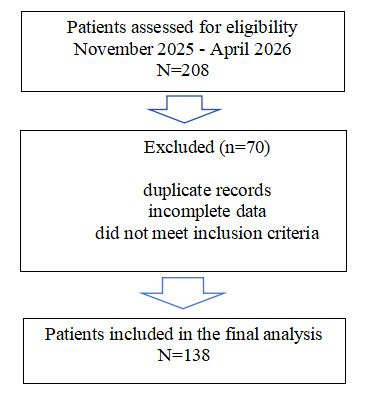
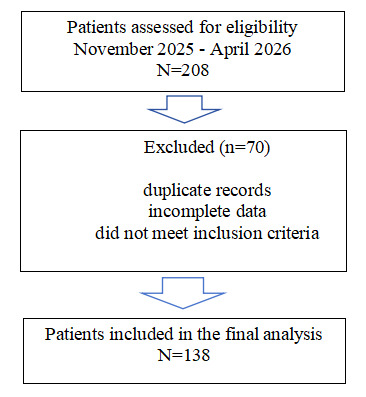
A total of 208 patients presenting with symptoms of carpal tunnel syndrome (CTS) or trigger finger (TF) were initially screened for eligibility. Duplicate records were identified and removed. In the final analysis, 138 patients were included according to the inclusion criteria (age ≥18 years, primary diagnosis of CTS or TF confirmed during clinical evaluation). The diagnosis of carpal tunnel syndrome and trigger finger was established based on clinical presentation and physical examination. Demographic and clinical data were obtained from medical records and patient interviews. Ethnicity was categorized into three groups, such as Kazakhs, Russians, and others. The “other ethnic groups” category included several minority ethnicities represented by small numbers of participants. The sample size was determined by the number of consecutive eligible patients presenting during the study period.
Statistical analysis was performed using Jamovi software (The Jamovi Project, version 2.6.44). Continuous variables were presented as mean ± standard deviation (SD), and categorical variables were expressed as frequencies and percentages. Normality of continuous variables was assessed using the Shapiro-Wilk test. Differences between diagnostic groups were analyzed using the chi-square test for categorical variables and one-way analysis of variance (ANOVA) for continuous variables. To identify factors associated with the coexistence of CTS and TF, a multivariable logistic regression analysis was performed. Results were reported as odds ratios (OR) with 95% confidence intervals (CI). A p-value < 0.05 was considered statistically significant.
This study was reported in accordance with the STROBE guidelines for observational studies. The dataset supporting the conclusions of this article is available in the Zenodo repository at https://doi.org/10.5281/zenodo.19181232.
Results
Participants
A total of 138 patients were included in the analysis. The mean age of the study participants was 57.5 ± 10.5 years, and the majority were women (87.0%). The mean body mass index (BMI) was 28.8 ± 5.2 kg/m2.
Among the participants, 45.7% were Kazakh, 30.4% were Russian, and 23.9% belonged to other ethnic groups. Diabetes mellitus was diagnosed in 27.5%, thyroid disease in 21.7%, arterial hypertension in 51.4%, and rheumatoid arthritis in 10.9%. Hormone therapy was reported in 23.2% of the study population (Table 1).
Distribution of Diagnoses
Among the patients included in the study, 82 (59.4%) were diagnosed with carpal tunnel syndrome (CTS), 48 (34.8%) with trigger finger (TF), and 8 patients (5.8%) had both CTS and TF (Table 2).
Univariate Analysis
Comparison of patient characteristics across the three diagnostic groups revealed several statistically significant differences (Table 3).
Gender distribution differed significantly between groups (p = 0.001). Women predominated in all groups; however, the proportion of men was higher among patients with trigger finger compared to patients with CTS.
Ethnicity also differed significantly between groups (p < 0.001). Patients with trigger finger were more likely to be of Kazakh ethnicity, while Russian ethnicity was more common among patients with CTS and in the combined CTS+TF group.
The prevalence of diabetes mellitus differed significantly between groups (p = 0.008), with the highest proportion observed among patients with combined CTS and TF. Similarly, thyroid disease (p = 0.010) and hormone therapy (p = 0.030) were more common in the combined CTS+TF group.
No statistically significant differences were found between groups for hypertension (p = 0.107) or rheumatoid arthritis (p = 0.443).
Mean age and BMI did not differ significantly between groups (p = 0.107 and p = 0.236, respectively).
Multivariable Logistic Regression
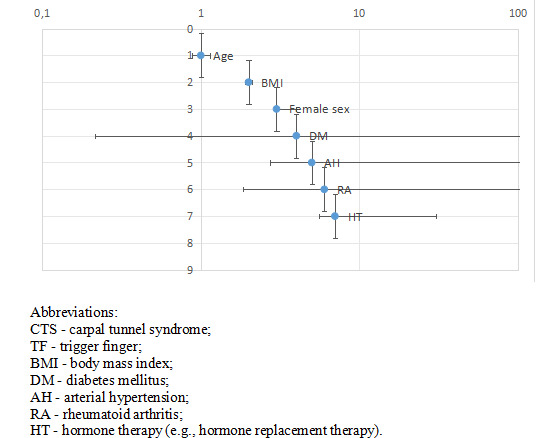
To identify factors associated with the coexistence of CTS and trigger finger, a multivariable logistic regression analysis was performed (Table 4).
_with_95__confidence_intervals_for_factors_associated_with_.png)
Increasing age was associated with lower odds of combined CTS and TF (OR = 0.77; 95% CI 0.63–0.92; p = 0.005).
Diabetes mellitus was significantly associated with the presence of the combined condition (OR = 72.96; 95% CI 2.41–2208.9; p = 0.014).
Ethnicity was also associated with the outcome. Compared with Kazakh ethnicity, patients from other ethnic groups were more likely to have a combination of CTS and TF (OR = 654.1; 95% CI 1.96–218768.1; p = 0.029), while Russian ethnicity showed a trend toward statistical significance (p = 0.052).
Because the number of patients with a combination of carpal tunnel syndrome and trigger finger was small (n = 8), the multivariate model was limited to key variables, and the results should be interpreted with caution.
Discussion
In this study, we evaluated the co-occurrence of carpal tunnel syndrome (CTS) and trigger finger (TF) and analyzed demographic and clinical factors associated with their simultaneous occurrence in a clinical cohort from Kazakhstan. Among the 138 included patients, 8 patients (5.8%) presented with concurrent CTS and TF, while the other patients were diagnosed with isolated CTS or TF.
The coexistence of CTS and TF has been described in previous studies, suggesting that these two disorders may share common underlying mechanisms. Both conditions involve pathological changes in fibrous tissue that lead to entrapment of the flexor tendons or median nerve compression.10 According to a recent meta-analysis by Sallai et al., the prevalence of CTS was approximately twice as high as that of TF . At the same time, TF was more frequently observed in patients with concomitant CTS than as an isolated disorder.15
In our study, diabetes mellitus was strongly associated with the coexistence of CTS and TF. This finding is consistent with previous studies reporting a higher prevalence of both CTS and TF among patients with diabetes,15,22,23 although other authors did not found a significant assosiation between diabetes and these diseases.16,24 Interestingly, diabetes was not associated with an increased risk of isolated CTS in the Korean study.19
Increasing age was associated with lower odds of concurrent CTS and TF in the multivariable regression analysis. This may indicate that the coexistence of these disorders occurs more often in patients in their 40s - 60s, while older patients more commonly present with isolated CTS or TF. However, this observation should be interpreted cautiously due to the small number of patients with combined CTS and TF in our cohort.
Other metabolic and systemic conditions, including rheumatoid arthritis, thyroid disease, and arterial hypertension, have been reported to contribute to the development of CTS, while diabetes has also been associated with an increased risk of TF.25–28 Sallai et al analysed risk factors for both conditions and suggested that diabetes has a significant influence on their coexistence.15 Our findings support the impact of diabetes and also highlight potential age-related features of these concurrent hand disorders.
We also observed differences related to ethnicity, although these estimates were associated with wide confidence intervals. Kazakhstan represents a multiethnic region with a big amount of caucasian and asian population. Compared with Kazakh ethnicity, patients from other ethnic groups, particularly Russians, were more likely to have a combination of CTS and TF. Non-Kazakhs tended to present more frequently with isolated CTS, whereas Kazakh patients more often had an isolated TF. Potential population-related differences in musculoskeletal disorders have been suggested in previous studies. For example, variations in ultrasonographic diagnostic thresholds for CTS have been reported between Asian and non-Asian populations.29 These observations indicate that regional and ethnic factors may influence the clinical presentation of CTS and related conditions.
Limitations
Several limitations of this study should be acknowledged. First, this study was conducted in a single-city clinical cohort, and therefore, the findings may not be fully representative of the broader Kazakh population. Second, the number of patients with concurrent CTS and TF was relatively small, which may have affected the stability of regression estimates and resulted in wide confidence intervals. Third, the diagnosis of CTS was based on clinical evaluation and physical examination, as electrophysiological testing was not routinely performed. However, clinical diagnosis reflects real-world clinical practice and is commonly used in everyday settings.
Despite these limitations, this study provides new clinical data from a Kazakhstani clinical population, a region that remains underrepresented in the literature on hand disorders. Our findings contribute to a better understanding of the clinical factors associated with the coexistence of CTS and TF and may help improve the clinical evaluation of patients presenting with hand symptoms.
Future studies with larger multicenter cohorts are needed to further investigate the mechanisms underlying the coexistence of CTS and TF and to clarify the role of metabolic and demographic factors in their simultaneous development.
Conclusion
In this clinical cohort from Kazakhstan, the coexistence of carpal tunnel syndrome and trigger finger was observed in a small proportion of patients. Diabetes mellitus showed the strongest association with the concurrent occurrence of these diseases. Increasing age showed an inverse association with the concurrent occurrence of combined CTS and TF. These findings provide new clinical data from an underrepresented region and suggest that systemic metabolic factors, particularly diabetes, may contribute to the simultaneous development of these hand disorders.
Acknowledgements
The authors thank Dmitriy Kim from the Clinic of Sports Rehabilitation and Kinesiology “Kinetik” (Astana, Kazakhstan) for his assistance in patient recruitment.
Corresponding author
Assel Kaliyeva; asselkyz@gmail.com, 202312181@amu.kz; Beybitshilik 49a, Astana, Kazakhstan; +7(705)8563982
Authors’ contributions
A.K. conceived and designed the study, collected the data, and drafted the manuscript. A.K. and A.K. performed the statistical analysis. A.B. and M.B. contributed to the study concept and critically revised the manuscript. M.I., S.B., E.K., and A.A. contributed to patient recruitment and data collection. All authors read and approved the final manuscript.
Conflict interests
The authors declare no competing interests.
Funding
The authors received no external funding for this study.