
INTRODUCTION
Acute stroke is one of the leading causes of death and disability in the United States.1 Mechanical thrombectomy, in which the clot is removed from a large vessel lumen,2 can be performed under monitored anesthesia care (MAC) to ensure adequate anesthesia and analgesia throughout the procedure.3
MAC is generally considered extremely safe and associated with better outcomes than general anesthesia4,5 while allowing titratable sedation and analgesia. These features have led many interventionalists and anesthesiologists to use MAC when appropriate instead of general anesthesia.6–8 A meta-analysis has shown significantly lower rates of mortality and postoperative complications with MAC compared with general anesthesia among patients undergoing transcatheter aortic valve implantation surgery.9 However, similar studies have not been performed in patients treated with mechanical thrombectomy under MAC for ischemic stroke.
One meta-analysis found no difference in rates of intraoperative complications, symptomatic intracranial hemorrhage, aspiration pneumonia, successful recanalization at 24 hours, and functional independence and mortality at 90 days in patients with stroke treated with mechanical thrombectomy under general anesthesia or MAC.10 A second meta-analysis found similar results, although recanalization in that study was more successful with general anesthesia than with MAC.11 However, the study of this limited set of postoperative adverse events related to anesthesia is insufficient. Complications such as the need for ventilator placement and development of acute respiratory failure can extend a patient’s hospital stay, increase morbidity and mortality, and detract from meaningful recovery.12 Thus, although the risk profile of MAC sedation is generally well known,13 a full risk profile of mechanical thrombectomy under MAC sedation is lacking.
We examined the rates of adverse events associated with MAC sedation in patients with stroke undergoing mechanical thrombectomy. Specifically, we sought to determine whether a particular adverse event occurred more often than others, and if so, whether it occurred more often in a particular subset of patients. A greater understanding of the potential complications that can occur following MAC sedation in patients with stroke can help guide anesthesia selection and help physicians better plan postoperative management strategies.
MATERIALS AND METHODS
Ethical Considerations
Study approval was obtained from the St. Joseph’s Hospital and Medical Center Internal Review Board (PHX-24-500-328-71-12, approved June 17, 2025), which waived the need for patient consent due to the retroactive nature of the study and use of de-identified patient data.
A retrospective chart review was performed to evaluate the occurrence of adverse events under MAC sedation in patients with stroke undergoing mechanical thrombectomy. Per institutional protocols, patients who received MAC sedation maintained their airway reflexes and received a combination of intravenous sedatives (e.g., propofol or midazolam) and local anesthetic agents to provide adequate sedation and analgesia.
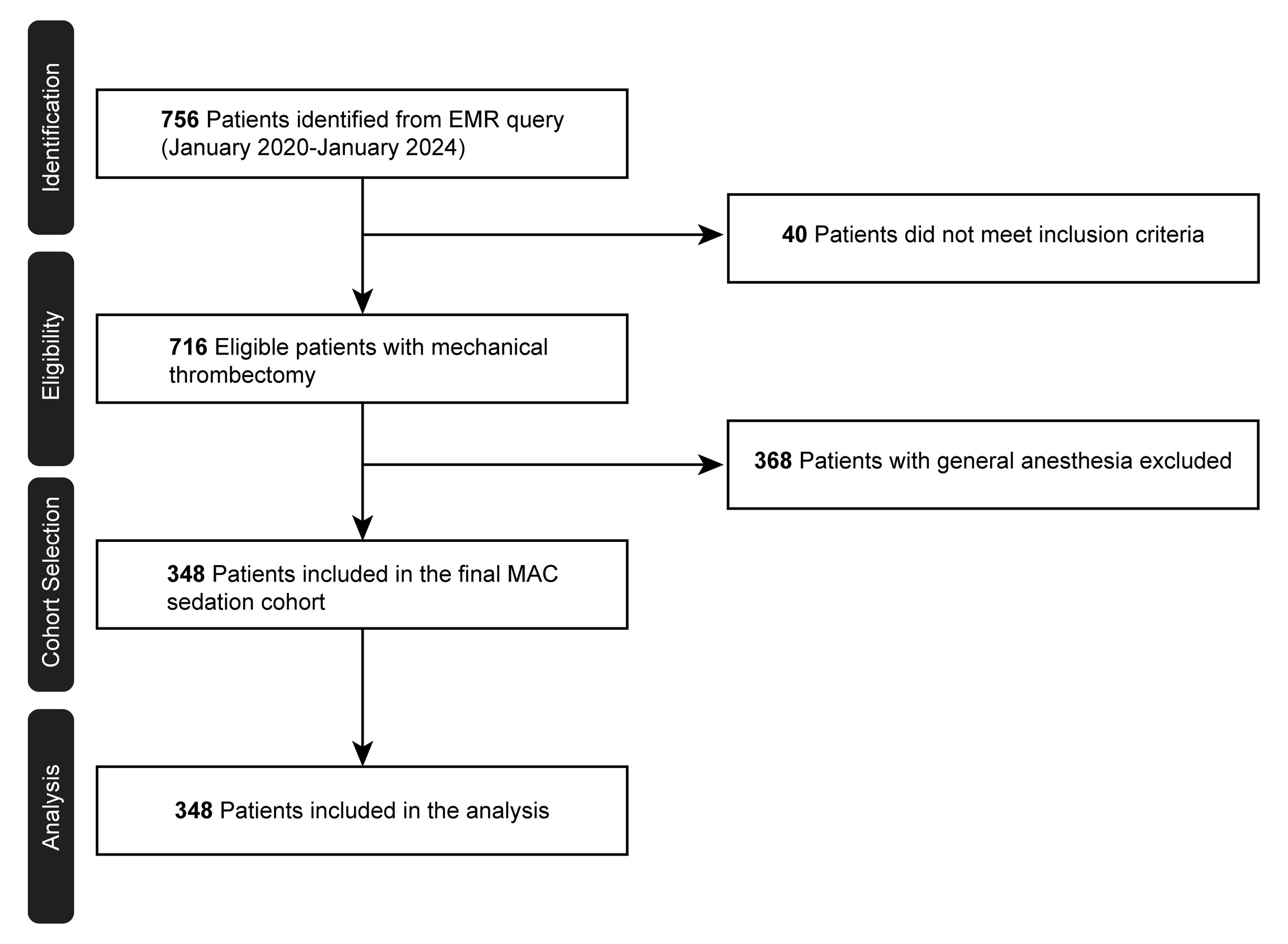
The data were collected from the electronic medical records (EMRs) system. Patients were eligible for inclusion in this study if they were 18 years of age or older, had a diagnosis of ischemic stroke, and underwent mechanical thrombectomy between January 1, 2020, and January 1, 2024 (Figure 1).
Data retrieved from the EMRs of each patient included demographic information, type of anesthesia used during thrombectomy, location of the stroke, respiratory complications, history of prior stroke, and comorbidities. The demographic information included age, sex, body mass index (BMI), and race. The type of anesthesia included MAC sedation, general anesthesia, and local anesthesia, as documented in anesthesia and postoperative notes. The stroke location included the middle cerebral artery (MCA), anterior cerebral artery, posterior cerebral artery, internal carotid artery, and basilar artery. Comorbidities included heart disease, hypertension, smoking status, atrial fibrillation, chronic obstructive pulmonary disease, chronic kidney disease, and active COVID-19 infection. Respiratory adverse events were categorized as none, pneumonia, acute respiratory failure, prolonged ventilator use, aspiration, or other complications. Prolonged ventilator use was defined as the receipt of mechanical ventilation for more than 24 hours.
The primary outcome was respiratory adverse events in each category in patients treated with MAC sedation. The length of hospital stay, defined as the total number of days the patient stayed in the hospital, was a secondary outcome.
Demographic and clinical characteristics were reported using means and standard deviation for continuous variables and frequencies and percentages for categorical variables. Univariate logistic regression assessed independent associations between each demographic and clinical covariate with the odds of adverse events, ventilator status, and respiratory failure, respectively. Covariates with p < 0.20 were entered into a second model, where Akaike’s information criterion was used to determine which covariates were most strongly associated with the likelihood of adverse clinical outcomes. For each final model, the area under the receiver operating characteristic curve was calculated to quantify the model’s ability to discriminate between individuals with and without the adverse event, with values close to 1 indicating better discrimination. Statistical significance was set at p = 0.05, and all p-values were 2-sided. Data were analyzed using Stata 18 (StataCorp; College Station, TX).
RESULTS
A total of 348 patients were included in this study. Mean (SD) age was 71.0 (12.9) years (Table 1). There was an even distribution of male and female patients, and 265 (76.2%) were White. Hypertension was the most common comorbidity, recorded in 233 patients (66.9%), and atrial fibrillation and heart disease were recorded in 111 (31.9%) and 66 (18.9%), respectively. Seventy patients (20.3%) had a history of previous stroke, and 261 (75.0%) underwent mechanical thrombectomy in the MCA.
Most patients (310 of 348, 89.1%) did not experience any respiratory adverse event (Table 1). Among the 38 patients who had adverse events, prolonged mechanical ventilation was the most common adverse event, with 28 patients (8.0%) needing ventilator support. Acute respiratory failure was recorded in 20 patients (5.7%), aspiration events in 7 (2.0%), and pneumonia and other adverse events in 5 or fewer patients.
Covariates were first stratified by respiratory adverse event status (Table 2). Univariate logistic regression without adjustments showed that patients aged 60–69 years were 3.23 times more likely to experience adverse events than those younger than 60 years (odds ratio [OR], 3.23; 95% confidence interval [CI], 1.01–10.4; p = 0.048). However, the frequency of adverse events did not differ by sex, race, BMI, or stroke location. The unadjusted model showed that smokers were significantly more likely to experience adverse events (OR, 2.44; 95% CI, 1.07–5.57; p = 0.04). Multivariable logistic regression adjusted for all covariates indicated that this difference remained significant, with smokers 2.41 times more likely to experience an adverse event (OR, 2.41; 95% CI, 1.01–5.72; p = 0.046) (Table 2, Supplemental Figure 1).
Covariates were next stratified by ventilator status (Table 3). Univariate logistic regression with no adjustments showed no significant differences in the likelihood of requiring mechanical ventilation based on age, sex, race, BMI, stroke location, prior stroke, or comorbidities. However, on multivariable logistic regression adjusted for all covariates, patients aged 60–69 years were 3.75 times more likely to require mechanical ventilation (OR, 3.75; 95% CI, 1.12–12.6; p = 0.03). Furthermore, those with other comorbidities were 3.45 times more likely to require mechanical ventilation (OR, 3.45; 95% CI, 1.49–7.95; p = 0.004) (Table 3, Supplemental Figure 2).
Finally, covariates were stratified by acute respiratory failure status (Table 4). Patients aged 60–69 years were 8 times more likely to experience respiratory failure than those less than 60 years (OR, 8.11; 95% CI, 1.00–65.8; p = 0.05), whereas those aged 70 years or older did not have statistically significantly greater odds of experiencing respiratory failure. Acute respiratory failure status did not differ by sex, race, BMI, stroke location, prior history of stroke, or comorbidity. Multivariate logistic regression did not show any significant differences in acute respiratory failure, regardless of hypertension, chronic obstructive pulmonary disease, or other comorbidities (Table 4, Supplemental Figure 3).
DISCUSSION
This study is one of the first to analyze adverse respiratory outcomes in patients with stroke undergoing mechanical thrombectomy under MAC sedation. Of the 348 patients who received MAC sedation, 310 (89.1%) experienced no adverse events, demonstrating the strong safety profile of MAC in the setting of mechanical thrombectomy in patients with stroke. However, the odds of complications were significantly higher in patients aged 60–69 years, in those with a history of smoking, and in those with comorbidities. These findings support the overall safety of MAC, yet they also highlight the importance of identifying subgroups at increased risk of adverse events.
We found age to be a strong predictor of adverse outcomes. On univariate analysis, patients aged 60–69 years had more than 3 times the odds of experiencing any adverse respiratory event than those less than 60 years of age (OR, 3.23; 95% CI, 1.01–10.4; p = 0.048) and more than 8 times the odds of developing acute respiratory failure (OR, 8.11; 95% CI, 1.00–65.8; p = 0.05). In the multivariable analysis, the significantly increased odds of ventilator use remained (OR, 3.75; 95% CI, 1.12–12.6; p = 0.03). Interestingly, the odds of adverse outcomes appeared to be lower in older age groups (70–79 years and ≥80 years), although these differences were not statistically significant (Table 3). This pattern could reflect selection bias, with more frail or higher-risk older patients receiving general anesthesia than MAC sedation.
This selection bias may be driven by clinical concerns surrounding physiologic decline experienced by older patients. Additionally, the wide confidence intervals and small event numbers further highlight the potential limitations of these data. However, the exploratory nature of these findings does invite further inquiry. Patients over 60 years of age experienced declines in functional reserve, leading to impaired responses to perioperative stressors such as hypovolemia, hypoxia, and hypercarbia.14 This decline continues to worsen with advancing age and further diminishes physiologic resistance to anesthetic complications. Furthermore, studies have shown that older patients exhibit increased sensitivity to sedatives and opioids, with sensitivity approximately doubling by the age of 80 years and quadrupling by the age of 90 years.14 Due to these physiologic changes associated with age, clinicians may perceive patients over 70 years of age, particularly those with higher perioperative risk, as less suitable for MAC sedation and more appropriate for general anesthesia. In fact, although MAC sedation is routinely used in patients scheduled for surgery or diagnostic procedures, the window for safely titrating sedative drugs is often limited in older individuals, further emphasizing the challenges of maintaining an appropriate depth of sedation and reinforcing the cautious approach that clinicians adopt when selecting MAC for older, higher-risk patients.15 Due to this perceived risk associated with MAC sedation in the older population, MAC may be disproportionately offered to patients less than 70 years of age and could contribute to the higher rate of adverse respiratory events observed in this age group.
Alternatively, this finding may indicate that patients 60–69 years of age represent a transitional physiologic group. These patients are old enough to be vulnerable to complications but are still commonly selected for MAC sedation over general anesthesia due to perceived clinical stability. Overall, these findings underscore the need for nuanced preoperative risk stratification rather than reliance on age alone.
Smoking was an additional variable that increased the likelihood of adverse outcomes. Multivariable analysis indicated that smokers had more than twice the odds of experiencing complications than those who did not smoke (OR, 2.41; 95% CI, 1.01–5.72; p = 0.046). Chronic tobacco use is a well-established risk factor for impaired pulmonary function and mucociliary clearance. Several studies have shown that cigarette smoke may cause numerous alterations to the respiratory system, including lung inflammation, impaired cilia genesis, and chronic airflow obstruction.16,17 Alternative studies exploring the relationship between tobacco exposure and postoperative outcomes note that smokers have significantly increased risks of postoperative complications such as pneumonia, surgical-site infection, and death, particularly in procedures involving sedation or anesthesia.18 Chronic smoke exposure has been associated with impaired ciliogenesis of respiratory cells and a diminished capacity to clear secretions.17,19 These physiologic impairments, in addition to reduced immune defense and chronic airway inflammation, could place smokers at a greater risk of perioperative pulmonary complications. In the context of MAC sedation, these vulnerabilities may be even more consequential. Our findings reinforce the importance of smoking history as a potential risk factor when assessing anesthetic plans. Furthermore, the findings support consideration of enhanced perioperative respiratory support in this population.
Limitations
We acknowledge that our study has several limitations. First, 75% of strokes were in the MCA. Due to the limited number of patients with strokes in other vascular territories, patients with stroke locations other than the MCA were combined, potentially masking stroke location-specific differences in respiratory outcomes.
Second, the overall number of adverse respiratory events was relatively low, with only 38 patients (11%) experiencing any complication. This low incidence may have limited the statistical power of the study to detect associations between risk factors and adverse outcomes. For example, although patients in the 60–69 years of age range had significantly increased odds of adverse events, the relatively small number of events in older cohorts may have led to an underestimation of risk in these groups.
Finally, although our analysis adjusted for a wide range of clinical covariates, it was not possible to account for all potential confounders. Confounding variables such as stroke severity and intraoperative physiologic parameters were not measured and may have influenced the generalizability of the findings. The lack of National Institutes of Health Stroke Scale and ASPECTS (Alberta Stroke Program Early CT Score) data, as well as data on baseline neurologic deficits and infract volume, are particularly important limitations, because these factors can influence anesthetic selection as well as respiratory outcomes. Additionally, because this study was a retrospective study of a specific patient cohort at a single institution, the findings may not be generalizable to other institutions with varying anesthesia protocols and resource availability.
CONCLUSION
An understanding of the adverse events that can occur when using MAC as anesthesia for mechanical thrombectomy in stroke is essential for improving patient safety and outcomes. Our findings suggest that, although MAC is generally well tolerated, some populations at higher risk should be monitored more closely and considered for alternative anesthesia plans. These insights underscore the importance of individualized anesthesia plans and the benefits of preoperative risk stratification. Further research is needed to validate our findings across broader patient populations, clarify the mechanisms contributing to these risks during MAC sedation, and elucidate any additional risks or benefits of endovascular therapy for acute stroke.
ACKNOWLEDGMENTS
We thank the staff of Neuroscience Publications at Barrow Neurological Institute for assistance with manuscript preparation.
AUTHOR CONTRIBUTIONS
Conceptualization: BTB, SHH, MLH, BGW
Data curation: BTB, MB, PK
Formal analysis: BTB, PK, BGW
Funding acquisition: n/a
Investigation: BGW
Methodology: BTB, SHH, MLH, BGW
Project administration: MB, BGW
Resources: MB, BGW
Software: n/a
Supervision: BGW
Validation: BGW
Visualization: PK
Roles/Writing - original draft: BTB, SHH, MLH, PK
Writing - review & editing: BTB, SHH, MLH, PK, SSK, OV, BGW
DISCLOSURES
The authors have no personal, financial, or institutional interest in any of the drugs, materials, or devices described in this manuscript.
FINANCIAL SUPPORT
None
ABBREVIATIONS
BMI, body mass index; CI, confidence interval; EMR, electronic medical record; MAC, monitored anesthesia care; MCA, middle cerebral artery; OR, odds ratio