
Introduction
Total knee arthroplasty (TKA) can provide substantial pain relief and improve function and health-related quality of life in people with advanced knee arthritis.1
Nevertheless, aseptic loosening, infection, instability, wear, stiffness, and periprosthetic fracture may necessitate revision total knee arthroplasty (rTKA). Demand for revision knee arthroplasty is expected to increase as the number of primary procedures rises.2
Compared with primary surgery, rTKA is technically more complex and typically associated with less predictable patient-reported recovery, making identification of potentially modifiable patient-level risk factors important.3
Depression is a common comorbidity among people undergoing lower-limb arthroplasty and has been associated with persistent pain, poorer patient-reported outcomes, dissatisfaction, complications, and greater resource use after total joint arthroplasty.3
Psychological factors, including poorer preoperative mental health and pain catastrophising, may also influence recovery after hip and knee arthroplasty.4
Patients undergoing rTKA differ from those undergoing primary surgery. They commonly have a longer surgical history, greater preoperative disability, and more complex indications for intervention, which may amplify the relationship between mental health and postoperative recovery. Evidence specific to the rTKA population is dispersed across registry, database, and institutional cohort studies. This systematic review therefore evaluated the association between depression or poor preoperative mental health and postoperative functional outcomes, complications, pain, satisfaction, quality of life, and healthcare utilisation after revision knee replacement surgery.
Methods
Ethical Considerations
This systematic review synthesised aggregate data from previously published studies. No participants were recruited, no individual-level identifiable data were accessed, and no intervention was delivered. Institutional review board approval and participant consent were therefore not required. Data were handled using information publicly reported in the included publications, with no collection or storage of personal identifiers.
Study Design
This systematic review was reported in accordance with the Preferred Reporting Items for Systematic Reviews and Meta-Analyses (PRISMA) 2020 statement.5
Search Strategy
A comprehensive literature search was performed in PubMed, MEDLINE, and Embase on August 12, 2025. The search was designed and reported using principles from the PRISMA-S extension.6
Controlled vocabulary and free-text terms were combined using Boolean operators. Core concepts included “depression,” “depressive disorder,” “mental health,” “psychological distress,” “revision total knee arthroplasty,” “revision knee replacement,” “revision knee surgery,” “outcomes,” “complications,” “quality of life,” “patient-reported outcome measures,” “pain,” and “satisfaction.” Database-specific syntax was adapted for each platform. Reference lists of eligible studies were also reviewed for additional relevant articles.
Eligibility Criteria
Studies were eligible if they included adults aged 18 years or older undergoing rTKA; evaluated depression or preoperative mental health as an exposure; and reported postoperative functional outcomes, pain, quality of life, satisfaction, complications, or healthcare utilisation. Only full-text, English-language articles published in peer-reviewed journals were included. Studies of primary TKA without separately extractable rTKA data, studies without depression- or mental-health-specific assessment, studies without relevant postoperative outcomes, conference abstracts, editorials, letters, reviews, protocols, and case reports or case series with fewer than 10 patients were excluded. Studies including hip and knee arthroplasty were eligible only when rTKA findings could be extracted separately.
Study Selection
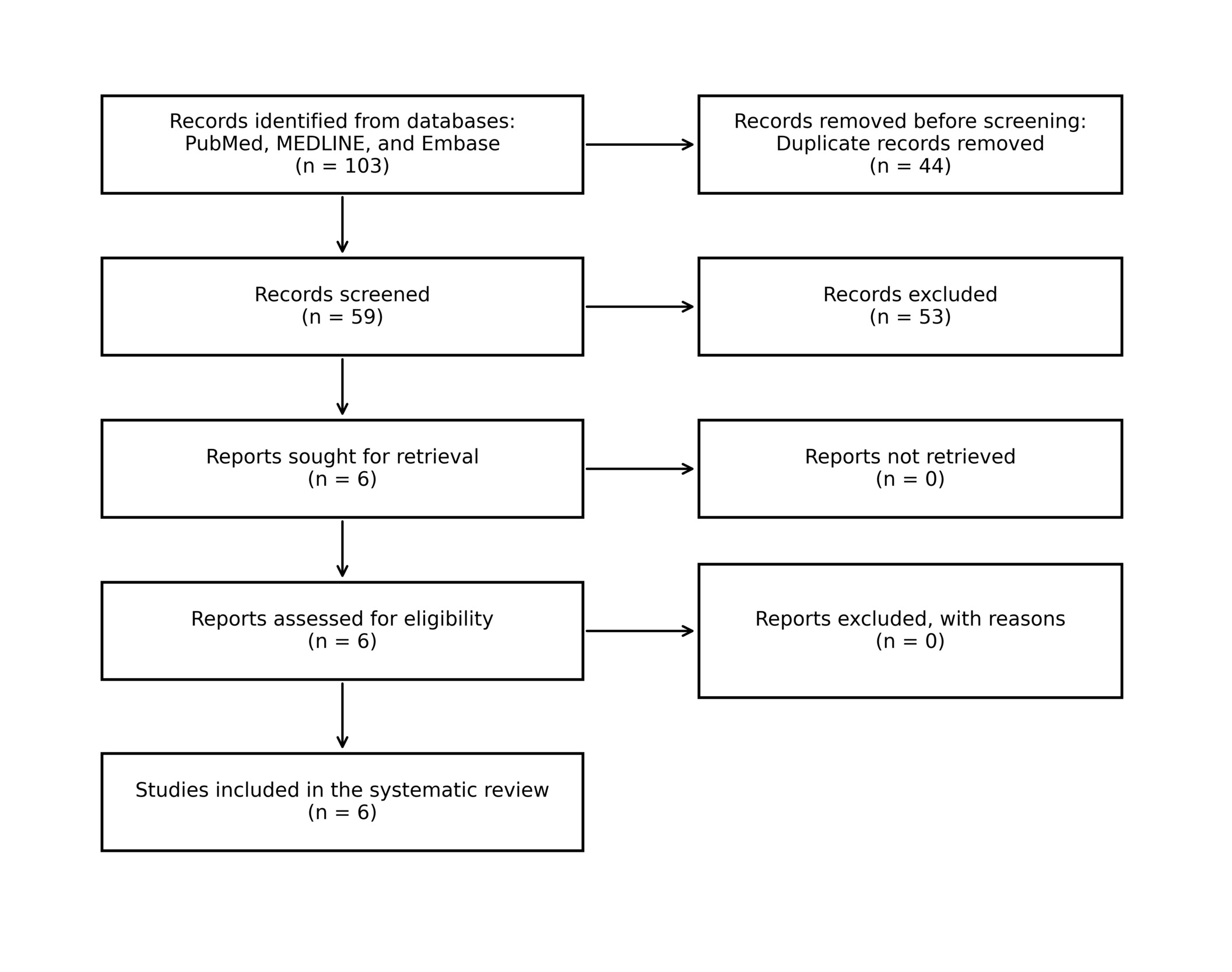
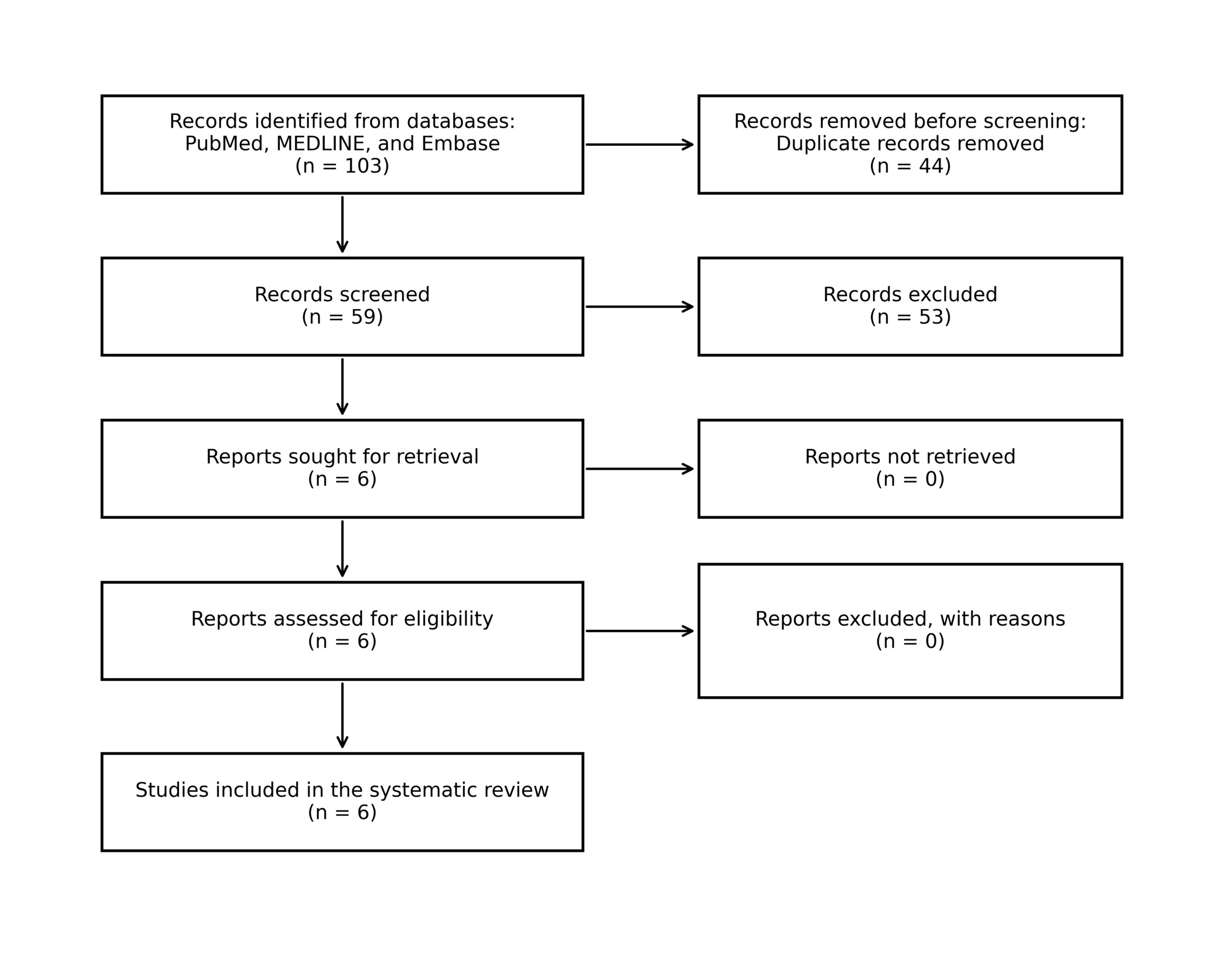
Records identified through database searching were imported into reference-management software and duplicate records removed. Titles and abstracts were screened against the predefined eligibility criteria. Full texts of potentially eligible records were assessed for inclusion. Of 103 records identified, 44 duplicate records were removed, leaving 59 records for title and abstract screening. Fifty-three records were excluded at screening. Six full-text reports were assessed, all met the eligibility criteria, and 6 studies were included. The selection process is shown in Figure 1.
Data Extraction
Data were extracted using a standardised form. Extracted information included author and year, study setting and design, sample size, depression or mental-health measure, revision indication where reported, duration of follow-up, functional outcomes, pain outcomes, satisfaction and quality-of-life outcomes, complications, healthcare utilisation, and main findings. Extracted data were checked against the source publication before narrative synthesis.
Outcome Measures
The primary outcomes were postoperative functional outcomes and complications following rTKA in patients with depression or poor preoperative mental health. Secondary outcomes were pain severity, persistent pain, postoperative analgesic use, satisfaction, health-related quality of life, length of stay, readmission, emergency department attendance, revision or re-revision, reoperation, costs, and other markers of healthcare utilisation.
Quality Assessment
Risk of bias was appraised using the Newcastle-Ottawa Scale for cohort studies. This tool evaluates selection of cohorts, comparability, and outcome ascertainment.7
Scores of 7 to 9 were interpreted as good methodological quality, 4 to 6 as moderate quality, and fewer than 4 as low quality. The assessment was used to inform interpretation of the findings rather than to exclude studies.
Data Synthesis
A meta-analysis was not undertaken because the included studies differed substantially in depression definitions, comparators, outcome measures, effect estimates, and follow-up duration. A narrative synthesis was undertaken across predefined domains: functional outcomes and patient-reported outcome measures, pain and analgesic use, satisfaction and quality of life, postoperative complications, and healthcare utilisation.
Results
Study Selection
The search identified 103 records across PubMed, MEDLINE, and Embase. After removal of 44 duplicate records, 59 records underwent title and abstract screening. Fifty-three records were excluded, and 6 full-text reports were assessed. All 6 full-text reports fulfilled the eligibility criteria and were included in the final review (Figure 1).
Study Characteristics
The six included studies were observational cohort, registry, and administrative database analyses conducted in the United States, United Kingdom, and Singapore. Sample sizes ranged from 245 rTKA patients in a single institutional registry to 13,973 rTKA patients in a large administrative database. One study included primary and revision hip and knee arthroplasty populations but reported rTKA-specific outcomes. Depression or mental health was measured using diagnostic coding, registry comorbidity data, electronic medical record diagnosis, the EQ-5D anxiety/depression domain, or the 36-Item Short Form Survey mental component summary. Follow-up ranged from 90 days to 5 years. Study characteristics are summarised in Table 1.
Functional Outcomes and Patient-Reported Outcome Measures
Sabah et al evaluated 10,727 patients undergoing elective rTKA in the National Health Service Patient-Reported Outcome Measures programme. The mean Oxford Knee Score change was 12.4 points and 65.6% achieved improvement above the minimal important change threshold; however, depression and problems in the EQ-5D anxiety/depression domain were associated with lower improvement.8
Goh et al reported poorer absolute Knee Society Score, Oxford Knee Score, and Short Form-36 physical scores at 6 months and 2 years among patients with low preoperative mental component summary scores. Both groups nonetheless had comparable improvement from baseline and similar proportions achieved a minimal clinically important difference.9
Pain Outcomes and Analgesic Use
In a registry study, Singh and Lewallen found that depression was associated with moderate-to-severe pain after rTKA (odds ratio, 1.8; 95% confidence interval, 1.1-3.1).10
In a second registry analysis, depression predicted narcotic analgesic use for index-knee pain at 5 years after rTKA (odds ratio, 4.58; 95% confidence interval, 1.58-13.18).11
Satisfaction and Quality of Life
In the NHS cohort, 69.7% of patients reported satisfaction and 74.1% considered the operation successful; depression and anxiety/depression-related EQ-5D problems were associated with less functional improvement.8
Goh et al reported lower 2-year satisfaction among patients with lower preoperative mental health compared with controls (72.2% vs 84.5%).9
Postoperative Complications
Wilson et al examined 13,973 rTKA patients and found that preoperative depression was associated with extended length of stay, non-home discharge, 90-day readmission, emergency department attendance, revision surgery, and increased costs.12
Harmer et al found depressive and/or anxiety disorders in 35% of revision TKA patients and reported an increased risk of infection, re-revision, and reoperation in this population; the hazard ratio for any infection after rTKA was 1.8.13
Healthcare Utilisation
The Wilson et al study demonstrated associations between preoperative depression and longer admission, non-home discharge, 90-day readmission, emergency department attendance, and higher costs after rTKA.12
The association between depression and longer-term narcotic use also suggests an ongoing resource burden beyond the immediate postoperative period.11
Risk of Bias Assessment
The included studies received Newcastle-Ottawa Scale scores of 7 or 8 out of 9, indicating generally good methodological quality (Table 2). Important limitations included reliance on diagnostic coding or routine comorbidity data to identify depression, incomplete patient-reported outcome follow-up in registry studies, single-centre design in one study, and residual confounding from chronic pain, comorbidity burden, frailty, socioeconomic circumstances, and opioid exposure.
Overall Synthesis
Across the included studies, depression or poorer preoperative mental health was consistently associated with poorer outcomes after rTKA. The most consistent patterns were worse absolute functional outcomes, persistent pain, increased analgesic use, lower satisfaction, more complications, and higher healthcare utilisation. The relationship was not uniform: poorer mental health did not preclude meaningful functional improvement, but was associated with a lower postoperative outcome level and greater risk of dissatisfaction.
Discussion
Principal Findings
This review found consistent associations between depression or poor preoperative mental health and adverse outcomes after rTKA. These associations included inferior patient-reported outcomes, persistent pain, increased narcotic analgesic use, lower satisfaction, complications, and greater healthcare use.8–13
The findings are congruent with broader total joint arthroplasty literature, in which depression has been associated with persistent pain, lower satisfaction, complications, and higher healthcare costs.3,4
Functional Outcomes and Patient-Reported Outcome Measures
Sabah et al and Goh et al both demonstrated that poorer preoperative mental health was associated with worse postoperative function. In the latter study, patients with poorer mental health achieved a comparable relative improvement and similar minimal clinically important difference attainment, despite poorer absolute postoperative scores.8,9
This distinction is clinically important. Depression should not be used to deny access to rTKA when surgery is otherwise indicated, but it may identify patients more likely to have residual limitation or perceive a smaller benefit. Depression may influence pain appraisal, sleep, coping, motivation, and engagement with rehabilitation; it may also mark a broader burden of chronic pain, multimorbidity, or psychosocial vulnerability.
Pain Outcomes and Analgesic Use
The association between depression and moderate-to-severe pain, as well as the more than four-fold higher odds of narcotic use at 5 years, highlights persistent pain as an important pathway through which mental health may affect rTKA recovery.10,11
Similar associations between psychological distress, pain catastrophising, anxiety, depression, and poorer postoperative pain and function have been reported after total hip and knee arthroplasty.14
Persistent pain after rTKA can have mechanical, infective, inflammatory, neuropathic, and psychological contributors. Preoperative assessment should therefore consider mental health alongside implant-related and biological causes of pain, particularly in patients with chronic pain or established opioid exposure.
Postoperative Complications and Healthcare Utilisation
The associations reported by Wilson et al and Harmer et al extend beyond subjective recovery. Depression or depressive/anxiety disorders were associated with readmission, emergency department use, prolonged stay, non-home discharge, infection, reoperation, re-revision, and higher costs.12,13
Broader arthroplasty evidence has also linked preoperative depression with postoperative readmission.15
These relationships are likely multifactorial. Depression may coexist with impaired sleep, lower activity, smoking, obesity, diabetes, chronic pain, and other comorbidities. Although included studies used adjusted analyses, residual confounding cannot be excluded. The findings should consequently be interpreted as prognostic associations rather than proof that depression alone causes complications.
Satisfaction and Quality of Life
Satisfaction after rTKA appears especially vulnerable to poorer mental health. In the included studies, lower preoperative mental health was associated with lower satisfaction even where clinically meaningful functional gain occurred.8,9
This gap between measured improvement and satisfaction reinforces the value of individualised counselling. Patients should be informed that rTKA may relieve symptoms and improve function, while outcomes may remain less predictable than after primary surgery and mental health may affect recovery, pain, and satisfaction.
Clinical Implications
Depression should be recognised as a relevant risk factor rather than an absolute contraindication to rTKA. Validated approaches to identifying depressive symptoms, including the Patient Health Questionnaire-9 and Hospital Anxiety and Depression Scale, could support assessment when integrated within local pathways.16,17
Patients with significant symptoms may benefit from coordinated primary care, mental health, pain, physiotherapy, and perioperative input. Optimisation should aim to improve wellbeing, set realistic expectations, address chronic pain and opioid use, and support rehabilitation. These measures should be framed as a means of improving the chance of a successful recovery rather than as a barrier to surgery.
Strengths of This Review
This review addressed a focused question in the under-studied rTKA population. It used three major databases and synthesised evidence across functional outcomes, pain, satisfaction, quality of life, complications, and healthcare utilisation. Included studies represented several healthcare systems and incorporated large registry and administrative datasets alongside institutional cohorts.
Future Research
Prospective studies should use depression-specific, validated measures; distinguish active symptoms from historical diagnoses and treated from untreated depression; and report standardised rTKA outcomes. Interventional research is needed to establish whether psychological therapy, medication optimisation, pain-management programmes, sleep interventions, prehabilitation, or integrated perioperative mental health pathways improve outcomes after rTKA.
Limitations
All included studies were observational, precluding causal inference. Depression definitions differed across administrative coding, electronic medical record diagnosis, registry comorbidity data, the EQ-5D anxiety/depression domain, and the Short Form-36 mental component summary. Several studies included mixed arthroplasty populations or combined depression with anxiety; rTKA-specific data were extracted where reported. Heterogeneous outcomes and follow-up intervals prevented meta-analysis. The review was limited to English-language, peer-reviewed literature and did not include grey literature, creating potential language and publication bias.
Conclusion
Depression and poorer preoperative mental health are associated with worse outcomes after revision total knee arthroplasty, including worse absolute functional outcomes, persistent pain, increased narcotic analgesic use, lower satisfaction, complications, and greater healthcare utilisation. Patients with depression may nevertheless achieve clinically meaningful postoperative improvement. Depression should therefore be identified, discussed, and optimised as part of routine preoperative planning, rather than viewed as a contraindication to revision surgery. Prospective studies are needed to determine whether targeted mental health interventions can improve recovery after rTKA.
Acknowledgments
None
Authors’ contributions
Conceptualization: [BA]. Methodology: [BA]. Formal analysis: [BA]. Investigation: [BA]. Writing – original draft: [BA]. Writing – review and editing: all authors.
Conflict of interest disclosures
The authors declare no conflicts of interest
Funding and further information
No external funding was received for this work