
Introduction
Proximal humerus fractures are among the most common fractures encountered in clinical practice, accounting for approximately 4–6% of all adult fractures and represents the third most frequent fracture type in the elderly population.1,2 Their incidence continues to rise in parallel with an ageing population and increasing prevalence of osteoporosis, while high-energy mechanisms remain an important cause in younger patients.3 These injuries therefore encompass a broad spectrum of fracture patterns and patient profiles, ranging from minimally displaced fractures amenable to conservative management, to complex multi-part injuries requiring surgical intervention.
Management of proximal humerus fractures remains a subject of ongoing debate and evolving practice. Historically, treatment decisions have been guided by fracture classification systems such as the Neer classification, although concerns persist regarding their reproducibility and reliability.4,5 While the majority of fractures can be managed non-operatively with satisfactory outcomes, a significant proportion, particularly displaced and unstable patterns, may benefit from surgical fixation or arthroplasty.6 Over recent decades, advances in implant technology, including locking plate systems and intramedullary devices, alongside the increasing utilisation of reverse shoulder arthroplasty (RSA), have expanded the surgical options available.
Despite these advances, high-quality evidence guiding optimal management remains limited and, at times, conflicting.7 Randomised controlled trials such as the PROFHER study have challenged the perceived benefits of operative intervention in certain fracture patterns, while other studies have demonstrated improved functional outcomes with arthroplasty in selected patient groups.8–10 Consequently, decision-making is often individualised, taking into account patient factors such as age, bone quality, functional demand, and comorbidities, in addition to fracture characteristics.
This narrative review aims to provide a contemporary overview of the management of proximal humerus fractures by synthesising current evidence with expert insight. Particular emphasis is placed on treatment indications and the development of a pragmatic, clinically applicable management approach.
Method
Ethical approval was not required for this narrative review as it involved analysis of previously published literature and did not include any human participants, patient data, or identifiable information.
A structured literature search was performed using electronic databases including PubMed, Embase, and the Cochrane Library. Search terms included combinations of “proximal humerus fracture”, “proximal humeral fracture”, “open reduction internal fixation”, “locking plate”, “intramedullary nail”, “hemiarthroplasty”, and “reverse shoulder arthroplasty”. Boolean operators (“AND”, “OR”) were used to refine the search. The search primarily focused on studies published in English between 2000 and 2025, although landmark studies published prior to this period were also included where relevant.
Eligible studies included randomised controlled trials, systematic reviews, meta-analyses, large cohort studies, and key observational studies addressing the management of proximal humerus fractures in adult populations. Particular emphasis was placed on studies comparing operative and non-operative management, as well as those evaluating outcomes of different surgical techniques. Case reports, small case series, and studies involving paediatric populations were excluded unless they provided unique or clinically significant insights.
Relevant articles were screened by title and abstract, followed by full-text review where appropriate. Additional studies were identified through manual review of reference lists of selected articles. Evidence was synthesised narratively, with a focus on clinical applicability, areas of controversy, and evolving treatment trends.
Given the narrative nature of this review, a formal systematic review protocol and quantitative meta-analysis was not undertaken. Instead, the aim was to provide a balanced, clinically relevant synthesis of the literature to inform decision-making.
Anatomy & Biomechanics
The proximal humerus is a complex anatomical structure that plays a critical role in shoulder mobility and function. It consists of the humeral head, greater and lesser tuberosities, and the surgical and anatomical necks. The humeral head articulates with the glenoid to form the glenohumeral joint, allowing a wide range of motion at the expense of inherent stability. The greater and lesser tuberosities serve as insertion sites for the rotator cuff tendons, which are essential for dynamic stabilisation and coordinated shoulder movement.
The vascular supply to the proximal humerus is a key consideration in fracture management. Traditionally, the anterior circumflex humeral artery, via its ascending branch, was thought to be the primary source of blood supply to the humeral head.11,12 However, more recent studies have demonstrated that the posterior circumflex humeral artery provides a significant contribution.11,13 Disruption of these vessels, particularly in displaced or multi-part fractures, increases the risk of humeral head ischaemia and subsequent avascular necrosis (AVN).
Biomechanically, the proximal humerus is subject to deforming forces generated by the rotator cuff and surrounding musculature. The supraspinatus and infraspinatus tend to displace the greater tuberosity superiorly and posteriorly, while the subscapularis exerts a medial pull on the lesser tuberosity. The pectoralis major, latissimus dorsi and deltoid contribute additional deforming forces on the shaft, often resulting in varus displacement of the humeral head fragment in surgical neck fractures. These forces can complicate fracture reduction and contribute to loss of fixation, particularly in osteoporotic bone.
In addition, the metaphyseal region of the proximal humerus is composed predominantly of cancellous bone, which is especially susceptible to comminution and collapse in elderly patients with reduced bone mineral density.14 This has important implications for fixation strategies, as poor bone quality is associated with increased risk of implant failure, screw cut-out and varus collapse. A thorough understanding of the anatomical and biomechanical principles underlying proximal humerus fractures is therefore essential to guide appropriate management and optimise clinical outcomes.
Classification Systems
Accurate classification of proximal humerus fractures is essential to guide management, facilitate communication, and enable comparison of outcomes across studies. Several classification systems have been described, although no single system has demonstrated universal reliability or clinical utility.
The most widely used system is the Neer classification, which is based on the concept of four anatomical segments: the humeral head, greater tuberosity, lesser tuberosity, and humeral shaft.4 Fractures are classified according to the number of displaced segments, with displacement defined as greater than 1cm or angulation exceeding 45 degrees. This system categorises fractures into one-part (minimally displaced), two-part, three-part, and four-part injuries. Despite its widespread adoption, the Neer classification has been criticised for its interobserver reliability, limiting its reproducibility in clinical practice.5
The AO/OTA classification system provides a more comprehensive and systematic framework, categorising fractures into three main groups (A, B, and C) based on fracture complexity and articular involvement. Type A fractures are extra-articular and unifocal, type B fractures demonstrate partial joint involvement with an intact shaft, and type C involves the articular surface with a separated shaft. While this system offers greater detail and is valuable for research purposes, it is often considered complex and less practical for routine clinical decision-making.15–17
More recently, alternative classification approaches have been proposed, incorporating factors such as fracture morphology, medial calcar integrity, and risk of humeral head ischaemia.18–20 Hertel’s criteria, for example, aim to predict the likelihood of avascular necrosis based on fracture characteristics, including disruption of the medial hinge and metaphyseal extension.21 These factors may have greater relevance in guiding treatment decisions than traditional classification systems alone.
Overall, while classification systems provide a useful framework for describing proximal humerus fractures, their limitations must be recognised. Fracture classifications show high consistency when used by the same observer but remain less reliable between different observers, highlighting the need for improved systems with better inter-observer agreement.22 As a result, clinical decision-making should not rely solely on classification but should instead integrate fracture pattern with patient-specific factors, including age, bone quality, and functional demands.
Complications
Complications following proximal humerus fractures are relatively common and may arise from both the injury itself and its management. One of the most significant complications is AVN of the humeral head, particularly in displaced three and four-part fractures where the vascular supply is compromised. AVN may lead to progressive collapse of the humeral head and poor functional outcomes.
Malunion and non-union are also recognised complications, especially in cases managed non-operatively or where fracture reduction is suboptimal. Varus malunion is frequently observed and can result in pain, weakness, and limited shoulder function. This can also lead to more complex arthroplasty surgery in the future. Stiffness is another common sequela, often related to prolonged immobilisation or inadequate rehabilitation.
Surgical management carries additional risks, including infection, neurovascular injury, and hardware-related complications. In fixation procedures, issues such as screw cut-out, implant failure, and loss of reduction are well documented, particularly in osteoporotic bone. Arthroplasty-specific complications include dislocation, periprosthetic fractures, prosthetic loosening, and tuberosity non-union, the latter being particularly relevant in hemiarthroplasty.
Recognition of these potential complications is essential, as they significantly influence treatment selection, patient counselling and overall outcomes.
Current management strategies
Management of proximal humerus fractures encompasses a spectrum of non-operative and operative approaches, tailored to fracture pattern and patient-specific factors. The majority of fractures, particularly minimally displaced injuries, are managed non-operatively with collar-and-cuff immobilisation followed by early physiotherapy. This approach has been shown to provide satisfactory functional outcomes in low-demand and elderly patients, avoiding the risks associated with surgery.23
Operative management is typically reserved for displaced, unstable, or complex fracture patterns, as well as in younger patients with higher functional demands.6 Open reduction and internal fixation (ORIF) remains a commonly employed technique, particularly in two- and three-part fractures with reconstructable anatomy. Intramedullary nailing offers an alternative in selected surgical neck fractures, with the advantage of less soft tissue disruption. Percutaneous fixation techniques may be considered in carefully selected cases with minimal comminution.
In more complex injuries, particularly three- and four-part fractures in elderly patients with poor bone quality, arthroplasty has an increasingly prominent role. While hemiarthroplasty was historically the treatment of choice, outcomes are often dependent on tuberosity healing and have demonstrated high rates of long-term failure.24 Consequently, reverse shoulder arthroplasty (RSA) has gained popularity, demonstrating more predictable functional outcomes and reduced reliance on rotator cuff integrity, with the number of RSA procedures scheduled to almost double by 2040.25,26
The landmark PROFHER trial, a multicentre, randomized study comparing surgical versus non-surgical management of displaced proximal humerus fractures, demonstrated no significant difference in functional outcomes between surgical and conservative management for many displaced fractures, challenging the routine use of operative intervention.8 However, critics highlight limitations in patient selection and fracture heterogeneity. Furthermore, the trial did not include RSA, further limiting extrapolation of its results. Contemporary management is therefore highly individualised, incorporating fracture characteristics, patient age, bone quality, comorbidities, and functional expectations. Increasingly, there is a shift towards evidence-based, patient-centred decision-making, with a growing emphasis on selecting the most appropriate intervention to optimise functional recovery while minimizing complications.
Proposed Management Framework
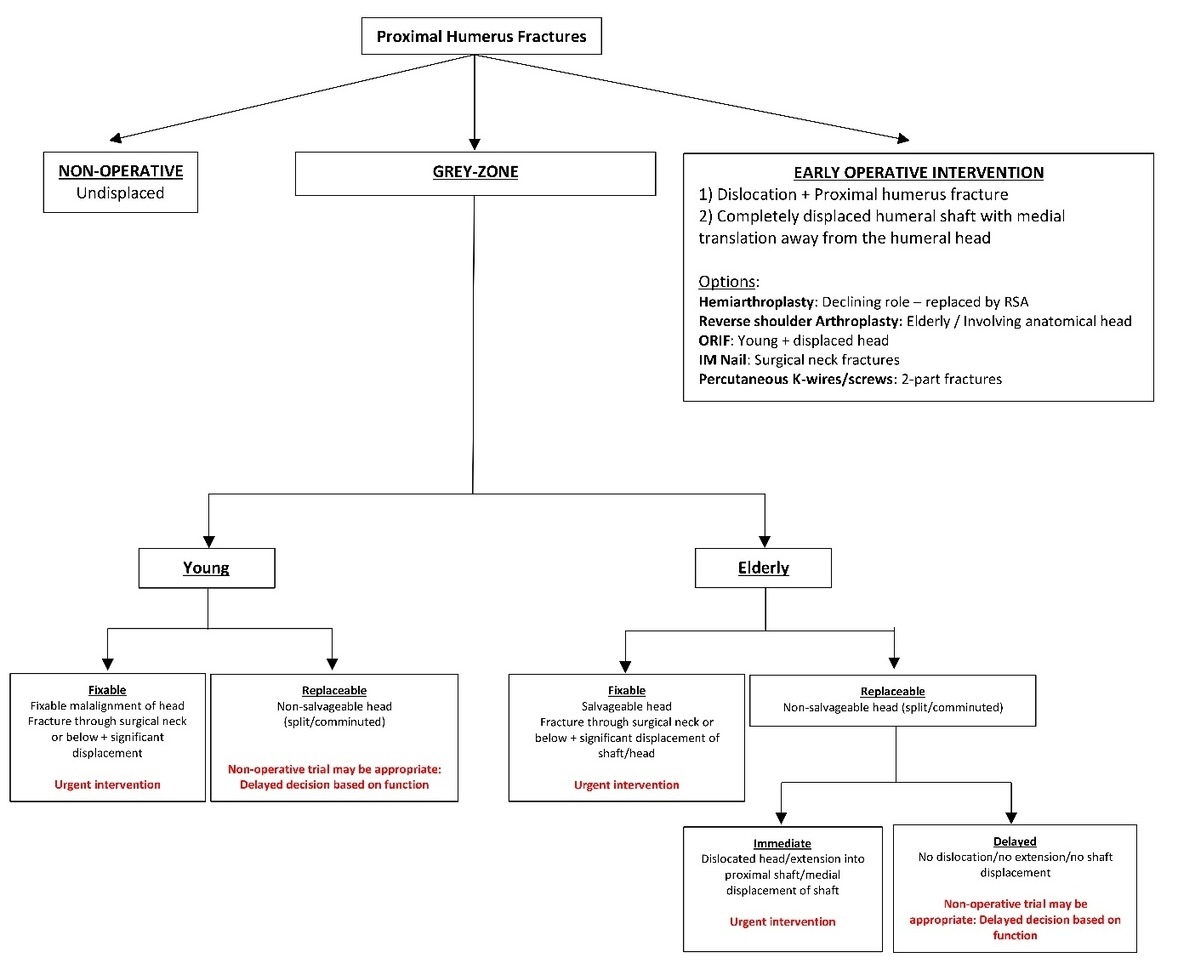
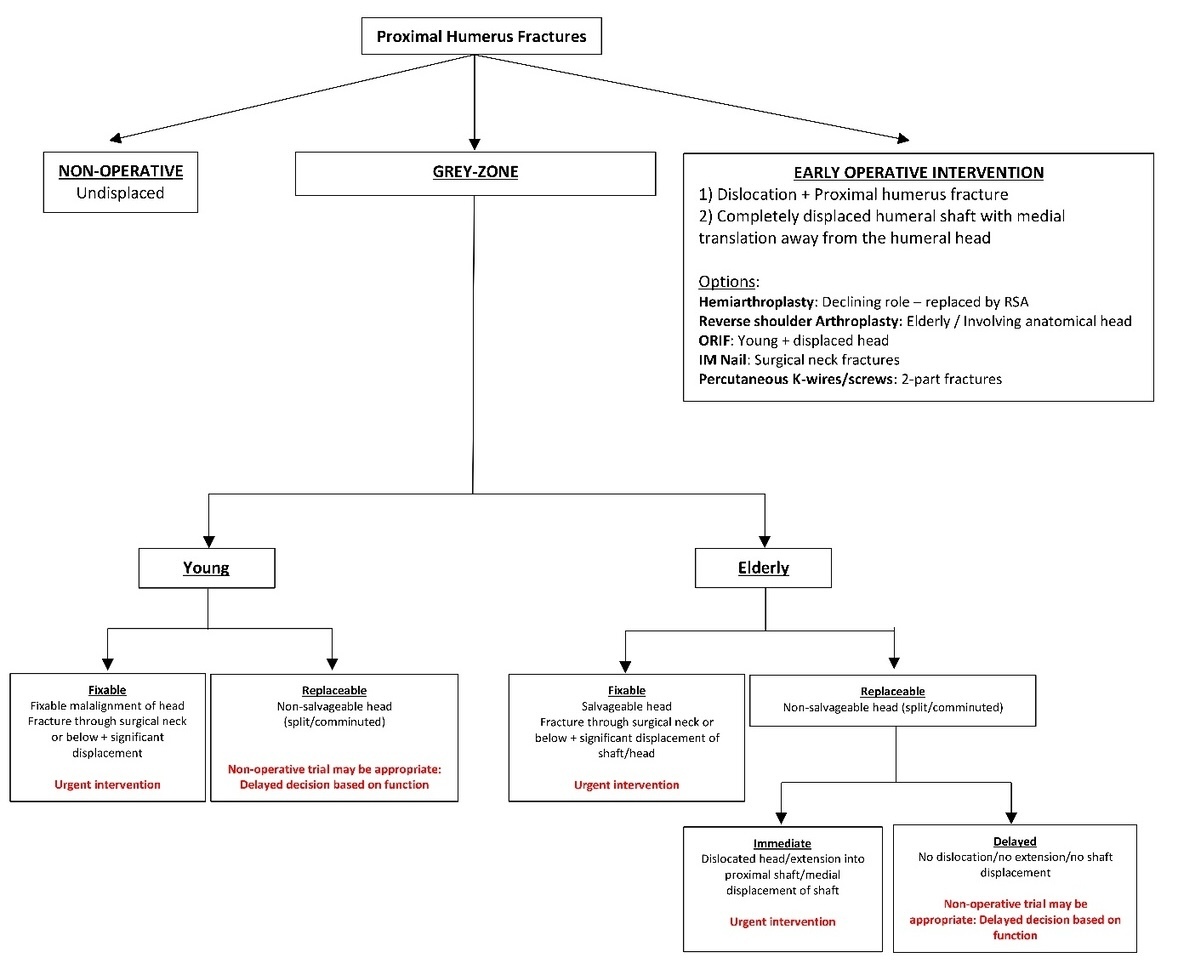
A pragmatic, clinically driven stratification of proximal humerus fractures can aid decision-making beyond traditional classification systems. Figure 1 highlights a clinically applicable approach to proximal humerus fracture management based on current evidence. Given the heterogeneity of proximal humerus fractures, it is designed to complement existing classification systems and be a useful tool in guiding management of these complex and nuanced fractures.
Undisplaced fractures are usually managed non-operatively, with predictable outcomes and thus minimal role for surgical intervention.8 A subset of injuries, however, usually require urgent surgical management. These include fracture-dislocations of the humeral head and cases where the humeral shaft is completely displaced from the humeral head, where the shaft is often pulled medially by the pectoralis major. These patterns represent biomechanically unstable injuries with a high risk of complications and are typically managed with early surgical intervention, most commonly via RSA in elderly patients or where there is significant articular involvement. Although RSA itself may not traditionally be considered a time-critical procedure, delayed intervention in these fracture patterns can result in significant soft tissue contraction around the displaced shaft fragment, thereby increasing technical difficulty and potentially predisposing the prosthesis to complications such as postoperative instability or dislocation.27
The majority of other proximal humerus fractures fall within a “grey zone,” characterized by comminuted or displaced fractures in which the humeral head remains in continuity with the shaft. The PROFHER trial demonstrated that operative management of these fractures does not confer superior functional outcomes at two years compared with non-operative treatment.8 In such cases, an initial trial of non-operative management with short-term immobilisation is reasonable, followed by reassessment. Decision-making should be guided by patient age, fracture morphology, and functional requirements.
Young patients with fractures amenable to fixation and high functional demands may benefit from early surgical intervention, as achieving anatomical reduction and stable fixation can optimise shoulder mechanics, preserve range of motion, and support a faster return to high-level activities.28
Management of complex proximal humerus fractures in young patients is individualized, with a general preference for humeral head preservation where reconstruction is feasible. Non-operative treatment may be appropriate in selected cases, particularly when acceptable alignment can be maintained, or when surgical fixation is considered unlikely to succeed and may instead expose the patient to an early hemiarthroplasty or reverse shoulder arthroplasty. In these cases, management is directed toward the sequelae of fracture healing. Based off current evidence, early conservative management which preserves native cartilage and minimizes iatrogenic disruption of blood supply, may lead to satisfactory functional outcomes.29 Should these patients develop post-fracture stiffness or impingement from a prominent greater tuberosity malunion, image-guided hydrodistension or subsequent arthroscopic capsular release and subacromial decompression may then be considered to restore motion.30
In elderly patients with significantly displaced proximal humeral fractures, treatment should be individualized according to fracture morphology, bone quality, physiological age, and functional demand. Where the humeral head is non-reconstructable, particularly in fractures with extension into the surgical neck or proximal shaft, early RSA may be favoured, as this generally achieves better outcomes than delayed salvage arthroplasty and avoids some of the technical challenges associated with fracture sequelae such as malunion, non-union, bone loss, tuberosity distortion and failed prior fixation.27 However, not all elderly patients with complex fractures require immediate arthroplasty. In selected lower-demand patients without severe pain or profound functional deficit, an initial period of nonoperative management with close follow-up may be appropriate.31 Delayed RSA can then be reserved for those who develop persistent pain or disabling loss of active elevation (pseudoparalytic pattern).
This stratified, evidence-informed approach emphasises two key principles: prioritising biological preservation in younger patients and timely intervention in elderly patients with fracture patterns that compromise future reconstructive options, with non-urgent cases offered an opportunity to demonstrate functional improvement to avoid the risks associated with surgical intervention. This represents a pragmatic, clinically applicable framework for proximal humerus fracture management. It utilises current evidence to facilitate individualized decision-making and optimize functional outcomes whilst minimizing unnecessary surgical risks.
Future Directions
The management of proximal humerus fractures continues to evolve, driven by advances in imaging, surgical techniques, and implant technology, as well as a growing emphasis on patient-centred care. Future research should aim to refine operative indications, particularly for complex, multi-part fractures in young, high-demand patients, through high-quality, prospective trials stratified by fracture morphology, age, bone quality, and functional requirements.
In elderly patients, innovations in RSA, including stemless implants, alongside optimized rehabilitation protocols, may further improve outcomes while minimizing complications. The integration of biomarkers,32 advanced imaging,33 and AI-assisted analytics,34 represents a promising avenue to tailor management, balancing fracture biology, surgical risk, and functional recovery in both young and elderly populations.
Limitations
As a narrative review, this review does not employ a formal systematic methodology or quantitative meta-analysis, introducing potential selection bias in the literature included. Although a structured search of major databases was undertaken, the absence of formal risk-of-bias assessment limits the ability to compare study quality directly. The evidence for proximal humerus fracture management remains heterogeneous, with variability in fracture classification, patient populations, surgical techniques and follow-up duration across studies, limiting direct comparison. Treatment recommendations also rely on retrospective studies, expert opinion, and interpretation of existing trials where high-quality randomised evidence remains limited, particularly in complex fracture patterns in younger patients. Finally, the proposed management framework is intended as a pragmatic, evidence-informed adjunct to clinical decision-making and requires prospective validation.
Conclusion
A pragmatic, clinically driven stratification of proximal humerus fractures can aid decision-making and complement traditional classification systems. Undisplaced fractures are reliably managed non-operatively, while fracture-dislocations and cases in which the humeral shaft is completely displaced and translated medially, represent biomechanically unstable injuries usually requiring early surgical intervention. Most other fractures fall within a “grey zone”. Young patients with fixable fractures and high functional demands may benefit from early fixation, whereas complex, non-salvageable fractures may heal satisfactorily with conservative treatment. Elderly patients with non-salvageable humeral heads extending into the surgical neck benefit from early arthroplasty, while delayed intervention is appropriate in selected cases. Future directions include integration of AI-assisted advanced imaging and patient-specific predictive analytics to further individualize management and optimize outcomes. Further studies are required to refine stratified treatment algorithms and validate long-term functional benefits.
Funding and sponsorship
This research received no specific grant from any funding agency in the public, commercial, or not-for-profit sectors.
Data availability statement
No new data were generated or analysed in this study.
Ethics Approval and Consent to Participate
Ethical approval was not required for this narrative review as no human participants, patient data, or identifiable information were involved.
Patient Consent
Not applicable
Conflict of Interest
The authors declare that they have no conflict of interest
AI Declaration
We have not used any AI tools or technologies to prepare this manuscript.
Author Contributions (CRediT)
Umair Baig: Conceptualization, Methodology, Investigation, Data curation, Formal analysis, Writing – original draft, Writing – review & editing, Visualization.
Basel Balbisi: Supervision, Conceptualization, Methodology, Validation, Writing – review & editing
Reece Patel: Conceptualization, Methodology, Investigation, Data curation, Formal analysis, Writing – review & editing.
Daoud Makki: Supervision, Conceptualization, Methodology, Validation, Writing – review & editing.
Co-first authorship: Umair Baig and Reece Patel contributed equally to this work and should be considered co-first authors.