
Introduction
Epidural steroid injections (ESIs) are among the most commonly performed interventional procedures for the management of spinal pain.1,2 These injections are typically performed using interlaminar, transforaminal, or caudal approaches to access the epidural space and commonly involve a combination of local anesthetic and corticosteroid.3–5 Corticosteroids exert their therapeutic effect by inhibiting arachidonic acid metabolism, thereby reducing the production of pro-inflammatory mediators such as prostaglandins and leukotrienes.6
Corticosteroids used in ESIs can be broadly categorized as particulate (e.g., triamcinolone, methylprednisolone) or non-particulate (e.g., dexamethasone) based on their solubility and aggregation characteristics. Particulate steroids form larger aggregates, raising concern for vascular occlusion if inadvertently injected intravascularly.7,8 In contrast, non-particulate steroids remain in solution and are less likely to embolize. These differences have been implicated in rare but catastrophic neurological complications, including spinal cord infarction and stroke.9
The comparative efficacy of particulate versus non-particulate steroids remains inconclusive. Some studies suggest improved pain relief with particulate steroids.10–12 However other studies demonstrate equivalent or even superior outcomes with non-particulate formulations.13 Most evidence indicates no clinically significant difference in pain relief between steroid types.14–16
In contrast, safety concerns are more clearly defined. Multiple reports have documented severe neurological complications associated with particulate steroid use, particularly in transforaminal approaches.9,16–21 These findings led to a U.S. Food and Drug Administration (FDA) warning regarding serious neurologic adverse events following ESIs.22
Despite evolving evidence and safety recommendations, variability in physician practice patterns persists.23 Physician perception of steroid efficacy likely plays a significant role in clinical decision-making. However, there is limited literature specifically evaluating clinician beliefs regarding particulate versus non-particulate steroid effectiveness. This study aims to assess physician perceptions of steroid efficacy in ESIs.
Methods
A cross-sectional, survey-based study was conducted to evaluate physician perceptions regarding the comparative efficacy of particulate versus non-particulate corticosteroids in ESIs. The survey instrument was developed by a panel of board-certified interventional pain physicians with expertise in spinal interventions. The questionnaire was designed to address clinically relevant topics within the interventional pain community. The study protocol was reviewed and approved by the Institutional Review Board (IRB) at The University of Texas Health Science Center at Houston (HSC-MS-23-0490). All procedures were conducted in accordance with the ethical standards of the Declaration of Helsinki and its subsequent amendments.
The survey was distributed over a three-month period from March 1 to May 31, 2024, using electronic platforms, including email distribution lists and professional networks, targeting physicians involved in interventional pain management in both academic and private practice settings. Participation was voluntary and anonymous. The first page of the survey included a description of the study purpose and served as implied informed consent. Respondents were informed that participation was optional and that they could exit the survey at any time.
For the purpose of this analysis, responses to the following key question was evaluated:
“In clinical practice, do you believe that particulate steroids provide longer pain relief in epidural steroid injections compared to non-particulate steroids?”
This question was selected for focused analysis because steroid selection in epidural steroid injections remains an area of substantial clinical interest, ongoing discussion, and practice variability. Although non-particulate steroids are increasingly favored in higher-risk settings because of safety considerations, physician perceptions regarding the comparative duration of benefit between particulate and non-particulate formulations remain highly divided. Given the clinical importance of this issue and the degree of variability observed in the survey data, we elected to analyze and report this topic separately to allow for a more detailed discussion of physician perception, safety considerations, efficacy data, and implications for shared decision-making. Additional findings from the broader survey instrument addressing other epidural steroid injection practice patterns will be analyzed and reported separately.
Results
Survey responses were collected over a three-month period from March 1 to May 31, 2024. The survey was disseminated electronically to physicians practicing interventional pain medicine through a combination of academic mailing lists and online professional platforms, including social media. Due to the use of multiple distribution channels and open-access survey links, the total number of individuals who received or viewed the survey could not be determined. As a result, an accurate response rate cannot be calculated, and analysis is limited to respondents who completed the survey. Despite this limitation, the data provide meaningful insight into current physician perspectives and practice variability within the interventional pain community.
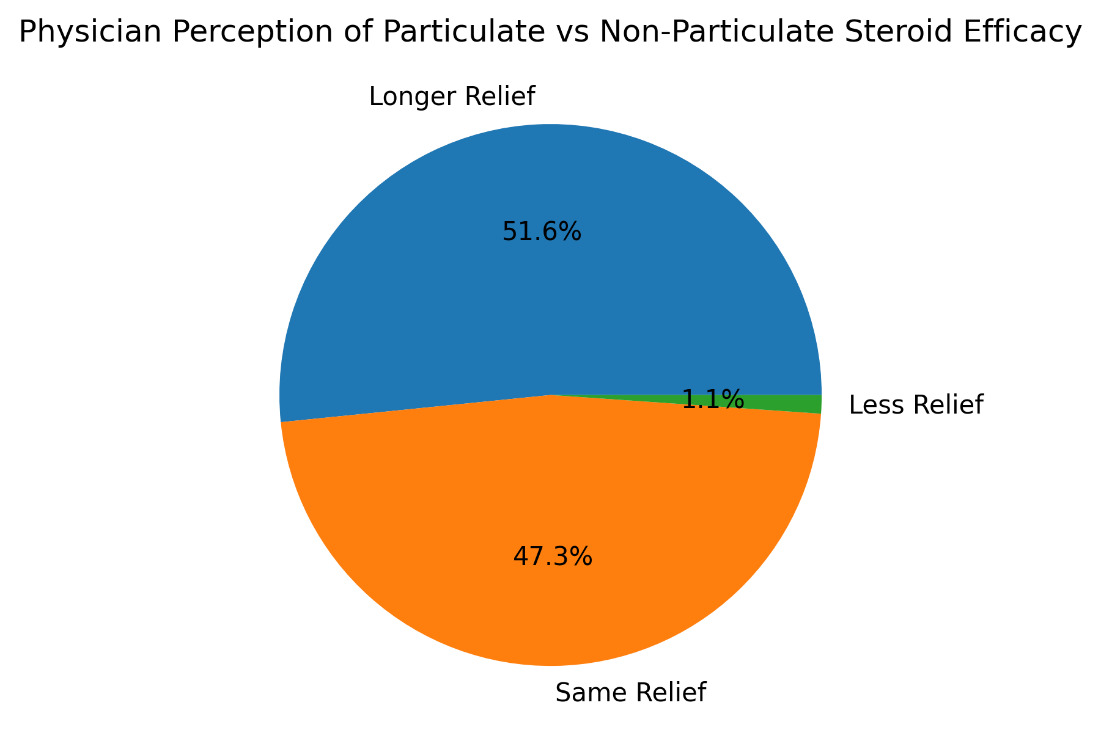
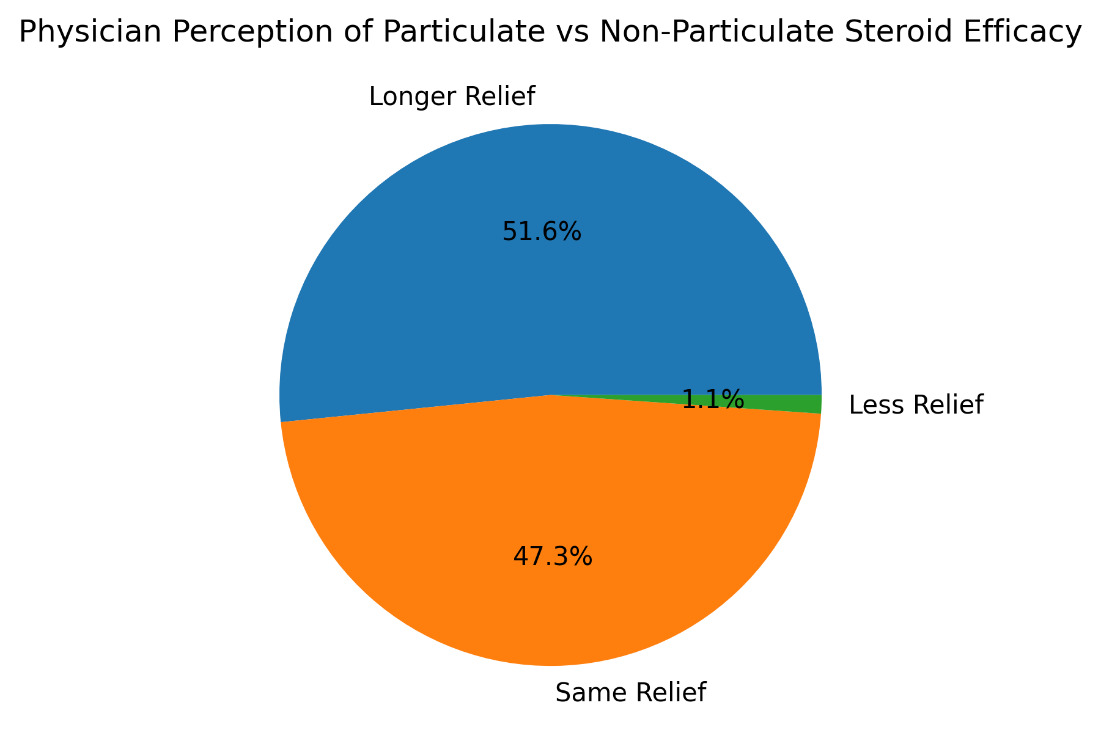
A total of 93 physician responses were collected during the study period, with 3 responses skipped for the primary question of interest. Among respondents who answered the question, the majority reported that particulate steroids provide either longer or equivalent pain relief compared to non-particulate steroids.
Specifically, 48 of 93 respondents (51.6%) indicated that they believe particulate steroids provide longer duration of pain relief. Forty-four respondents (47.3%) reported that particulate steroids provide similar duration of relief compared to non-particulate steroids. Only 1 respondent (1.1%) believed that particulate steroids provide less effective pain relief.
Overall, these findings demonstrate that nearly all respondents (98.9%) perceive particulate steroids to be at least equivalent, if not superior, in terms of duration of analgesic effect when compared to non-particulate formulations. The data is presented in Table 1 and Figure 1.
Discussion
This study demonstrates that most physicians perceive particulate steroids to provide either equivalent or longer-lasting pain relief compared to non-particulate steroids in ESIs, with a slight majority favoring particulate formulations. Very few physicians believe particulate steroids provide inferior analgesia. These findings are consistent with the broader literature, which generally demonstrates comparable efficacy between steroid types, with occasional trends favoring particulate steroids in certain outcomes.11–16
Multiple comparative studies have reported no statistically significant difference in pain relief between particulate and non-particulate steroids.11,12,14–16 Some studies demonstrate modest short-term advantages with particulate steroids.10,12 Though one study does suggest improved outcomes with non-particulate formulations.13 The heterogeneity of study design, injection technique, and outcome measures likely contributes to these inconsistencies and may influence physician perception.
Safety considerations remain of particular importance and of interest. Although ESIs are generally safe, rare but severe neurological complications including spinal cord infarction, stroke, and paralysis have been reported, most commonly associated with particulate steroid use.8,9,17–22 Proposed mechanisms include arterial embolization of particulate material, vascular injury, and vasospasm.19–21,24 These concerns have led to consensus recommendations advocating for risk mitigation strategies, including preferential use of non-particulate steroids in high-risk procedures such as cervical transforaminal injections.21,25,26 Recent survey data suggest increasing adherence to these safety recommendations, with the majority of physicians reporting routine use of non-particulate steroids in higher-risk settings.27 However, meaningful variability persists in clinical practice, likely reflecting differences in training, regional practice patterns, institutional protocols, perceived efficacy, and individual physician experience.5,28–32
Although non-particulate steroids are generally favored in anatomically higher-risk injections because of their safety profile, some clinicians may still consider particulate formulations in selected cases after careful risk-benefit assessment. Existing evidence suggests that outcomes between particulate and non-particulate steroids are often comparable, while the rare but catastrophic neurologic complications associated with particulate steroid use remain an important safety concern, particularly in higher-risk transforaminal injections. Therefore, a cautious approach is warranted, and non-particulate steroid should generally be preferred when procedural anatomy or vascular risk raises concern. Importantly, the continued use of particulate steroid in selected clinical scenarios should not, by itself, be interpreted as practice outside the standard of care. Rather, our findings suggest that steroid selection remains an area of individualized clinical judgment, particularly when physicians weigh perceived duration of benefit, patient-specific factors, anatomic risk, and procedural indication. However, this judgment must be balanced against the well-recognized safety concern that catastrophic neurologic injury from embolic phenomena has been implicated in association with particulate steroid use in transforaminal settings, particularly when inadvertent intra-arterial injection occurs.
Ultimately, steroid selection should be guided by individualized patient factors, procedural risk stratification, and shared decision-making. Thorough informed consent is essential, especially when considering the use of particulate steroids in higher-risk settings, to ensure patients are aware of both potential benefits and associated risks. This approach recognizes the preference for non-particulate steroid in many settings while acknowledging that selective particulate steroid use, may still fall within the range of accepted clinical practice.
Limitations
This study has several limitations that should be considered when interpreting the findings. Primarily, the distribution of the survey across multiple platforms precluded calculation of an accurate response rate, limiting assessment of representativeness.
Second, the study evaluates physician perceptions rather than objective clinical outcomes. As such, the findings reflect beliefs and practice tendencies rather than measured differences in efficacy between particulate and non-particulate steroids. These perceptions may be influenced by individual training background, regional practice patterns, anecdotal experience, or interpretation of the literature.
Third, the focus was on a single primary question regarding perceived duration of pain relief, which limits the depth of analysis. Additional factors that may influence steroid selection, such as safety considerations, injection approach, patient-specific risk factors, and procedural setting. However, this was not directly assessed in this analysis.
Finally, given the cross-sectional nature of the study, causality cannot be established, and the results should be interpreted as hypothesis-generating. Future studies incorporating larger, more diverse physician populations and correlating perceptions with real-world clinical outcomes are needed to better understand the relationship between steroid selection, physician beliefs, and patient outcomes.
Despite these limitations, this topic remains widely debated in everyday clinical practice. The findings of this study highlight that, as a specialty, physicians are not unified in their beliefs regarding the comparative efficacy of particulate versus non-particulate steroids. The near-even distribution of responses demonstrates meaningful variability in perception, which likely translates into differences in real-world practice patterns. This underscores the value of capturing clinician perspectives, as real-world decision-making is often influenced not only by published evidence but also by experience, training, and individual risk tolerance. Understanding this variability is important, as it reflects the complexity of balancing efficacy and safety in clinical care and highlights the need for continued research to better align evidence-based guidelines with everyday practice.
Conclusion
In this survey-based study, most physicians perceive particulate steroids to provide either equivalent or longer duration of pain relief compared to non-particulate steroids in epidural steroid injections. Despite this perception, current evidence suggests largely comparable efficacy between steroid formulations, with no consistent or clinically significant differences in outcomes across most studies.
The findings highlight an important gap between physician perception and the existing literature, as well as ongoing variability in clinical practice. Ultimately, these results underscore the importance of continued efforts to standardize practice patterns, improve education, and integrate new evidence into clinical decision-making. Further prospective studies correlating physician perceptions with patient outcomes are needed to better inform optimal steroid selection in epidural steroid injections.
Funding
This study received no funding or financial support from any external sources.
Institutional Review Board Statement
The study was conducted in accordance with the Declaration of Helsinki, and approved by the by the Institutional Review Board (IRB) at The University of Texas Health Science Center at Houston (IRB Number: HSC-MS-23-0490; approval date: 2 January 2024).
Informed Consent Statement
A statement outlining the purpose of this study was emailed to participants and included at the beginning of the study. Participation was voluntary and anonymous, and formal written consent was not required due to the nature of data collection.
Data Availability Statement
The original contributions presented in this study are included in the article. Further inquiries can be directed to the corresponding author.
Conflicts of Interest
The authors declare no relevant conflicts of interest related to this study.