
INTRODUCTION
Olecranon fractures are common intra-articular injuries of the elbow, accounting for approximately 10% of elbow fractures and occurring across a broad age spectrum.1,2 The olecranon plays an essential role in elbow extension and joint stability; therefore, displaced fractures frequently require surgical fixation to restore anatomical alignment, preserve joint congruity, facilitate early mobilization, and reduce the risk of long-term complications such as stiffness and post-traumatic arthritis.1 Epidemiological studies have shown that olecranon fractures commonly occur in older adults following low-energy falls, particularly among elderly women, while younger patients are more likely to sustain injuries related to high-energy trauma such as road traffic accidents.3,4 Simple displaced and stable fracture patterns, particularly Mayo type 2A fractures, represent the most frequently encountered injury configuration in clinical practice.2,3
Among the available surgical techniques, tension band wiring (TBW) has long been considered the standard treatment method for simple displaced olecranon fractures.5,6 The biomechanical principle of TBW converts tensile forces generated by the triceps muscle into compressive forces at the fracture site, thereby promoting fracture stability and bone union during elbow movement.1 Previous studies have demonstrated that TBW can provide satisfactory fracture healing, favorable Mayo Elbow Performance Scores, effective pain relief, and high rates of good-to-excellent functional outcomes.1,6 However, despite these advantages, TBW is also associated with several hardware-related complications, including implant irritation, infection, symptomatic prominence, and the need for secondary implant removal procedures.7,8 Comparative studies and meta-analyses have reported that although TBW and plate fixation may achieve similar functional outcomes, TBW is often associated with higher complication and reoperation rates.8,9
Functional recovery following olecranon fracture fixation is influenced not only by fracture union but also by fracture morphology, quality of reduction, elbow stability, rehabilitation practice, and patient-related factors.10,11 In elderly patients, frailty, duration of immobilization, and treatment approach may substantially affect postoperative elbow motion and disability.12,13 Nevertheless, evidence specifically evaluating clinical, radiographic, and patient-centered outcomes in patients treated with TBW remains limited, particularly regarding factors associated with postoperative functional recovery and patient satisfaction. Therefore, this study was conducted to evaluate the clinical, radiographic, and functional outcomes of olecranon fractures treated with tension band wiring and to identify factors associated with postoperative functional recovery and patient satisfaction.
MATERIALS AND METHOD
Ethical Considerations
The study complied with ethical principles that all methods and procedures involving human data in this study were performed in accordance with the relevant guidelines and regulations, including the Declaration of Helsinki. Written informed consent was obtained from all participants and the parents or legal guardians participant before data collection. All collected information was anonymized and used solely for research purposes. This study was approved by the Institutional Review Board / Science and Technology Committee of Thai Binh University of Medicine and Pharmacy (Approval Institutional Decision Number: 821/QĐ-YDTB , Date: April 23, 2026).
Study Design
This study was conducted using a retrospective–prospective cross-sectional descriptive design to evaluate the clinical, radiographic, and functional outcomes of patients with olecranon fractures treated surgically using the tension band wiring technique.
Setting
The study was carried out at the Department of Orthopedic Trauma and Burns, Thai Binh General Hospital, located at 530 Ly Bon Street, Tran Lam Ward, Hung Yen Province, Vietnam. Data collection and patient follow-up were conducted from January 2026 to June 2026. The study included patients who underwent surgery between January 2023 and December 2025 and were followed for a minimum duration of 6 months after surgery.
Participants
The study population consisted of patients diagnosed with olecranon fractures who underwent surgical fixation using the tension band wiring method at Thai Binh General Hospital. Eligible participants were aged ≥18 years and had complete medical records, radiographic films, laboratory investigations, and operative reports. Patients were required to have complete study-related information according to the standardized data collection form and provide consent to participate in the study.
Patients were excluded if they had incomplete retrospective medical records, multiple trauma or concomitant fractures, pre-existing sequelae of the affected upper limb such as elbow stiffness, muscle atrophy, or deformity, or open olecranon fractures.
Study Size
A total sampling approach was applied in this study. All patients who met the eligibility criteria during the study period were included. In total, 82 patients fulfilled the inclusion criteria and were enrolled in the final analysis.
Variables
The study variables included demographic characteristics such as age, sex, injured side, cause of injury, and injury mechanism. Fracture-related and treatment-related variables included Mayo fracture classification and radiographic reduction outcomes. Postoperative follow-up variables included wound healing, rehabilitation practice, postoperative follow-up duration, elbow joint function, and postoperative complications.
Functional and satisfaction outcomes were assessed using the Oxford Elbow Score (OES). The OES is a patient-reported outcome measure widely used in orthopedic studies to evaluate pain, elbow function, and psychosocial impact associated with elbow disorders. Each item is scored using a 5-point Likert scale ranging from 0 to 4 points, where 0 represents the worst condition and 4 represents the best condition. The total OES ranges from 0 to 48 points, with higher scores indicating better elbow function. Outcomes were categorized as follows: 40–48 points, very satisfied; 30–39 points, satisfied; 20–29 points, moderate; and <20 points, poor.
In addition to the total OES score, individual OES domains, including pain, function, and psychosocial status, were analyzed separately. Each domain score ranged from 0 to 16 points and was classified into four levels: 14–16 points, excellent; 11–13 points, good; 8–10 points, fair; and <8 points, poor.
Data Sources and Measurement
Data were collected from hospital medical records, operative reports, radiographic films, and structured study questionnaires. Retrospective clinical information was extracted from patient records, while prospective postoperative follow-up information was obtained through outpatient reassessment and direct patient interviews during follow-up visits.
Radiographic reduction outcomes were evaluated using postoperative X-ray images. Functional outcomes were assessed using the Mayo Elbow Performance Score (MEPS) and the Oxford Elbow Score (OES). Rehabilitation practices and patient satisfaction were evaluated using standardized follow-up questionnaires administered during postoperative follow-up.
Bias
Several measures were implemented to minimize potential sources of bias. Standardized data collection forms were used for all participants to ensure consistency of information. Patients with incomplete medical records or associated injuries that could affect functional outcomes were excluded from the study. In addition, validated assessment tools, including the OES and MEPS, were used to improve the reliability and objectivity of postoperative functional evaluations. All patients were followed for at least 6 months after surgery to ensure adequate assessment of treatment outcomes.
Quantitative Variables
Continuous variables, including age and functional scores, were summarized using means and standard deviations. Quantitative OES scores were further categorized into clinically meaningful groups according to predefined cutoff values to facilitate interpretation of postoperative functional recovery and patient satisfaction.
Statistical Methods
Data were entered, coded, and analyzed using SPSS version 22.0. Descriptive statistics were used to summarize demographic, clinical, radiographic, and functional characteristics. Categorical variables were presented as frequencies and percentages, while continuous variables were expressed as mean ± standard deviation.
The Chi-square (χ2) test was used to compare categorical variables and evaluate associations between fracture classification, rehabilitation practice, elbow mobility, patient satisfaction, and OES outcomes. A p-value of less than 0.05 was considered statistically significant.
Cases with incomplete data were excluded during the participant selection process; therefore, no imputation methods for missing data were required. No subgroup analyses, interaction analyses, or sensitivity analyses were performed in the present study.
Ethical Approval
The study was approved by the Scientific and Ethics Committee of Thai Binh University of Medicine and Pharmacy under Decision No. 821/QD-YDTB and was conducted with permission from the Board of Directors of Thai Binh General Hospital. All surgical procedures used in the study had previously been approved by the hospital’s professional council. All participants were fully informed regarding the objectives, contents, and benefits of the study before enrollment. Participation was voluntary, and patients had the right to refuse or withdraw from the study at any time without affecting their treatment process. All personal information and medical records were kept strictly confidential and used solely for scientific research purposes. Collected data were anonymized and coded before analysis. The study did not alter routine treatment procedures or introduce any additional intervention or risk to the participants. Data collection, outcome assessment, and statistical analysis were performed objectively and accurately to ensure scientific validity and integrity.
RESULTS
The demographic and injury characteristics of the study population are presented in Table 1. The mean age of the patients was 46.9 ± 22.6 years, with the >60-year age group accounting for the highest proportion (39.0%). Male patients predominated (56.1%). Traffic accidents were the most common cause of injury (56.1%), and all cases resulted from direct trauma.
Postoperative complications and radiographic reduction outcomes are summarized in Table 2. Only a small proportion of patients experienced delayed union after surgery (2.4%), while no cases of nonunion, osteomyelitis, myositis ossificans, or osteoarthritis were observed. Most patients achieved satisfactory radiographic reduction with complete correction of displacement (92.7%).
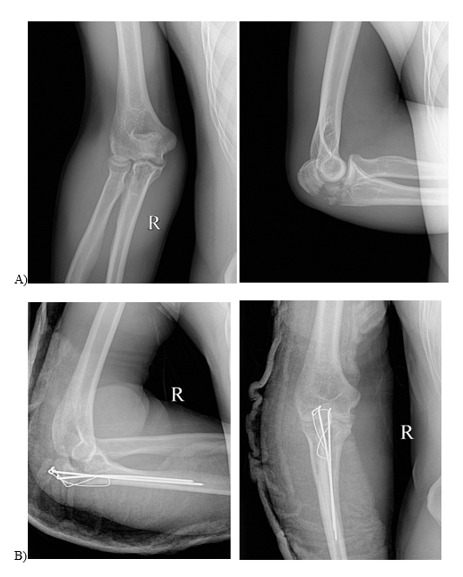
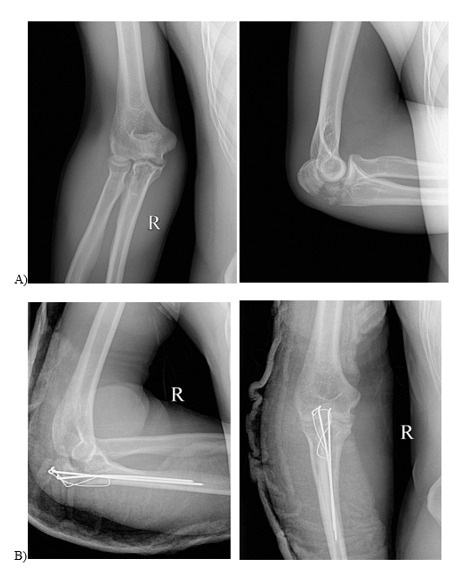
Figure 1 presents the preoperative and postoperative radiographic findings of a right olecranon fracture treated with tension band wiring. Preoperative radiographs demonstrated a displaced olecranon fracture, while postoperative images showed satisfactory fracture reduction and stable fixation with tension band wiring.
Functional outcomes of the elbow joint after surgery are shown in Table 3. Most postoperative patients achieved good-to-excellent functional outcomes. Pain was generally mild, and the majority of patients obtained favorable Mayo Elbow Performance Score (MEPS) results.
Factors associated with functional rehabilitation outcomes according to the Oxford Elbow Score (OES) are presented in Table 4. Patients with higher satisfaction levels generally demonstrated better OES outcomes, and this association was statistically significant (p = 0.013). Patients who underwent guided rehabilitation or rehabilitation at medical facilities tended to achieve better OES outcomes; however, the difference was not statistically significant. Similarly, better elbow mobility according to MEPS was associated with higher OES scores, although the difference did not reach statistical significance.
DISCUSSION
The present study evaluated the clinical, radiographic, and functional outcomes of olecranon fractures treated using tension band wiring. Most patients achieved favorable radiographic reduction and postoperative elbow function, while postoperative complications were relatively uncommon. In addition, patient satisfaction appeared to be associated with Oxford Elbow Score outcomes, whereas rehabilitation practice and MEPS-based elbow mobility showed less clear relationships with postoperative OES classification.
Only a small proportion of patients developed delayed union, and no cases of nonunion, osteomyelitis, myositis ossificans, or osteoarthritis were observed during follow-up. These findings appear lower than those reported in several previous studies in which complication or reoperation rates after tension band wiring ranged from approximately 20% to 60%, often related to implant irritation or hardware prominence rather than biological failure of fracture healing.7,14–17 Similarly, systematic reviews have described post-traumatic osteoarthritis in a notable proportion of patients after olecranon fracture fixation, particularly in the presence of instability or comminution.11,17 The relatively low complication profile in the current study may partly reflect the inclusion of selected fracture patterns suitable for tension band wiring, acceptable surgical reduction, and the relatively limited duration of follow-up.
Radiographic outcomes in the present study were generally favorable, with most patients achieving complete correction of displacement. Functional recovery was also encouraging, as the majority of patients demonstrated good-to-excellent elbow function, forearm rotation, pain outcomes, and MEPS scores. These findings are comparable with previous reports showing satisfactory elbow motion and high functional scores following olecranon fracture fixation with either tension band wiring or plate fixation.5,7,15,18 Randomized trials and observational studies have suggested that when stable fixation and acceptable reduction are achieved, postoperative elbow function may remain favorable despite small residual radiographic incongruities.9,14 This may explain why the majority of patients in the present cohort maintained satisfactory elbow performance after surgery.
The relationship between patient satisfaction and OES outcomes observed in this study is consistent with the patient-centered nature of the Oxford Elbow Score. OES directly reflects subjective perceptions of pain, daily function, and psychosocial impact, which are closely related to how patients evaluate treatment success.14 In contrast, rehabilitation approach and clinician-rated elbow mobility according to MEPS were not clearly associated with postoperative OES classification. Previous studies have also suggested that subjective disability, pain perception, and individual expectations may influence patient-reported outcomes more strongly than isolated radiographic or clinician-based assessments.14,19 Therefore, functional evaluation after olecranon fracture fixation may benefit from combining objective clinical assessment with patient-reported outcome measures.
Another notable finding was that most patients in the study were older adults, while traffic accidents remained the leading cause of injury. Previous epidemiological studies have shown that olecranon fractures commonly occur in elderly individuals after low-energy falls, particularly among women, whereas younger patients more frequently sustain injuries related to high-energy trauma such as road traffic accidents.3,4 The relatively high proportion of traffic-related injuries in the present study may reflect local injury patterns and demographic characteristics within the study population.
From a practical perspective, the findings suggest that tension band wiring remains an appropriate option for selected olecranon fractures, particularly simple displaced patterns with preserved stability. Acceptable radiographic reduction and careful surgical technique may contribute to favorable postoperative elbow function and a relatively low rate of major complications. The association between OES and patient satisfaction also highlights the value of incorporating patient-reported outcome measures into routine postoperative follow-up and counseling, as these tools may better capture the patient’s perspective regarding pain relief and functional recovery.
Several limitations should be considered when interpreting the results of this study. First, the study was conducted at a single center with a relatively modest sample size, which may limit the generalizability of the findings. Second, the retrospective–prospective design may introduce selection bias and information bias related to medical record completeness. Third, the follow-up duration may not have been sufficient to fully evaluate late complications such as post-traumatic osteoarthritis or long-term implant-related symptoms. In addition, the study did not include a comparison group treated with alternative fixation techniques such as plate fixation, limiting direct comparison between treatment methods. Future studies with larger multicenter cohorts, longer follow-up periods, and comparative designs may provide additional insight into long-term functional outcomes and patient-reported recovery after olecranon fracture fixation.
CONCLUSION
Tension band wiring for olecranon fractures achieved favorable radiographic reduction and postoperative elbow function with a low rate of major complications in this study. Most patients demonstrated good-to-excellent functional recovery, and patient satisfaction appeared to be more closely associated with Oxford Elbow Score outcomes than with clinician-based functional assessment or rehabilitation approach. These findings support the continued use of tension band wiring in appropriately selected olecranon fractures.
Acknowledgments
None
Corresponding Author
Assoc. Prof. Hai Vu Minh, PhD
Department of Trauma
Thai Binh University of Medicine and Pharmacy
Hung Yen, 17000, Vietnam
Email: vuminhhai777@gmail.com
Mobie: 0338126299
ORCID: 0000-0002-7439-3862
Authorship contribution
Hai Vu Minh: Data curation, Project administration, Investigation, Writing – Review & Editing
Anh Doan Van: Resources, Validation, Writing – Review & Editing
Duc Nguyen Minh: Methodology, Conceptualization, Writing – Review & Editing
Tu Pham Duc: Formal analysis, Data curation, Writing – Review & Editing
Bach Pham Xuan: Formal analysis, Visualization, Writing – Review & Editing
Chau Nguyen Minh: Supervision, Methodology, Writing – Review & Editing
Nam Phan Thanh: Data curation, Resources, Writing – Review & Editing
Nam Duong Nhu: Project administration, Investigation, Writing – Review & Editing
Giang Doan Truong: Investigation, Methodology, Writing – Review & Editing
Dung Nguyen Van: Resources, Data curation, Writing – Review & Editing
Tai Nguyen Duc: Visualization, : Project administration, Writing – Review & Editing
All authors reviewed and approved the final manuscript.
Conflict of Interest
The authors declare that they have no conflicts of interest to disclose relative to this article.
Funding
This research did not receive any specific grant from funding agencies in the public, commercial, or not-for-profit sectors.