
1. INTRODUCTION
Fractures of the upper extremities are among the most common musculoskeletal injuries in the pediatric population, accounting for up to 75% of all pediatric fractures.1 In cases of open fractures, instability, displacement, or failed conservative management, the rate of nonunion or malunion increases, necessitating operative intervention.2,3 Traditionally, operative fixation of pediatric fractures has relied on metallic implants. Intramedullary fixation using titanium elastic nails (TENs) offers significant mechanical strength and stability, while percutaneous Kirschner wires (K-wires) are often indicated for small bones and fractures near joints, with advantages related to reduced invasiveness, low cost, and ease of use.4 However, metallic implants often necessitate a secondary surgery for hardware removal. In addition, they expose patients to potential complications in the form of soft tissue irritation, implant migration, infection, and injury to the growth plate or neurovascular structures.5,6 In response to these challenges, resorbable implants made of polyglycolide (PGA) or polylactide (PLA) have emerged as a novel alternative.7 These implants are designed for improved biocompatibility and gradual degradation, reducing the risk for secondary surgery. Furthermore, they may lower infection rates while promoting bone remodeling by gradually transferring load to the bone as the implant resorbs.8
Despite these theoretical advantages, there remains uncertainty in long-term efficacy compared to traditional metallic implant fixation, particularly in balancing the rate of degradation with the need for sufficient mechanical stability.9 While some studies have reported non-inferiority or superior outcomes in healing, recovery, biodegradation, and complication rates,10–12 others have reported isolated risks of synostosis13 or foreign body reactions due to fluid accumulation and sinus formation.14
Although a promising alternative, variability in reported outcomes, implant materials, and study designs across the literature has led to a lack of consensus among pediatric orthopedic surgeons. In response to these challenges, this systematic review aims to compare clinical outcomes, complication rates, and the need for secondary procedures between polymer-based resorbable and traditional metallic implants in the treatment of pediatric upper extremity fractures.
2. METHODS
2.1. Literature and Database Search
This is a systematic review of all peer-reviewed published studies that compared resorbable and non-resorbable implants in pediatric upper extremity fractures. This study followed Preferred Reporting Items for Systematic Reviews and Meta-Analyses (PRISMA) guidelines for reporting systematic review.15 One author (J.C.) searched the Pubmed, Web of Science, and Embase (OVID) databases, using the keywords “pediatric”, “fractures”, “resorbable”. A detailed summary of the search strategy can be found in Appendix A.
2.2. Screening, Inclusion/Exclusion Criteria
Two authors (KE and BV) independently screened all articles returned from the initial search using this review’s inclusions and exclusion criteria to identify studies that investigated outcomes between resorbable and non-resorbable implants in pediatric upper extremity fractures. Studies were first screened by title and abstract then by full text using the same inclusion and exclusion criteria. Eligible studies were cohort or randomized control trial studies comparing short term complications between polymer-based resorbable and non-resorbable implants in pediatric upper extremity fractures. Non-randomized controlled trial study designs, non-cohort studies, lower extremity fractures, subjects over the age of 18, studies, non-English studies, and studies that did not directly compare resorbable to non-resorbable implant outcomes were excluded. Any conflicts between reviewers were resolved by a third author (KO). Full details of the protocol for this systematic review were prospectively registered on PROSPERO (CRD# 42024604042).
2.3. Methodological Quality Assessment
Methodological quality of included studies was assessed using the Joanna Briggs Institute (JBI) protocol checklist for cohort and randomized control studies.16 Each criterion possesses a unique set of questions to evaluate the validity of methods, quality of analysis and presentation for each study type. Two reviewers (KE, BV) each reviewed the included studies and discussed discrepancies to reach a consensus. Any disputes were settled by a third reviewer (KO).
2.4. Data Extraction
For each included study, one of two authors (KE, BV) independently extracted data into a Google Sheets spreadsheet (Google LLC, Mountain View, California, United States). A second review of the data extraction was performed by the opposite reviewer, with any discrepancies between reviewers being resolved by a third author (KO). Data points for extraction from each study included study type, level of evidence, number of cases, sex, mean age, type of fracture reported, type of non-resorbable screws used, type of resorbable screws used, subjective outcomes, objective outcomes, and follow-up duration.
2.5. Outcomes of Interest
All reported outcomes in the included studies were considered of interest in this review.
3. RESULTS
3.1. Literature Search and Screening
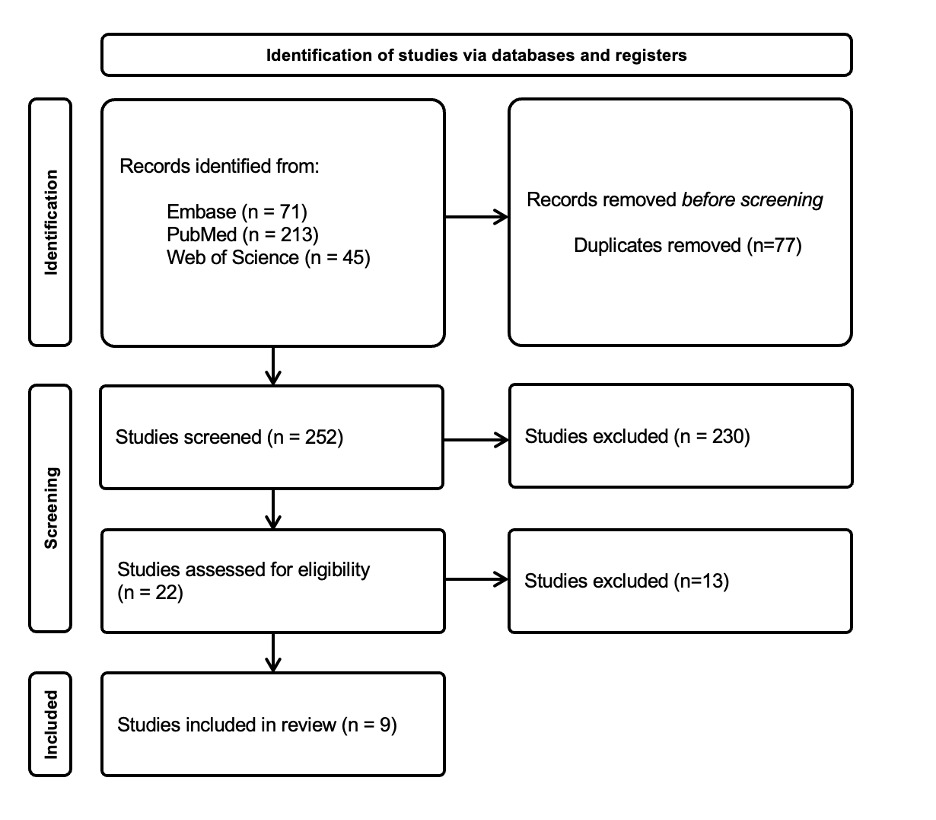
The initial search returned 329 articles. After duplicates were removed, 252 articles remained. Of these 252 articles, 230 articles were excluded based on title and abstract screening. The full texts of the remaining studies were screened, where an additional 13 studies were excluded. Nine studies remained for quality assessment after full-text screening.11,17–24 Data extraction was performed on seven retrospective cohort studies (Level III evidence) and two randomized control trials (Level I evidence). All results were reported per the PRISMA reporting standards, with results summarized in Figure 1.15
3.2. Methodological Quality Assessment
Two authors (KE and BV) assessed each study for risk of bias using the JBI protocol checklist for each study type.16 Seven retrospective cohort studies had a mean score of 9.6 out of 1017,18,20–24 Two randomized control trials had a score of 11 out of 13.11,19 All nine studies were determined to have adequate methodology to be included in the review.
3.3. Patient Demographics
Four studies evaluated fixation outcomes of diaphyseal ulna and radius fractures,11,17,19 and distal radius fractures18 including a total of 116 cases of non-resorbable implants and 105 cases of resorbable implants (Table 1). Three of the four studies were retrospective cohort studies,11,17,19 while one was a randomized control trial.19 Three of the four studies evaluated elastic stable intramedullary nail (ESIN) as their non-resorbable implant,11,17,19 while one used Kirschner wire (K-wire).19 All four studies used polylactide -co-glycolide (PLGA) resorbable implants as a comparator implant. Mean ages were similar across groups and between studies ranging from 8.1 to 10.4 with a balanced male to female ratio between the cohorts. Average follow up period varied from 1818 to up to 48 months.11
Two studies focused on medial epicondyle fractures, including 45 cases of non-resorbable implants and 47 cases of resorbable implants (Table 2). Both studies were retrospective cohort studies with similar follow up times of 26 and 24 months.20,21 Baldini et al. (2022) used K-wire as a non-resorbable implant,20 while Li et al. (2020) used cannulated lag screws.21 One study used resorbable magnesium implants20 while the other used L-lactide and trimethylene carbonate (TMC) screws.21 Mean ages were similar across groups and between studies ranging from 10.2 to 11.6 with a balanced male to female ratio between cohorts.
Finally, three studies focused on lateral condyle fractures and included 37 cases of non-resorbable implants and 41 cases of resorbable implants (Table 3). All three studies are retrospective cohort studies.22–24 All three studies used K-wires for non-resorbable implants and PLGA for resorbable implants. Mean ages were similar across groups and between studies ranging from 5.6 to 9.2 with a balanced male to female ratio between the cohorts. Average follow up period varied from 6 months23 to 48 months.24
3.4. Post-operative Complications
Across the four studies examining forearm fractures (Table 1), re-displacement was noted in two cases (2%) in the non-resorbable group and eight cases (8%) in the resorbable group; however, only one case (1%) in the resorbable group required revision surgical intervention. Radial nerve injury was seen exclusively in the non-resorbable group, affecting three cases (3%), while complications specific to resorbable implants included implant fracture/nail splitting (1%) and re-fracture (2%). Two cases (10.5%) in the non-resorbable group had an unprovoked refracture, and one case had an extensor pollicis longus injury (1%), compared to no cases in the resorbable group. Additionally, two patients in the non-resorbable group had implant fractures that required re-operation and open reduction and internal fixation. No such cases were reported in the resorbable group. Postoperative pain was reported in five cases (4%) in the non-resorbable group and one case (1%) in the resorbable group. Skin irritation occurred in five cases (4%) with non-resorbable implants, while no such cases were observed with resorbable implants. Long term strength and range of motion was similar in both groups as assessed by Perhomaa et al. (2021).11
For medial epicondyle fractures (Table 2), growth plate disruption, referred to by authors as hypoplasia was reported in one case (2%) and growth plate overgrowth, referred to as hyperplasia in one case (2%) in both groups. Infection rates were low, with three cases (6%) in the non-resorbable group and two cases (4%) in the resorbable group. Nonunion, which was defined as radiolucency interposed between the humerus and medial epicondyle apophysis six months after surgery. Nonunion was seen in three cases (6%) with non-resorbable implants and in one case (2%) with resorbable implants, however none of the cases required return to the operating room for revision.
Among the three studies on lateral condyle fractures (Table 3), mild superficial skin irritation due to hardware prominence under the skin and soft tissues, was more common in the non-resorbable group (five cases, 14%) compared to the resorbable group (four cases, 10%). One case in the resorbable group required implant removal due to severe irritation. Mild bone deposition and bony formation were noted in 15 cases (41%) with non-resorbable implants and 10 cases (24%) with resorbable implants, though none were clinically significant. Valgus deformity occurred in one case (3%) in the non-resorbable group and in two cases (5%) in the resorbable group. Other complications exclusively seen in the resorbable group included one case (3%) of avascular necrosis and one case (3%) of reduced range of motion. On the other hand, three cases (7%) of infection were documented in the non-resorbable cohort with no documented cases of infection in the resorbable cohort. Importantly, all infections resolved after removal of the non-resorbable implant with no progression to osteomyelitis.22
3.5. Range of motion and strength
Seven out of nine studies11,18–23 evaluated postoperative range of motion and strength outcomes. In all seven studies, no statistical difference in final follow up post-operative range of motion or strength between resorbable and non-resorbable implant groups was detected. In their study comparing K-wire tension band constructs and bioresorbable pin tension band construct fixation of lateral condyle fractures of the elbow, Kassai et al. had two patients in the resorbable implant group who demonstrated decreased range of motion at 3 month follow up; this deficit resolved to full elbow range of motion by 6 month follow up.22
_flow_diagram._.png)
4. DISCUSSION
4.1. General Interpretation of Findings
This systematic review assessed the safety and efficacy of resorbable implants compared to traditional metallic fixation in pediatric upper extremity fractures. The data suggest that resorbable implants provide comparable or superior outcomes in terms of post-operative complications, healing, and the avoidance of secondary surgeries. Key advantages included lower incidences of soft tissue irritation, postoperative pain, and hardware-related infections, which are often attributable to the need for a second surgical procedure with metal implants. These benefits support previously published literature that favors resorbable implants for their biocompatibility, gradual load-sharing during degradation, and reduction in second interventions.7 Given that seven out of nine studies11,18–23 showed no significant difference in strength or range of motion suggests that both methods are equally effective at treating various upper extremity fractures in the pediatric population. Of note, one of the standout advantages of resorbable systems is the elimination of hardware removal, a significant consideration in pediatric populations. Secondary procedures not only increase surgical risk and healthcare costs but also add to patient and caregiver burden. Studies have estimated that implant removal accounts for up to 30% of orthopedic reoperations in children.6 In one study by Scheider et al. (2020), 17.1% of 449 pediatric hardware removal cases resulted in complications, including delayed union, wound healing issues, and superficial infections, with rare but serious events such as permanent nerve injury and ICU admission.25 Another large-scale analysis by Kellam et al. (2021) 13,089 hardware removal surgeries reported a 9.6% complication rate, most commonly involving wound healing problems and infections, while severe complications remained uncommon.26 Additionally, a national estimate from Finland projected over €472,000 in annual direct costs from elective hardware removal in pediatric orthopedics, not including lost parental income or indirect healthcare expenses such as travel cost.27 Notably, in the context of ankle fractures, resorbable implants were found to be more cost-effective than metallic implants when accounting for total expenses including hospitalization, additional outpatient appointments, and implant removal surgeries.28 However, no formal cost analyses have been performed specifically on the cost of pediatric fractures with resorbable and non-resorbable implants. Furthermore, patients require a shorter casting course after resorbable implantation when compared to non-resorbable implantations which can improve patient comfort and decrease muscle atrophy.18 It is important to recognize that while resorbable implants are advantageous, they can pose biological changes during degradation leading to localized bone demineralization from lactic acid and glycolic acid monomer release,29 although this was not noted on image analysis by Perhomaa et al. Additionally, due to the low visibility under fluoroscopy, resorbable implants require experienced surgeons to operate, but resorbable implants with bio-labelled ends are now available.17,18,22
4.2. Forearm Fractures
In forearm fractures, while the rate of fracture displacement was higher with resorbable implants, most cases were minor and did not require further surgical intervention. This suggests that, with appropriate surgical technique and patient selection, resorbable implants can provide stable fixation with a favorable safety profile. These findings are consistent with recent literature,30 which reported similar or improved functional outcomes and patient satisfaction with resorbable devices, particularly in diaphyseal forearm fractures where elastic stability is critical. The only notable complications unique to resorbable implants were implant breakage/nail splitting during insertion and refracture, but these were rare and non-catastrophic. Resorbable implants were associated with fewer cases of patient reported postoperative pain and skin irritation, and no radial nerve injuries were reported in this group, although radial nerve injuries are likely due to the technique used as opposed to the implant type.31 Biodegradation was typically uneventful, and longer-term follow-up of 4 years did not reveal delayed adverse events.11 These findings support the clinical adoption of resorbable implants as a reliable alternative in pediatric fracture care, particularly in cases where minimizing long-term implant burden is a priority or access to care is limited.
4.3. Medial Epicondyle Fractures
In this subset, both implant types demonstrated low rates of infection and nonunion. The slightly lower incidence of nonunion and infection in the resorbable implant group supports the hypothesis that the absence of permanent foreign material may reduce the risk of late complications. This observation is echoed in recent systematic reviews of magnesium-based resorbable implants, which have demonstrated stable fixation, good clinical outcomes, and no implant-related adverse reactions in skeletally immature patients.32 However, some magnesium-based implants incorporate rare earth metals for added strength and controlled degradation which raises the concern for potential long term effects and accumulation of these rare earth metals especially in growing children.33
4.4. Lateral Condyle Fractures
Lateral condyle fractures presented a nuanced picture. While skin irritation and the need for implant removal were more frequent with non-resorbable devices, both groups experienced similar rates of painless bony formation, none of which were clinically significant. The absence of avascular necrosis and refracture in the resorbable group is encouraging, although the overall event rates were low. These results suggest that resorbable implants are a viable alternative for lateral condyle fractures, provided that meticulous attention is paid to implant positioning and patient selection.24
4.5. Emerging Insight and Literature Support
New studies on resorbable pins and screws made of composite materials like PLLA-TMC or PLA-PGA blends suggest customizable degradation rates and improved tensile strength, which are critical for load-bearing applications.30 Concerns about foreign body reactions, once prevalent with early-generation resorbable implants, have largely been mitigated in modern materials.27 Kim et al. (2014) documented cases of sinus tract formation with PLLA screws, but these are rare and appear to be minimized with current formulations and surgical protocols.14
4.6. Limitations and Future Studies
It is necessary to acknowledge the limitations of the existing evidence. There were only nine studies in the current literature that compared resorbable versus non-resorbable implants for pediatric upper extremity fractures. Most were retrospective cohort studies, with inherent risks of selection bias and heterogeneity in surgical technique, follow-up duration, and outcome reporting. Additionally, the relatively short follow-up periods in some studies may underestimate the incidence of late complications such as implant-related osteolysis or growth disturbance. The nine included studies examined only a limited subset of fracture types, which restricts our ability to determine the most appropriate implant choice for different patient populations and various fracture types. Given the distinct characteristics of various resorbable implants, additional studies are needed to clarify their suitability across a broader spectrum of fracture patterns and clinical scenarios. Future research should prioritize multicenter randomized controlled trials with standardized outcome measures, cost-benefit analyses to evaluate economic impact of resorbable implants, and longitudinal studies to track bone growth, remodeling, and implant dissolution to better define the optimal indications for resorbable implants in pediatric fracture care.
5. CONCLUSION
This systematic review offers a detailed evaluation of the existing evidence comparing resorbable polymer-based implants with traditional metallic fixation for pediatric upper extremity fractures. Outcomes in efficacy and safety of resorbable implants, and a comparison of resorbable versus non-resorbable devices, yield essential information for patients and clinicians to inform clinical decision-making and operative technique. Across fracture types, resorbable implants demonstrated similar or lower complication rates, similar outcomes in strength and range of motion, less soft tissue irritation, and a clear benefit of avoiding secondary procedures for hardware removal. While some complications such as fracture displacement were noted with the use of resorbable implants, these were typically minor and manageable without additional intervention. Given these clinical benefits and promising functional outcomes, resorbable implants represent a valuable option in pediatric fracture care. The included studies focused on a narrow range of fracture subtypes, making it challenging to determine which patients are best suited for the various implant options, especially given the distinct characteristics of each implant. Furthermore, the diversity of implant materials and designs may influence outcomes in ways that cannot be fully assessed due to the limited data available. Continued innovation in biomaterials and additional high-quality, long-term studies are warranted to refine their indications and optimize patient outcomes in pediatric orthopedic surgery.
Corresponding Author
Kareem Elhigzi BS
elhigzikm@vcu.edu
(804) 688-5063 1201 E Marshall St, Richmond, VA 23298
Institutional Review Board Statement
Ethical review and approval were waived for this study due to analysis of previously published data. This work has not been previously published.
Acknowledgements
The authors have no acknowledgements at this time.
Author Contributions
Conceptualization, KE, KO, BV; literature review, KE; literature search, JC; study screening, KE, KO, BV; data curation, KE, BV; writing original draft, KE; writing revisions, KE; reviewing, KO, BV, MS, BC, OP, JV; editing, KO, BV, MS, BC, OP, JV; final approval, OP, JV; all authors have read and agreed to the published version of the manuscript.
Funding
This research received no external funding
Informed Consent Statement
Patient consent was waived as this is a systematic review of the current literature.
Data Availability Statement
No new data were collected.
Conflicts of Interest
The authors declare no conflicts of interest.