
Introduction
Sports injuries remain a central problem in orthopedic practice, sports medicine, athletic training, school sport, and recreational physical activity. They may interrupt training and competition, increase medical and rehabilitation burden, delay return to sport, and reduce confidence in long-term participation.1,2
The scope of sports injury research has widened considerably. Early work often described injury incidence, anatomical sites, and clinical management, whereas more recent studies have emphasized standardized injury definitions, exposure measurement, prevention programs, workload monitoring, rehabilitation quality, and athlete health across the sporting life course.3–6
This expansion has also produced a dispersed knowledge base. Bibliometric analysis can help summarize the structure of this field, but its value for orthopedic and sports medicine readers depends on whether the mapped patterns are translated into clinically and practically relevant questions: which knowledge bases have shaped sports injury research, where the field is moving, and what gaps remain for surveillance, prevention, and rehabilitation.7,8
This study therefore analyzed sports injury research from 1990 through 2024. Rather than treating bibliometric maps as an end point, we used them to clarify how the field has moved from treatment-focused description toward prevention-oriented risk management and to identify implications for orthopedic and sports medicine practice.
Accordingly, the present study interprets bibliometric patterns as evidence for a broader sports medicine question: how the accumulated literature can inform surveillance standards, prevention pathways, rehabilitation decisions, and long-term participation.
Materials and Methods
Ethical Considerations
This study analyzed bibliographic records from a publicly indexed academic database and did not involve human participants, animals, identifiable personal information, or patient-level clinical data. Institutional review board approval and informed consent were therefore not required.
Data Source and Search Strategy
The Web of Science Core Collection was searched for sports injury-related publications dated from January 1, 1990, to December 31, 2024. The analysis was designed to characterize long-term research evolution rather than to provide real-time coverage of 2026 literature. The search focused on sports injury and related terms in titles, abstracts, and keywords, and records were exported with full bibliographic information and cited references.
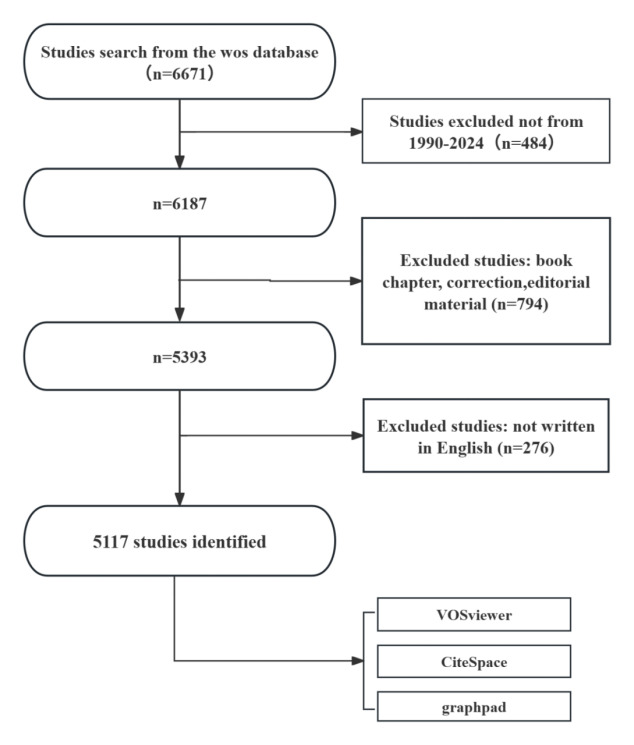
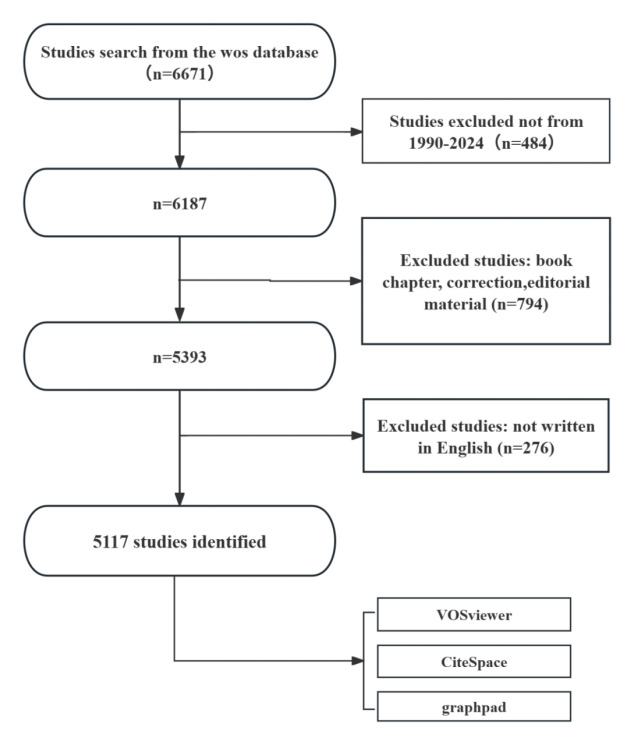
After screening, the final dataset was used for descriptive statistics and knowledge mapping. The retrieval and screening process is summarized in Figure 1.
Bibliometric and Thematic Analysis
Annual publication output was used to describe field growth. Collaboration and source patterns were examined descriptively. Co-cited references were used to identify the knowledge base of the field, while keyword co-occurrence and temporal patterns were used to interpret the evolution of research topics. CiteSpace and VOSviewer were used for visualization and network analysis.7,8
For interpretation, bibliometric results were organized around four orthopedic and sports medicine themes: injury surveillance, prevention, rehabilitation and return to sport, and risk management in sport and physical activity settings.
Figures and tables were intentionally limited to the results that most directly support the clinical and translational argument, while secondary rankings and large network maps were summarized narratively.
Results
Publication Growth and Field Expansion
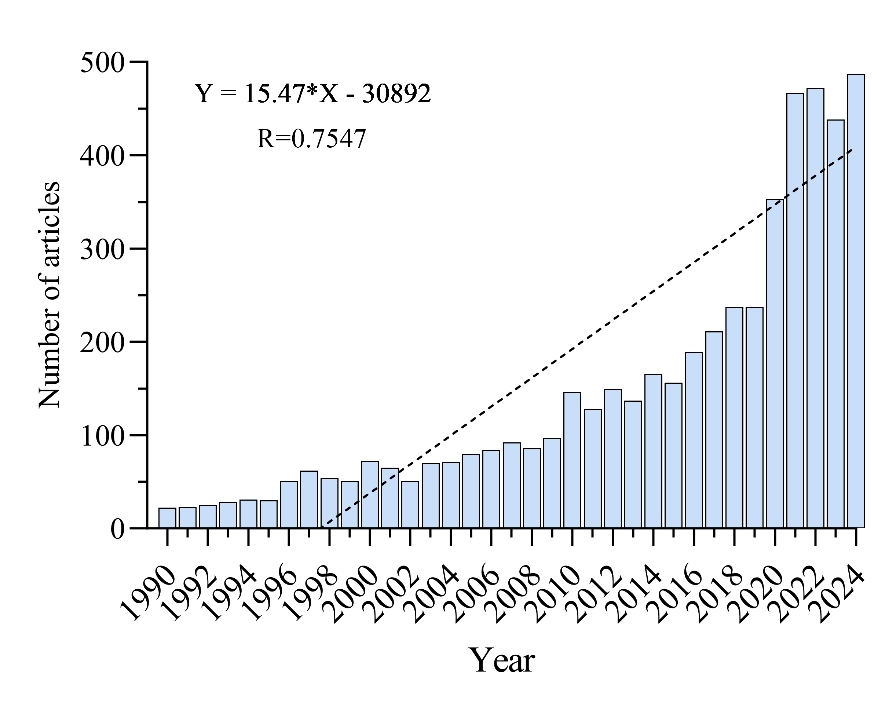
Sports injury publications increased over the study period, indicating that the topic has developed from a relatively specialized clinical and epidemiologic area into a sustained sports medicine and public health research field. The annual trajectory is shown in Figure 2.
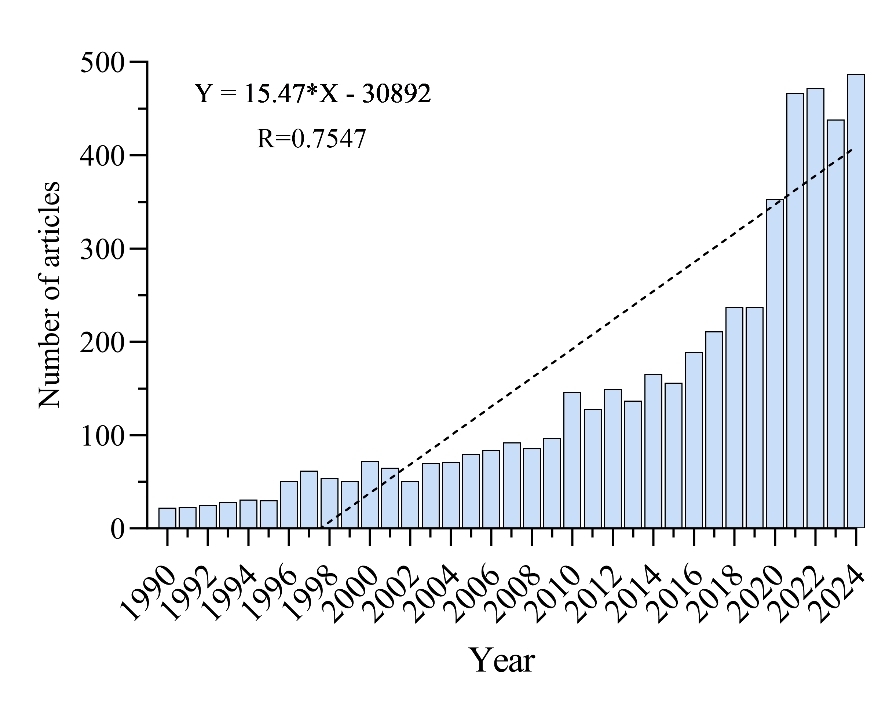
The final dataset included 5,117 publications, comprising 4,303 original research articles and 814 review articles. These records involved contributions from 116 countries or regions, 5,501 institutions, and 16,722 authors, showing that sports injury research has become a broad international field rather than a narrow clinical subspecialty.
The growth pattern suggests a broadening of research attention. Sports injury was no longer addressed only as an event requiring post-injury care; it was increasingly studied as a preventable and monitorable risk that occurs within training, competition, education, and recreational physical activity.
Annual output showed a three-stage pattern: slow growth from 1990 to 1995, more stable expansion from 1996 to 2018, and rapid growth after 2019. The post-2019 acceleration suggests that sports injury research has increasingly been shaped by athlete health, injury surveillance, load management, and prevention concerns, rather than by isolated injury description alone.
The increase in output also reflects the changing social position of sport. Competitive sport has become more intensive, youth sport has become more organized, and physical activity has been promoted as a health strategy for the wider population. These changes have enlarged the population exposed to sport-related injury risk and have increased the need for research that links clinical care with prevention.
Geographic, Institutional, and Journal Contributions
The United States was the leading contributor, with 1,552 publications, accounting for 30.33% of the total output. China ranked second with 542 publications (10.59%), followed by Australia with 502 publications (9.81%) and England with 459 publications (8.97%). This distribution indicates that the field is internationally active but remains concentrated in countries with stronger sports medicine research infrastructure.
At the institutional level, Harvard University ranked first in publication volume with 133 papers and 4,716 citations, while the Norwegian School of Sport Sciences produced 124 papers and achieved a higher average citation impact. At the journal level, the British Journal of Sports Medicine was the most productive source, publishing 327 sports injury-related articles, followed by the American Journal of Sports Medicine with 156 articles. These patterns show that sports injury research is anchored in both orthopedic sports medicine and broader sports health journals.
Knowledge Base of Sports Injury Research
The co-cited literature indicates that the knowledge base of the field is anchored in injury epidemiology, consensus definitions, exposure-based reporting, prevention frameworks, and sport-specific injury mechanisms. Table 1 summarizes the major knowledge-base areas represented by highly influential references.
This pattern is important for orthopedic and sports medicine readers because it shows that clinical treatment and rehabilitation are increasingly linked to upstream surveillance and prevention. Accurate injury definition and exposure measurement are prerequisites for comparing injury rates, evaluating prevention programs, and improving return-to-sport pathways.3–6
A second implication is that the field has developed through methodological consolidation as much as through the accumulation of injury-specific findings. The repeated influence of consensus and reporting papers shows that sports injury research depends on shared language. Without agreed definitions, an apparent difference in injury rates may reflect measurement variation rather than a true difference in risk.
The most influential co-cited reference was the 2020 International Olympic Committee consensus statement on methods for recording and reporting injury and illness epidemiology in sport. Other highly cited records included Olympic Games surveillance studies and work on complex systems approaches to sports injury. Highly co-cited authors included R. Bahr, W. van Mechelen, and A. Junge, whose work has helped shape injury prevention, surveillance, and epidemiologic methodology.
Thematic Evolution Toward Surveillance, Prevention, and Athlete Health
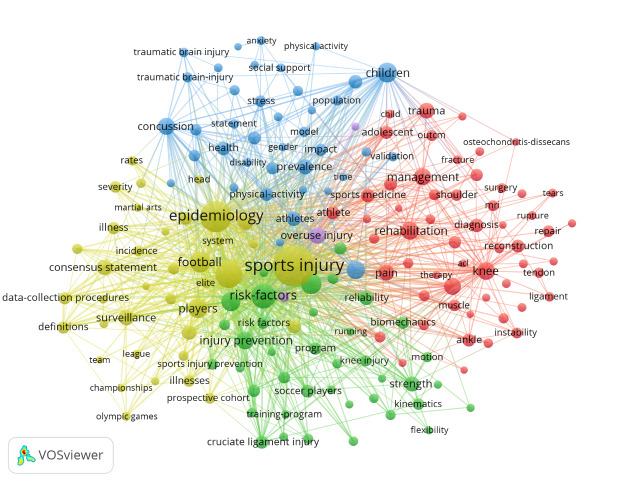
Keyword patterns showed that earlier topics centered on common injury types and anatomical sites, including knee injury, ankle sprain, anterior cruciate ligament injury, and concussion. Later themes increasingly included prevention, surveillance, rehabilitation, workload, return to sport, performance, and athlete health. The keyword co-occurrence structure is presented in Figure 3.
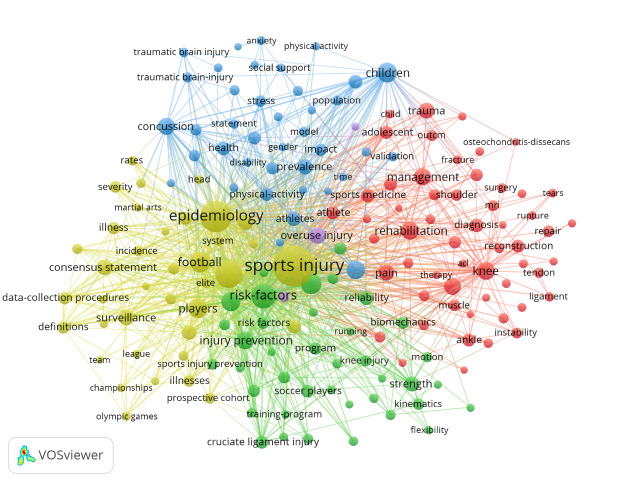
The most frequent keywords were sports injury, epidemiology, prevention, risk factors, and soccer. Co-occurrence analysis identified five major thematic clusters: clinical management of specific injuries; biomechanics, prevention, and risk factors; psychological and physiological responses to injury; epidemiologic surveillance in sport-specific contexts; and youth or overuse-related musculoskeletal injury.
This evolution indicates a shift from injury documentation toward integrated risk management. The field increasingly asks not only how injuries are diagnosed and treated, but also how they can be anticipated, monitored, prevented, and managed across the continuum from training exposure to rehabilitation and safe return.
The thematic pattern also shows why sports injury research cannot be reduced to a single clinical topic. Knee injury, ankle sprain, concussion, overuse injury, and return to sport are clinically distinct, yet they share common research needs: reliable surveillance, exposure-adjusted risk estimates, intervention adherence, individualized rehabilitation, and evaluation of reinjury and long-term function.
Evidence Gaps With Practical Relevance
The mapped literature also revealed gaps that limit translation into practice. These gaps are summarized in Table 2. They include inconsistent surveillance systems across sport settings, limited implementation research in schools and recreational sport, insufficient integration between workload monitoring and clinical decision-making, and uneven attention to long-term recovery and health outcomes.
These gaps suggest that sports injury research requires a stronger bridge between bibliographic knowledge, clinical standards, and applied prevention systems.
In practical terms, the gaps point to a translation problem. The literature has generated substantial knowledge on what injuries occur and which prevention principles may be useful, but many sport settings still lack routine mechanisms for recording injuries, interpreting risk signals, and feeding information back into training or participation decisions.
The bibliometric evidence therefore supports a more selective interpretation of research gaps. The issue is not simply that more studies are needed, but that future studies should connect injury surveillance, clinical assessment, prevention adherence, rehabilitation progression, and return-to-sport outcomes within the same practice pathway.
Discussion
From Treatment-Centered Description to Prevention-Oriented Risk Management
The main finding of this study is that sports injury research has progressively moved from descriptive and treatment-centered work toward prevention-oriented risk management. This does not reduce the importance of orthopedic diagnosis, surgery, rehabilitation, or return-to-sport care. Rather, it places these clinical processes within a broader chain that begins before injury occurs.
For orthopedic and sports medicine practice, this shift means that injury care should be connected with exposure measurement, training history, previous injury status, sport-specific demands, and contextual risk factors. Clinical expertise remains central, but prevention increasingly depends on standardized data, interdisciplinary communication, and actionable monitoring systems.9–12
For this reason, general bibliometric description alone is insufficient. Ranking countries, authors, institutions, or keywords can describe the field, but it does not by itself tell clinicians, coaches, or rehabilitation professionals how to act. The more valuable contribution is to translate those patterns into a framework for reducing injury occurrence, shortening unsafe return pathways, and improving durable participation.
Standardized Surveillance as the Foundation of Prevention
The co-cited literature highlights the foundational role of injury definitions, surveillance standards, and reporting consensus. Without consistent definitions of injury, illness, exposure, recurrence, severity, and time loss, comparisons across sports, countries, levels of play, and age groups remain unstable.3–6
This point is particularly relevant beyond elite sport. School sport and community physical activity often lack systematic injury recording, although they represent large populations and diverse exposure patterns. A practical surveillance system does not need to be technologically complex, but it must collect core information consistently: injury type, mechanism, severity, exposure, training load, and return-to-activity status.
For elite teams, surveillance can be linked to medical records, training-load systems, and performance staff workflows. For schools and recreational settings, simpler reporting systems may be more appropriate. The core principle is the same: injury prevention begins with knowing what injuries occur, in whom, under what exposure, and with what consequences.
A minimum surveillance dataset should therefore include injury diagnosis or body region, injury mechanism, activity context, exposure denominator, time loss or severity, recurrence, previous injury, and return-to-activity status. These elements are modest enough for practical use but strong enough to connect clinical records with prevention evaluation.
Rehabilitation, Return to Sport, and Long-Term Athlete Health
Recent themes also emphasize rehabilitation quality and return-to-sport decision-making. Injuries such as anterior cruciate ligament rupture, ankle sprain, and concussion show that the outcome of sports injury cannot be evaluated only by symptom resolution or time loss. Functional recovery, re-injury risk, psychological readiness, and long-term participation are increasingly important.13–16
A prevention-oriented framework should therefore integrate rehabilitation with risk reduction. Return-to-sport decisions require clinical assessment, functional testing, sport-specific progression, and communication among physicians, therapists, coaches, athletes, teachers, and families when youth or school sport is involved.
The literature trend also suggests that rehabilitation should be evaluated as a process rather than a single endpoint. Progression criteria, neuromuscular control, workload restoration, psychological readiness, and recurrence surveillance are all part of the same continuum. This is especially important for injuries with high recurrence or long-term sequelae.
Implications for Orthopedic and Sports Medicine Research
The evidence gaps identified in this study suggest several priorities. First, surveillance data should be made more comparable across sports and participation settings. Second, prevention programs should be evaluated not only for efficacy under controlled conditions but also for adherence, feasibility, cost, and sustainability. Third, workload monitoring and digital tools should be connected to clinical reasoning rather than treated as stand-alone technologies. Fourth, rehabilitation studies should report long-term outcomes relevant to recurrent injury, function, and participation.
These priorities can help move the field from producing more injury descriptions toward building prevention systems that are clinically meaningful, context-sensitive, and usable in real sport and physical activity environments.
Clinical and Practical Implications
For clinicians, the findings support a more systematic use of injury history, sport exposure, and return-to-sport criteria during assessment and follow-up. For rehabilitation professionals, they reinforce the need to document function, progression, and readiness rather than relying only on time since injury. For coaches and sport organizations, they suggest that prevention is not a single warm-up program or isolated education session, but a routine management process embedded in training design.
For researchers, the findings point toward studies that combine bibliometric insight with prospective data. Future work should test whether surveillance-informed prevention systems reduce injury burden in specific settings, such as youth team sports, school physical education, collegiate sport, recreational running, and return-to-sport programs after knee or ankle injury.
Limitations
This study has several limitations. The analysis was based on the Web of Science Core Collection and therefore may not fully represent publications indexed only in other databases or non-English local literature. Bibliometric results are also influenced by search terms, database coverage, citation practices, and visualization parameters. In addition, this study did not include new patient-level clinical data, so its findings should be interpreted as evidence mapping rather than direct clinical effectiveness evidence. Future research should combine bibliometric evidence with prospective surveillance data, intervention trials, and implementation studies in specific sport settings.
Conclusion
Sports injury research from 1990 to 2024 showed sustained growth and a clear transition from treatment-centered description to prevention-oriented risk management. The field is increasingly shaped by standardized surveillance, injury prevention, rehabilitation, return-to-sport decision-making, workload monitoring, and athlete health. For orthopedic and sports medicine practice, the next step is to translate this knowledge into comparable surveillance systems, context-specific prevention programs, integrated rehabilitation pathways, and practical risk-management tools across elite, school, and recreational sport settings.
Acknowledgments
None.
Author contributions
Conceptualization: Yuming Xu and Jun Peng; methodology: Yuming Xu and Nuan Wen; software and visualization: Nuan Wen and Yuting Xu; validation: Jun Peng and Yuting Xu; formal analysis: Yuming Xu and Nuan Wen; investigation and data curation: Yuming Xu, Yuting Xu, and Nuan Wen; writing - original draft: Yuming Xu; writing - review and editing: Jun Peng, Yuting Xu, and Nuan Wen; supervision: Jun Peng; project administration: Yuming Xu and Jun Peng. All authors have read and approved the final manuscript.
Conflict of interest disclosures
The authors declare that they have no competing interests.
Corresponding author
Nuan Wen, City University of Macau, Macau, China. Email: m25092100176@cityu.edu.mo.
Yuting Xu, City University of Macau, Macau, China. Email: m26092100212@cityu.edu.mo.
Funding
This work was supported by the 2026 Guangzhou Philosophy and Social Sciences Planning Project (Grant No. 2026GZQN69); supported by “the Fundamental Research Funds for the Central Universities” (Grant No. QNMS2610); and the Student Research Program of South China University of Technology (Grant No. X202610561714).
Data availability
The bibliographic records analyzed in this study were retrieved from the Web of Science Core Collection. Derived bibliometric data and search details are available from the corresponding author upon reasonable request, subject to database licensing restrictions.
Artificial intelligence statement
No generative artificial intelligence tool was used to generate, analyze, or interpret the bibliometric data. Language and formatting were reviewed by the authors.