1. Introduction
Concussion safety involves recognizing possible injury, reporting symptoms, and making appropriate decisions about continued participation. The Amsterdam consensus describes clinical assessment and a graduated return-to-sport process after sport-related concussion.1 Public agreement that concussion is serious may not fully describe how people respond to more specific participation questions.
Research in the Journal of Safety Research has examined concussion education and reporting intentions among adolescents,2 parental symptom knowledge and care-seeking attitudes,3 and parents’ perceptions of concussion safety in youth soccer.4 These studies address different populations and constructs, underscoring the need to distinguish perceived risk, knowledge, confidence, and intended behavior. Stead et al.5 also evaluated concussion knowledge and attitudes before and after a brief educational intervention among middle school students.
Previous studies also distinguish general awareness from actionable knowledge. Community research assessed perceived and measured knowledge separately,6 while surveys of parents examined symptom knowledge and care-seeking attitudes using distinct measures.7,8 This distinction is relevant when interpreting agreement with broad safety statements alongside answers to specific participation questions.
The present study described concussion safety beliefs, symptom-recognition confidence, and hypothetical participation decisions among US adults with a self-reported history of concussion. All survey items were summarized, with exploratory within-respondent comparisons between general safety statements and related questions about immediate participation and medical clearance. The aim was to identify topics for subsequent safety-education research, without treating survey responses as observed behavior or validated knowledge scores.
2. Methods
2.1. Design and participants
This cross-sectional study used an anonymous, voluntary, web-based convenience survey conducted in July 2026 among US adults with a previous concussion. Participation was opt-in. Respondents were informed of the study purpose and provided informed consent, as described in the original study documentation. Concussion history was self-reported and was not verified against medical records. The analysis included 100 respondent records; all identified the United States as their country and selected concussion on the injury-screening item. The research was considered non-human-subjects research under Title 45 of the Code of Federal Regulations, Part 46 (45 CFR 46).
2.2. Measures
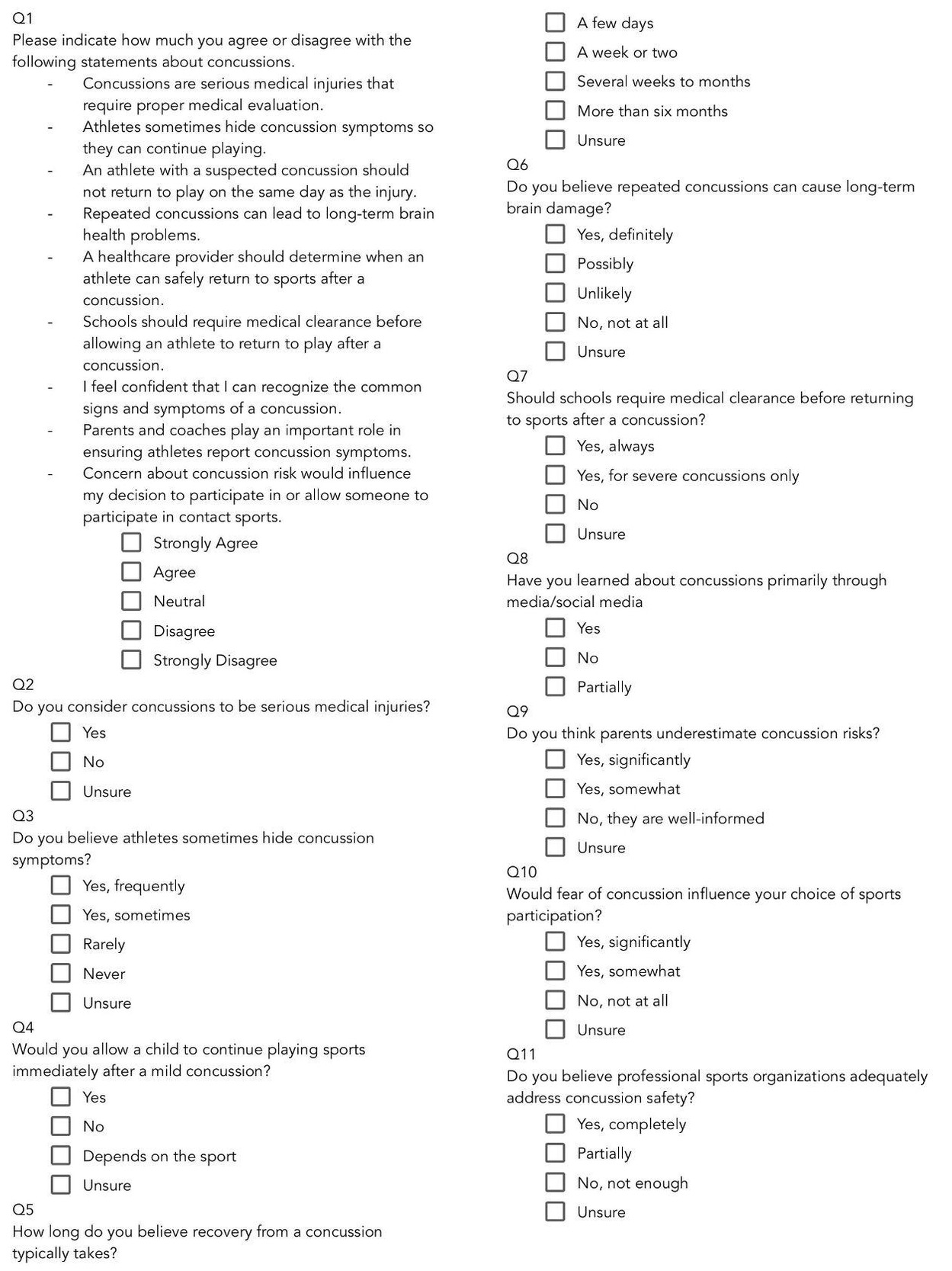
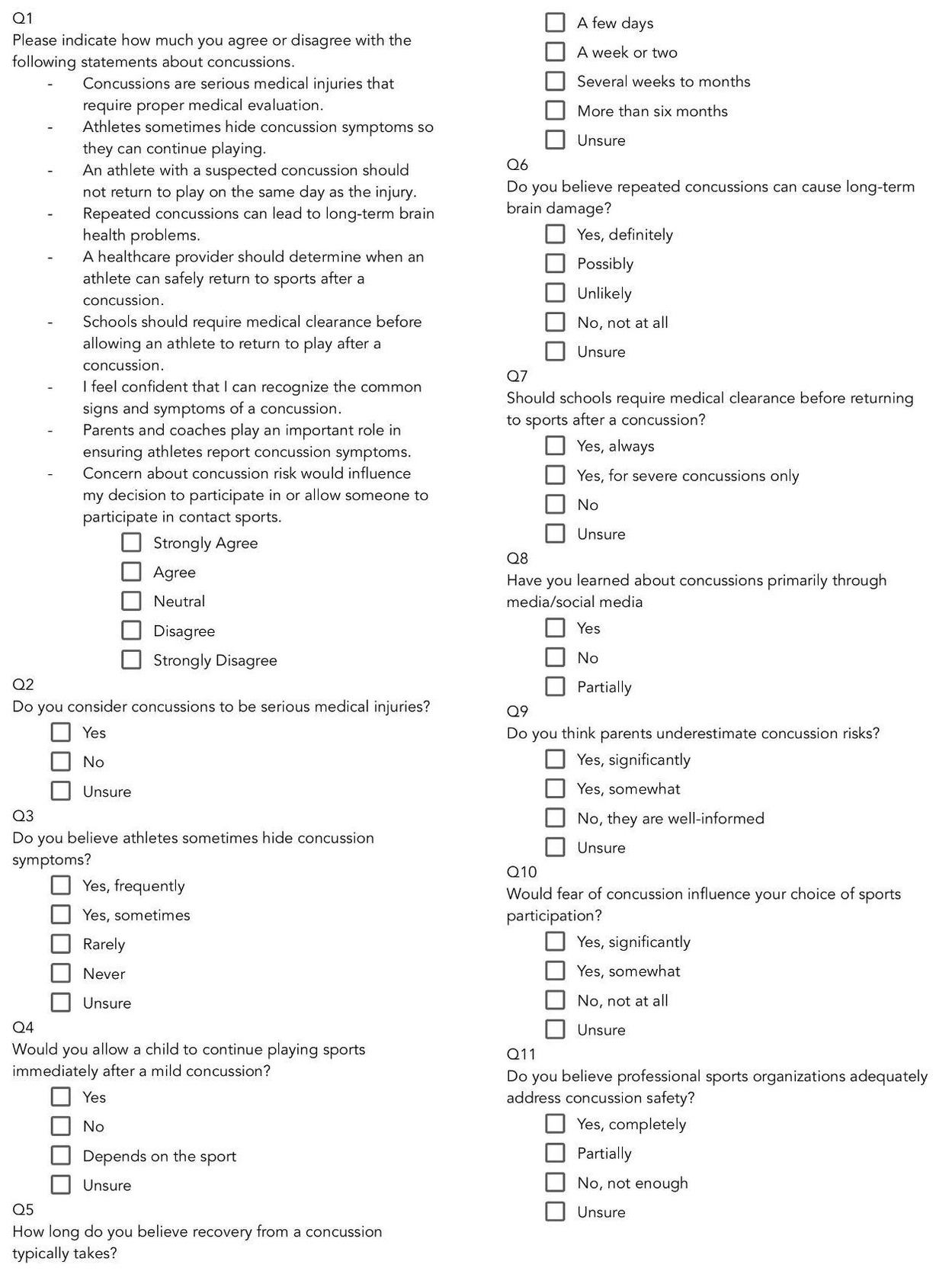
The questionnaire contained 11 numbered questions. Question 1 included nine statements rated from strongly agree to strongly disagree. Questions 2–11 addressed perceived seriousness, athletes’ symptom concealment, immediate participation after a child’s mild concussion, recovery duration, repeated concussion, school medical clearance, media as an information source, parental risk estimation, fear-related participation choices, and professional sports organizations’ safety practices. The questionnaire is reproduced in Appendix A. Demographic fields included age, gender, and a combined race/ethnicity categorization. The export labeled the demographic field “Gender,” with male and female responses; the available documentation did not define how this field distinguished sex from gender. These labels are reported as recorded.
The items measured respondents’ stated beliefs and intentions. No clinical diagnosis, verified concussion-management behavior, validated knowledge score, or educational intervention outcome was available. The child-participation question was hypothetical; respondents were not identified as parents, coaches, or active athletes. The term “mild concussion” was part of the administered wording and was not a clinical classification assigned by this study.
2.3. Analysis
Analyses used the respondent-level data and were unweighted. Counts and percentages were calculated for every substantive response category, with a denominator of 100 unless a subset was specified. Age was summarized using the median, interquartile range, and range. All 100 records contained responses to the screening item and questions 1–11; no imputation was performed. The data export included a weight field, but its derivation and calibration targets were not documented in the supplied study materials, so it was not used.
Strongly agree and agree were combined when describing endorsement, while the complete agreement distributions were retained. Two exploratory cross-tabulations examined responses to related questions within the same respondents: endorsement of no same-day return versus allowing immediate participation after a child’s mild concussion, and endorsement of school medical clearance versus the conditions under which clearance was considered necessary. These comparisons were descriptive and were not prespecified hypothesis tests. No significance tests, population projections, or causal models were used.
3. Results
3.1. Participant characteristics
Respondents were aged 18–63 years, with a median age of 42.5 years (interquartile range, 32.8–54.0). There were 51 male and 49 female respondents. Table 1 summarizes the demographic categories recorded in the dataset.
3.2. General safety beliefs and symptom recognition
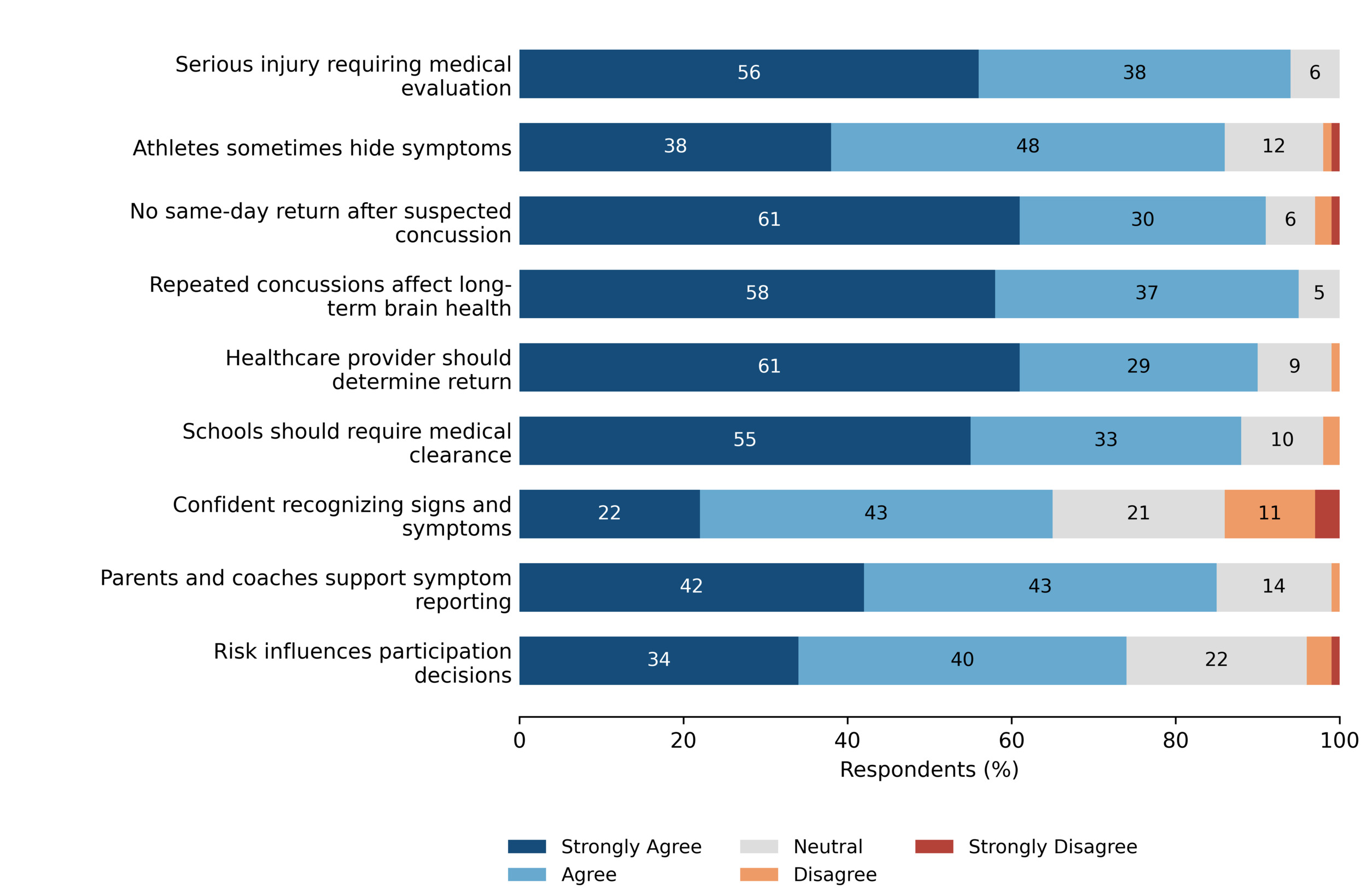
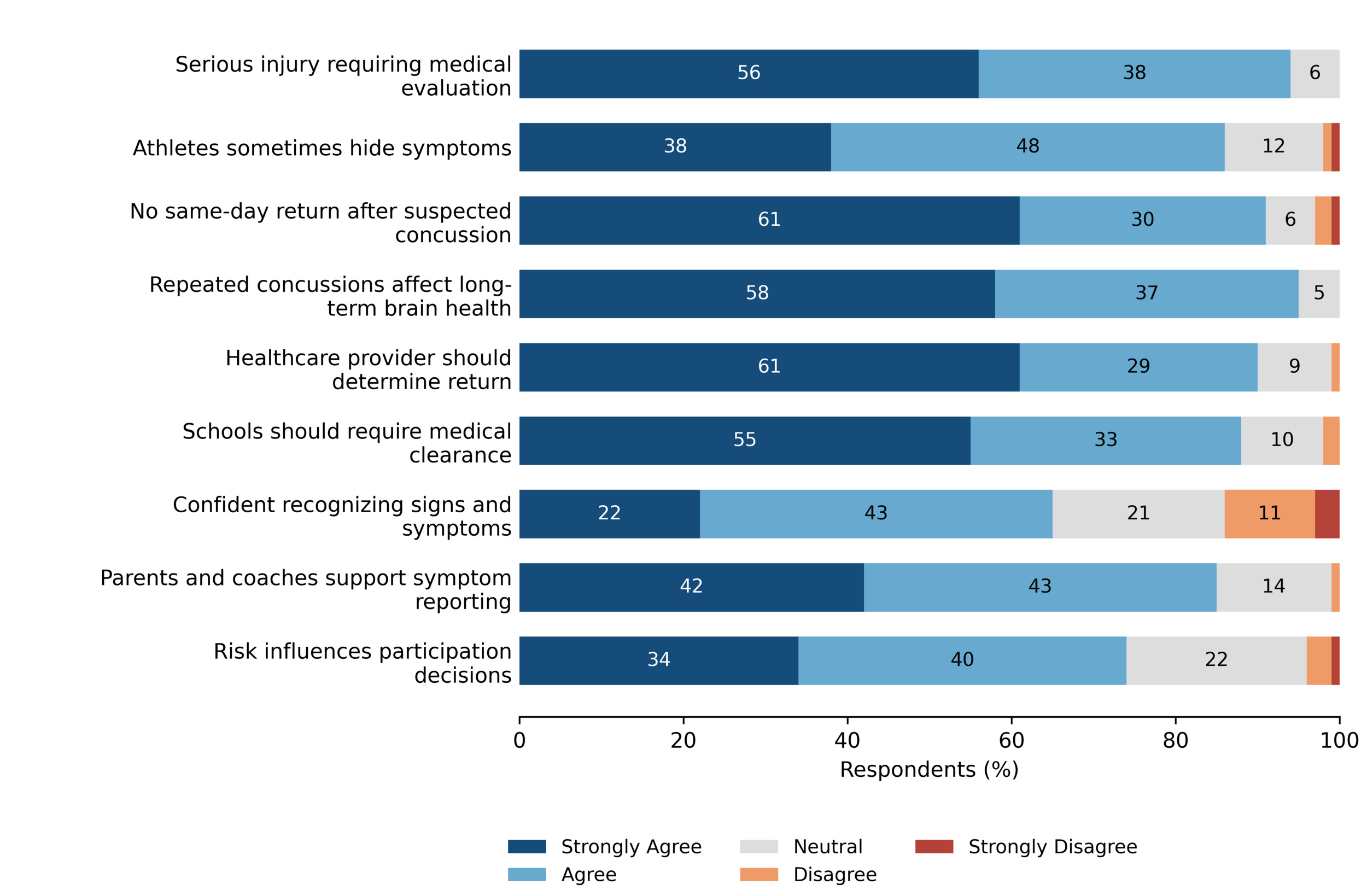
Most respondents agreed or strongly agreed that concussion requires medical evaluation (94%), that repeated concussions can lead to long-term brain health problems (95%), and that a healthcare provider should determine return to sports (90%). Ninety-one percent endorsed avoiding same-day return after suspected concussion, and 88% endorsed school medical-clearance requirements. Confidence in recognizing common signs and symptoms was endorsed by 65%; 21% were neutral and 14% disagreed or strongly disagreed. Figure 1 displays the full agreement distributions.
3.3. Specific participation and clearance decisions
Eighty-one respondents would not allow a child to continue playing sports immediately after a mild concussion; 9 would allow it, 8 said it depended on the sport, and 2 were unsure. Seventy-seven respondents supported school medical clearance after every concussion, whereas 19 limited clearance to severe concussions, 2 opposed it, and 2 were unsure (Table 2).
Within the 91 respondents endorsing no same-day return, 73 (80.2%) would not allow immediate continuation after a child’s mild concussion. The other 18 (19.8%) selected yes (9), depends on the sport (7), or unsure (2). Among the 88 endorsing school medical clearance, 67 (76.1%) selected “Yes, always” on the separate clearance question; 17 (19.3%) selected severe concussions only, 2 (2.3%) selected no, and 2 (2.3%) were unsure. These are within-respondent response patterns across differently worded items, rather than measures of nonadherence.
3.4. Recovery expectations and perceptions of others
Ninety-two percent considered concussion a serious medical injury. Expected recovery was a few days for 33%, a week or two for 25%, several weeks to months for 27%, and more than six months for 2%; 13% were unsure. Regarding repeated concussions and long-term brain damage, 64% selected “Yes, definitely” and 29% selected “Possibly.”
Eighty-seven percent believed athletes hide symptoms frequently or sometimes, and 82% believed parents underestimate concussion risks significantly or somewhat. Fear of concussion would influence sports participation significantly or somewhat for 69%. Twenty-five percent reported learning about concussion primarily through media/social media, 21% selected partially, and 54% selected no. Professional sports organizations were perceived as addressing concussion safety completely by 27%, partially by 41%, and inadequately by 25%; 7% were unsure.
4. Discussion
4.1. Interpreting general beliefs and specific choices
Most respondents endorsed general concussion-safety principles. Responses were less uniform when questions introduced immediate participation after a “mild” concussion or allowed medical clearance only for severe injuries. The within-respondent comparisons show that endorsement of a general statement did not always coincide with the most restrictive response to a related question. However, the items differed in wording, referent, and response options. These differences could reflect interpretation of the questions, uncertainty, or differences in beliefs; the survey cannot identify which explanation applies.
This distinction matters for education. Agreement that concussion is serious does not establish the ability to recognize symptoms or make a safe participation decision. Only 65% endorsed confidence in recognizing symptoms, and confidence itself was not tested against a clinical vignette or objective knowledge measure. Future studies could use matched scenarios and validated measures to examine whether the term “mild” changes participation intentions and whether explicit explanations improve decisions.
Prior concussion experience should not be assumed to ensure adequate knowledge. Kay et al.9 found that parents’ concussion-related experiences had limited associations with overall knowledge and attitudes. In a mixed-method study, parents reported uncertainty about return-to-play protocols and often relied on coaches’ understanding.10 These findings provide context for asking explicitly what respondents would do, although the present survey cannot establish whether prior experience affected their answers.
The Amsterdam consensus supports removal and assessment when concussion is suspected and describes a graduated return-to-sport process.1 Educational messages should distinguish immediate continuation after injury from later, appropriately supervised activity. This clinical context should not be used to assign a diagnostic or behavioral label to respondents on the basis of these survey answers.
Clinical outcome studies explain why immediate participation is a meaningful educational topic. Delayed reporting and removal were associated with longer recovery in a collegiate sample.11 A prospective adolescent study also found longer recovery among athletes who continued playing,12 and a larger multicenter collegiate cohort associated immediate removal with shorter recovery and less severe acute symptoms.13 These observational findings support discussing timely reporting and removal; they do not establish an outcome effect for the hypothetical choices measured here.
4.2. Recovery expectations and communication
The spread of recovery expectations does not, by itself, demonstrate incorrect knowledge. The question did not define recovery as symptom resolution, return to school or work, or unrestricted sports participation. It also did not specify age, symptoms, or injury circumstances. Accordingly, the response categories cannot be interpreted as answers to a clinical prognosis question with one universally correct duration.
Clinical studies by Ganti et al. provide context for individualized recovery discussions. A prospective emergency department study evaluated features associated with post-concussion symptoms,14 and another examined acute neurocognitive measures in relation to subsequent outcomes.15 A study of early emergency department returns identified post-concussive symptoms among the reasons patients sought further care.16 These clinical cohorts support attention to symptoms and follow-up when explaining recovery, but they do not validate the present questionnaire or establish that any particular educational intervention would improve outcomes in this sample.
Most respondents endorsed possible long-term consequences of repeated concussion. The questionnaire did not assess exposure frequency, injury severity, or individual disease risk. Communication should therefore acknowledge concern without converting these beliefs into estimates of later neurological disease. The Amsterdam consensus discusses both the evidence and remaining uncertainties surrounding long-term effects of repetitive head impacts.1
4.3. Implications for safety-education research
Prior safety research has assessed reporting intentions among young athletes,2 parental knowledge and care-seeking attitudes,3 and parental perceptions of youth-soccer safety.4 The present survey adds descriptive information from adults reporting a previous concussion, whose sports and caregiving roles were not established. Differences between studies should not be interpreted as changes over time because their populations, instruments, and sampling methods differ.
Respondents’ perceptions that athletes conceal symptoms and parents underestimate risks identify concerns for further investigation. They do not estimate actual concealment or demonstrate that parents lack knowledge. Similarly, opinions about professional sports organizations do not measure protocol adherence or organizational performance. Education studies should distinguish what respondents believe other people do from their own intentions and observed actions.
Athlete-specific research links reporting to both knowledge and attitudes. Register-Mihalik et al.17 examined recalled disclosure and continued participation while symptomatic, finding associations with these separate constructs. The present item about athletes hiding symptoms measures an observer’s belief and cannot be interpreted as an equivalent measure of personal reporting behavior. Future questionnaires could distinguish symptom recognition, intention to disclose, and actual disclosure after an injury.
Stead et al.5 used paired surveys around a brief school-based educational intervention. That design offers an example of evaluating change, whereas this cross-sectional survey cannot assess educational effectiveness. Subsequent work could evaluate clear messages about immediate removal, medical assessment, and graduated return using prospective outcomes, rather than relying only on endorsement of general statements.
Parent-focused research offers a concrete communication approach for subsequent testing. Focus groups identified uncertainty about parents’ roles and reliance on coaches for concussion communication.18 In a cluster-randomized study, distributing CDC HEADS UP materials with instructions for parent–child discussion increased reported communication about concussion.19 This intervention evidence concerns communication, not demonstrated reductions in injury or unsafe participation. It supports evaluating explicit discussion prompts alongside safety information, with behavior and health outcomes measured separately.
4.4. Limitations
This small, opt-in convenience sample is vulnerable to selection bias. People with greater interest in concussion or particular prior experiences may have been more likely to participate. All respondents reported a previous concussion, and there was no comparison group without concussion history. Results cannot be generalized to US adults, athletes, parents, or coaches, and national representativeness should not be inferred from the country of residence.
Concussion history and survey answers were self-reported, introducing potential recall and social-desirability biases. The supplied materials did not document the number invited or screened or survey participation rates. The original study description specified exclusion of incomplete and duplicate responses, but exclusion counts and the procedures used to identify duplicate participants were not available. The analyzed export contained complete substantive responses, which does not establish the completeness of recruitment reporting. The CHERRIES reporting checklist emphasizes transparent descriptions of recruitment, self-selection, participation, and procedures for preventing duplicate entries in web surveys.20 Unavailable recruitment information limits appraisal of these aspects of the present study.
The instrument was not documented as a validated measure. Similar items used different wording and response scales, some response categories were broad, and all agreement statements were framed in the same direction. Acquiescence and wording effects may therefore influence responses. The exploratory paired comparisons were selected during analysis and require independent confirmation. The study did not measure actual return-to-play behavior, test an intervention, or support causal conclusions. Sex- or gender-specific response patterns were not evaluated, limiting assessment of whether these findings apply similarly across groups.
5. Conclusions
In this sample of 100 adults with self-reported concussion history, general support for concussion safety coexisted with varied responses to immediate participation and medical-clearance questions. Recovery expectations and symptom-recognition confidence also varied. These findings identify questions for subsequent research but do not demonstrate clinical knowledge deficits, unsafe behavior, or population prevalence.
6. Practical Applications
Concussion education could explicitly connect general safety principles to concrete decisions: stopping participation when injury is suspected, seeking assessment even when an injury is described as mild, and distinguishing early appropriate activity from unrestricted return to sport. Scenario-based evaluation could test whether these explanations improve understanding and decisions. The present data support selecting these topics for evaluation; they do not establish the effectiveness of any message or program.
Data availability
The dataset supporting this study is deposited in Synapse: https://doi.org/10.7303/syn77635953.
Declaration of generative AI and AI-assisted technologies in the manuscript preparation process
During preparation of this manuscript, the authors used ChatGPT (OpenAI) to assist with language editing, manuscript organization, and reference checking. The authors take full responsibility for the content of the manuscript.