



1. Introduction
There has been a recent substantial increase in the prevalence of degenerative cervical spinal disease due to the aging population.1,2 In fact, while some patients improve symptomatically with non-operative treatment, about 10-15% of patients will still need operative management for symptom resolution.3 Fortunately, these interventions, such as anterior cervical discectomy and fusion (ACDF), disc replacement, and laminoplasty, have been shown to significantly improve functional outcomes and reduce symptom burden.4,5
In fact, ACDF has been the treatment of choice for degenerative conditions of the cervical spine, including myelopathy, radiculopathy, and degenerative disc disease.6 However, this procedure necessitates the use of autologous bone grafts to facilitate fusion with fusion rates reaching as high as 90% to 95%, making autografts the preferred choice of graft material.7 However, the utilization of iliac crest autologous bone grafts (ICBG), which is common in spine surgeries, is often associated with significant morbidities such as chronic pain, injury to the lateral femoral cutaneous nerve, donor site infection, pelvic stress fractures, and pelvic instability.8 Nonetheless, allografts are not without drawbacks, as they carry a lower fusion rate than autografts, along with concerns regarding disease transmission, immunogenic rejection, and higher cost, which limit their use as a universally preferred substitute9
Recombinant human bone morphogenetic protein-2 (rhBMP-2) is an osteoinductive protein shown to induce fusion in spine surgery.10 While some studies have shown higher rates of fusion with BMP, other studies have shown BMP use to be associated with a higher complication rate.8,11–17 A previous systematic review examined the outcomes of cervical spine surgery with and without BMP.17 However, this review was limited by considerable heterogeneity in the control arm without a separate analysis by control type, and included retrospective, prospective, and randomized studies across both ACDF and posterior cervical fusion, which may obscure the true effect of BMP relative to any single comparator.17 To date, no meta-analysis has isolated the effect of BMP specifically in ACDF using only prospective and randomized data, nor has one stratified outcomes by whether the control group received an allograft or an ICBG autograft. The present meta-analysis therefore aims to evaluate the fusion, safety, and clinical outcomes of BMP use in ACDF using only RCTs and prospective comparative studies, with a dedicated sub-analysis by control graft type (allograft vs ICBG), to clarify whether the benefits and risks of BMP differ depending on the graft material it is being compared against
2. Material and Methods
2.1. Search strategy
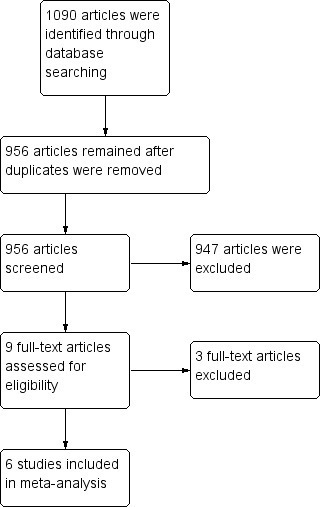
Following the PRISMA guidelines, PubMed, Cochrane, and Google Scholar (pages 1-20) were accessed and explored until July 2026 using the following keywords “cervical”, “bone morphogenetic protein”, and “BMP” to find articles comparing outcomes of ACDF in patients whether or not they received BMP. Additional articles were identified by reviewing reference lists from relevant articles. Two reviewers determined the eligibility of the included studies independently (Figure 1). While one author extracted the data, another author confirmed the accuracy of the extracted data. If present, differences between the investigators were resolved by tie breaker via a third independent reviewer throughout the search and inclusion stages.
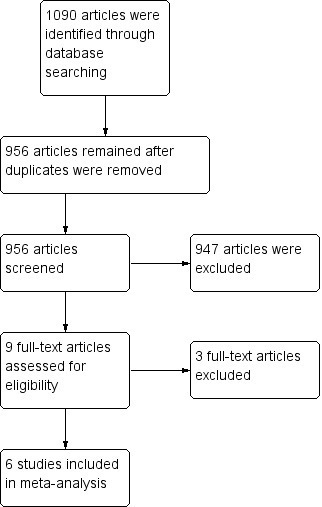
We specifically looked at articles comparing ACDF outcomes between patients receiving/not receiving BMP. Inclusion criteria consisted of RCTs and prospective comparative English and non-English-language articles. There were no restrictions on language. Nevertheless, all of the included articles were in English. Therefore, specific handling for non-English articles was not required. Exclusion criteria consisted of noncomparative studies, retrospective observational studies and articles assessing the outcomes of cervical spine surgery other than ACDF such as cervical deformity and posterior cervical decompression and fusion.18,19
2.2. Data extraction
The eligibility of the included studies was independently determined by two reviewers. Extracted data included fusion rates, adverse events (subsidence, reoperations, dysphagia, heterotopic ossification (HO)), surgery related outcomes (operative time, and estimated blood loss (EBL)), and the improvement in patient-reported outcome measures (PROMS) (Visual analog scale (VAS) in the arm and neck, and Neck disability index (NDI)). A sub-analysis was done by whether the control group was an allograft or an ICBG.
2.3. Risk of bias assessment
The ROBINS-I tool was used to assess the risk of bias in the included studies that were not RCTs by two authors independently.20 Studies were excluded if they had a critical risk of bias. Risk of bias in RCT was assessed using the Cochrane Risk of Bias tool in a similar manner.21
2.4. Statistical analysis
Review Manager 5.4 (The Cochrane Collaboration, 2020) was implemented for the statistical analysis. Mean differences (MD) with 95% CI were used for continuous data while odds ratio (OR) was utilized for dichotomous data. Heterogeneity was evaluated by Q tests and I2 statistics. If considerable heterogeneity was indicated by p < 0.05 or I2> 50%, random-effects model was used. Otherwise, the fixed-effect model was implemented. Statistical significance was defined as p<0.05.
3. Results
3.1. Characteristics of the included studies
Two RCTs and 4 prospective studies (based on 3 cohorts) met the inclusion criteria.11–16 These studies included 1888 patients, with 821 patients being in the BMP group and 1067 patients in the control group. Patients in the BMP group had a mean age of 53 years while patients in the control group had a mean age of 50 years. Mean follow-up was 3.7 years in both groups. The main characteristics of the included studies are summarized in Table 1.
3.2. Fusion
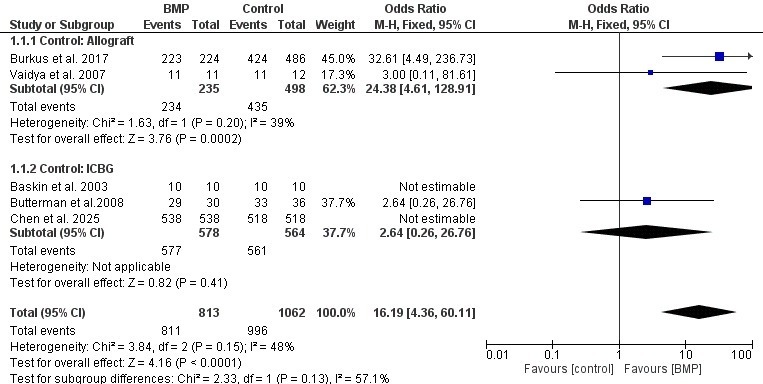
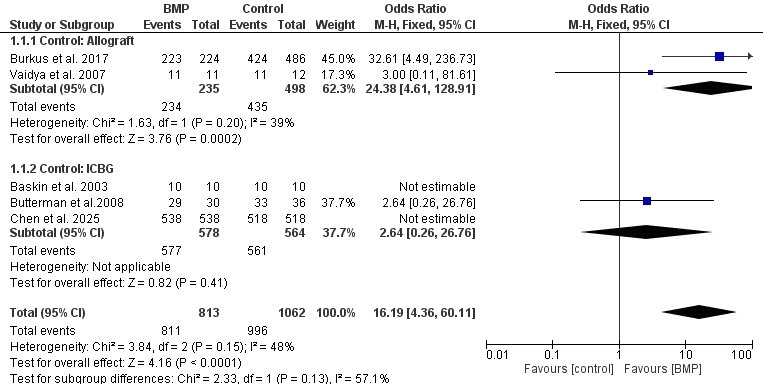
Five studies reported data on fusion rates including 1875 patients (BMP: 813 patients; control: 1062 patients). Patients in the BMP groups had a higher rate of fusion (OR=16.19; 95% CI: 4.36–60.11, p<.001, Figure 2) compared to the control group. When sub-analyzing by control groups, patients in the BMP group still had a higher rate of fusion compared to the control Allograft group (Figure 2) with no difference in fusion rate when compared to the control ICBG group (Figure 2).
3.3. Adverse events
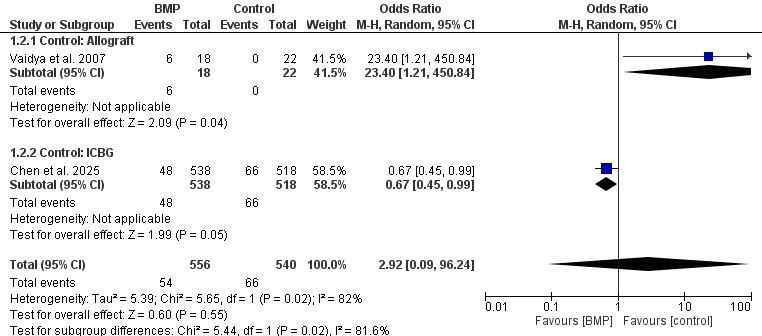
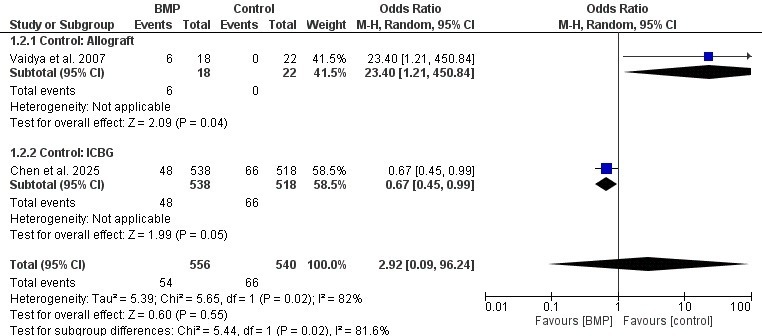
Two studies reported data on subsidence rates including 1096 patients (BMP: 556 patients; control: 540 patients). There was no difference in subsidence rates between the two groups (OR=2.92; 95% CI: 0.04–96.24, p=0.55, Figure 3A) compared to the control group. Sub-analysis by control group is not accurate due to the presence of only one study in each subgroup.
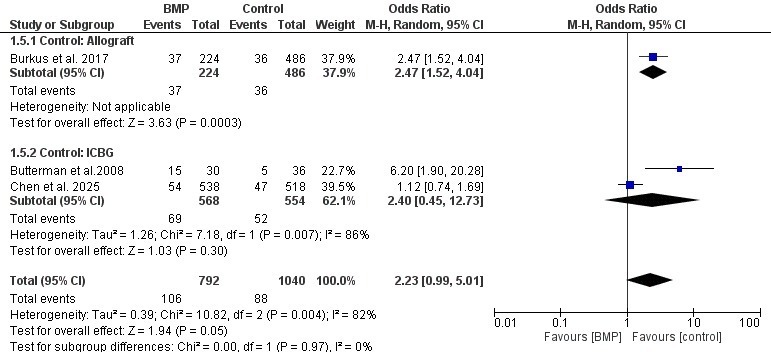
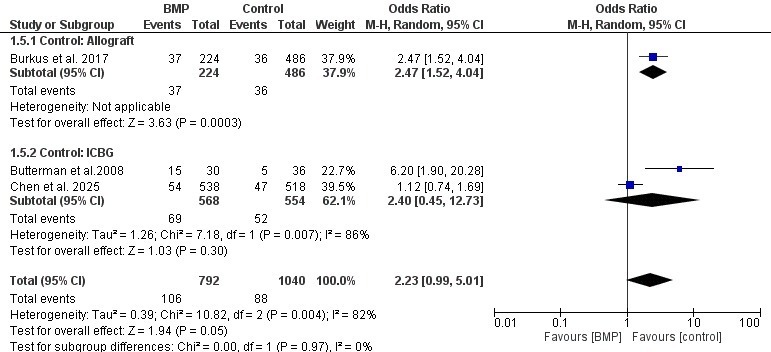
Three studies reported data on dysphagia rates including 1832 patients (BMP: 792 patients; control: 1040 patients). There was no difference in dysphagia rates between the two groups (OR=2.23; 95% CI: 0.99–5.01, p=0.05, Figure 3B) compared to the control group. Sub-analysis by control group reported similar results when the BMP group was compared to the autograft control group (Figure 3B). Comparison to the allograft control group is not accurate due to the presence of only one study in this subgroup.
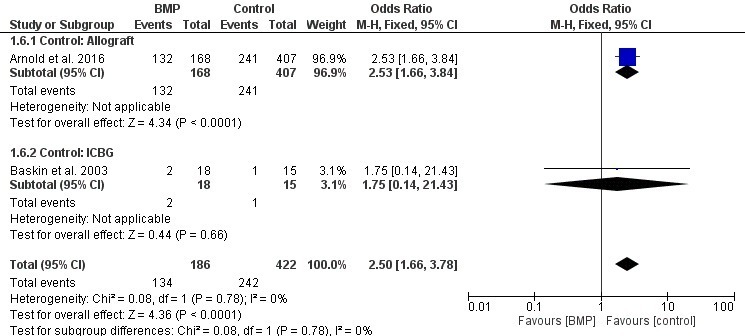
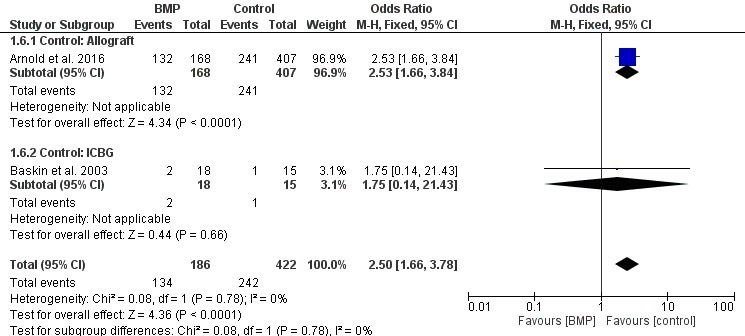
Two studies reported data on HO rates including 608 patients (BMP: 186 patients; control: 422 patients). There was a higher rate of HO in the BMP group compared to the control group (OR=2.50; 95% CI: 1.66–3.78, p<.001, Figure 3C). Sub-analysis by control group is not accurate due to the presence of only one study in each subgroup.
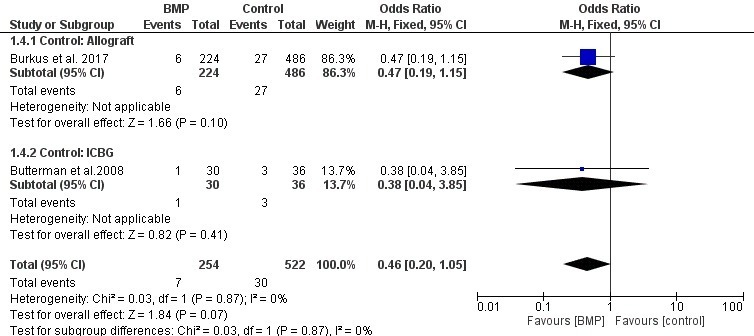
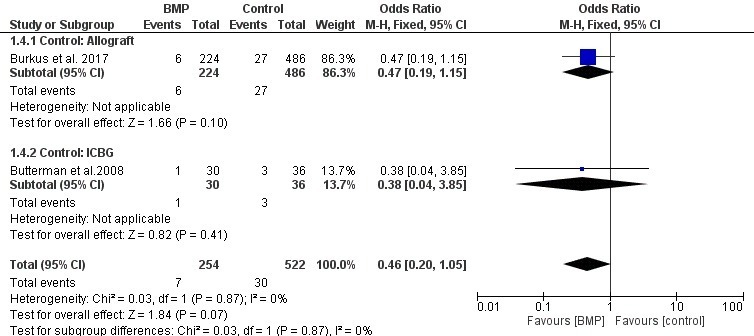
Two studies reported data on reoperation rates including 776 patients (BMP: 254 patients; control: 522 patients). There was no difference in reoperation rates between the two groups (OR=0.46; 95% CI: 0.20–1.05, p=0.07, Figure 3D) compared to the control group. Sub-analysis by control group is not accurate due to the presence of only one study in each subgroup.
3.4. Surgery-related outcomes
Two studies reported data on surgery related-outcomes with one study reporting on single level ACDF and the other comprised of 2 groups: one level ACDF and two levels ACDF in each of the BMP and control group, including 1766 patients (BMP:762patients; control:1004 patients). There was no difference in operative time between the two groups (MD=-7.29 minutes; 95% CI: -22.28–7.69, p=0.34, Figure 4A). However, patients in the BMP group had less EBL (MD=-7.43 ml; 95% CI: -12.40– -2.47, p=0.003, Figure 4B) compared to the control group.


3.5. Improvement in PROMs
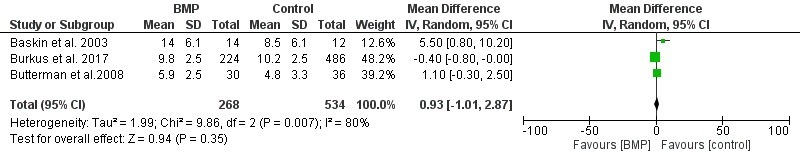
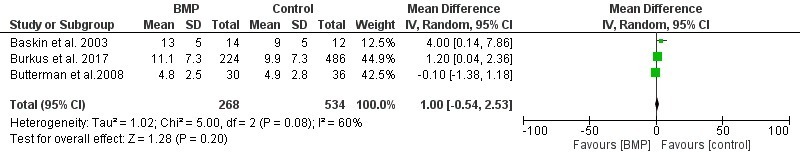
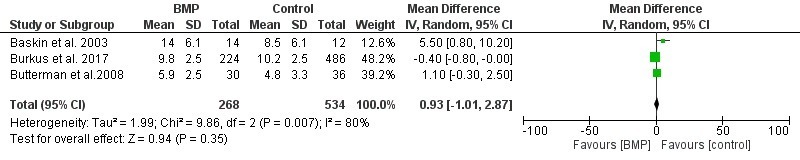
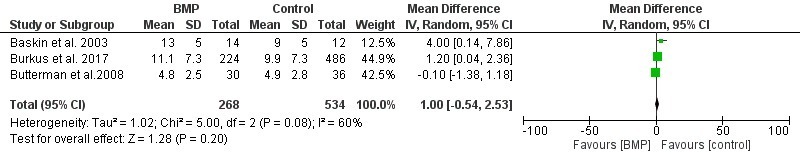
Three studies reported data on PROMs improvement including 802 patients (BMP:268 patients; control:534 patients). There was no difference between the two groups in arm pain improvement (MD=0.93; 95% CI: -1.01–2.87, p=0.35, Figure 5A), neck pain improvement (MD=1.00; 95% CI: -0.54–2.53, p=0.20, Figure 5B), or NDI improvement (MD=4.01; 95% CI: -2.73–10.74, p=0.24, Figure 5C).

4. Discussion
There has been a recent substantial increase in the prevalence of degenerative cervical spinal disease due to the aging population.1,2 While ACDF has been the treatment of choice for degenerative conditions of the cervical spine, this procedure necessitates the use of autologous bone grafts or allografts to facilitate fusion.7 However, the utilization of ICBG is often associated with significant morbidities and allografts are not without drawbacks, as they carry a lower fusion rate than autografts, along with other concerns.9 BMP, an osteoinductive protein have been shown to have higher rates of fusion with a potentially a higher complication rate.11–17 Our meta-analysis showed that patients in the BMP group had a higher rate of fusion compared to the control group. However, this finding persisted only when compared to the control Allograft group with no difference in fusion rate when compared to the control ICBG group. Furthermore, patients in the BMP group had a higher rate of heterotopic ossification and less EBL compared to the control group.
The odds to achieve fusion using BMP were 16 times higher compared to the control group. However, this difference persisted when compared to the allograft group with no difference compared to the autograft (ICBG) control group. One potential explanation to this finding is that allografts carry a lower fusion rate than autografts making BMP superior to allograft with not enough superiority to achieve higher fusion rates compared to autograft.9 Notably, while Ibrahim et al. similarly reported a higher fusion rate with BMP in ACDF (OR=1.12) in their meta-analysis, they did not stratify this fusion benefit by control graft type, limiting the ability to determine whether their pooled effect was primarily driven by comparisons against allograft rather than autograft.17 Furthermore, they pooled retrospective and prospective studies with RCTs which would increase the risk of selection bias and heterogeneity as shown by their I2 being 77% compared to ours being 48%. Importantly, even though BMP did not demonstrate superiority over ICBG in fusion rate, achieving equivalent fusion without the associated donor-site morbidity including chronic pain, lateral femoral cutaneous nerve injury, and pelvic fracture risk still represents a clinically meaningful advantage, as it allows surgeons to match autograft-level fusion reliability while avoiding a second surgical site altogether.8
As for surgery-related outcomes, the BMP group had less EBL compared to the control group by a mean difference of 7 ml. Of note, this difference in EBL is very minimal and may be attributed to measurement errors rather than being a true effect. Another potential explanation to this finding is that ICBG harvest in the control group may contribute to more EBL compared to the BMP group with no required separate incision. Regarding adverse events, the BMP group demonstrated a significantly higher rate of HO (OR=2.50) compared to the control group. This is a novel finding since HO was not assessed by Ibrahim et al. in their meta-analysis.17 This finding is consistent with the known biologic mechanism of BMP, as this osteoinductive protein is not tissue-selective and can induce ectopic bone formation in the soft tissues or disc space when it extends beyond the intended graft containment site.10 While the clinical significance of HO in the cervical spine remains debated, as it is often radiographically incidental rather than symptomatic, its occurrence may still raise concern regarding adjacent-segment motion restriction or technical difficulty during future revision surgery.16 This underscores the importance of proper BMP dosing, carrier selection, and containment technique to minimize off-target ossification when used in the cervical spine.
Lastly, our meta-analysis found no significant differences between the BMP and control groups in dysphagia, subsidence, reoperation, or improvement in PROMs, suggesting that BMP use in ACDF may not carry the safety burden previously attributed to it in less selective analyses. This is notably discordant with the findings of Ibrahim et al., who reported a significantly higher rate of dysphagia with BMP use.17 This divergence may be explained by differences in study inclusion since Ibrahim et al. pooled retrospective, prospective, and randomized data with the majority of their included studies being retrospective in design and may be more prone to inconsistent or incomplete reporting of dysphagia severity. Similarly, the lack of significant differences in reoperation rates and PROM improvement between groups in our analysis suggests that, at least among higher-quality comparative studies, BMP use does not meaningfully compromise clinical recovery or necessitate more frequent revision surgery relative to traditional graft options. Altogether, these findings support a more reassuring safety profile for BMP in ACDF than has been portrayed in prior heterogeneous analyses. Nevertheless, the wide confidence interval around our dysphagia estimate indicates this comparison remains underpowered and should be interpreted with appropriate caution rather than as definitive evidence of safety.
Potential Limitations:
This is the first meta-analysis to compare fusion, safety, and clinical outcomes of BMP use in ACDF using only RCTs and prospective comparative studies, with a dedicated sub-analysis by control graft type. Nevertheless, several limitations should be considered when interpreting our findings. First, only 6 studies met our stricter inclusion criteria of RCTs and prospective comparative designs, and the number of patients in some subgroups was relatively small, which limits the statistical power of our pooled estimates. Nevertheless, we were able to demonstrate significant findings despite the reduced sample size relative to prior reviews that included retrospective data. Second, as a meta-analysis, our findings are dependent on the variables and follow-up periods reported by the included studies, and heterogeneity in BMP dosing, delivery mechanism, and containment technique across studies may have influenced pooled outcomes. Third, the indications for ACDF and the specific interbody device or plating system used were not uniform across the included cohort, which may affect fusion and complication rates independent of graft type. Lastly, some of the included studies did not report adverse events stratified by control group which limited some of the power in the sub-analysis. Despite these limitations, this meta-analysis leverages the highest available level of evidence and is the first to stratify BMP outcomes in ACDF by control graft type, providing clinically relevant, higher-quality evidence to guide graft selection and BMP utilization in anterior cervical arthrodesis.
5. Conclusion
This meta-analysis demonstrates that BMP use in ACDF is associated with substantially higher odds of fusion compared to control, though this benefit is driven primarily by comparisons against allograft, with no significant fusion advantage over ICBG autograft. Patients receiving BMP also experienced a higher rate of heterotopic ossification, though no significant differences were observed in dysphagia, subsidence, reoperation, or improvement in patient-reported outcomes. These findings suggest that BMP may be most valuable as a means of achieving autograft-level fusion reliability in patients receiving allograft, rather than as a routine substitute for ICBG, given its comparable fusion performance and associated risk of HO formation. Surgeons should weigh the fusion benefits of BMP against its risk of HO when selecting graft strategy in ACDF, particularly in patients for whom allograft is being considered as an alternative to autologous bone harvest.
Acknowledgments
We would like to acknowledge the team at the ResPar platform for their support with the mentorship of our junior team members and their help with guiding the data analysis