
Introduction
Blood loss in femoral and tibial fracture surgery reflects both the original injury and subsequent operative treatment. Measured intraoperative bleeding may capture only part of the total burden, because blood can accumulate in injured tissues and the medullary canal. Trials of tranexamic acid (TXA) have therefore evaluated calculated total blood loss, hidden blood loss, postoperative hemoglobin, and transfusion requirements as distinct outcomes.1,2 These measures are clinically related, but improvement in one does not necessarily demonstrate improvement in the others.
TXA inhibits fibrinolysis through interactions with lysine-binding sites on plasminogen and plasmin.1 Intravenous administration provides systemic exposure, whereas local application places the drug directly into a wound, joint, or medullary cavity. Randomized studies support blood-conservation benefits in several fracture settings, including hip arthroplasty performed for an acute femoral neck fracture and topical treatment during hip-fracture surgery.3,4 However, these populations and procedures differ from elective arthroplasty and from resuscitation of patients with major traumatic hemorrhage.
The practical question is whether one route offers a meaningful advantage for a particular fracture procedure. Available comparisons include complex tibial plateau fixation, hip hemiarthroplasty, and tibial intramedullary nailing.5–7 Observational proximal femur studies add information but yield inconsistent route rankings.8,9 A separate question concerns fracture union, for which direct clinical evidence is limited.10 This review examines the evidence by route and outcome, with emphasis on femoral and tibial fractures because these dominate the available source material.
Methods
Review design and source identification
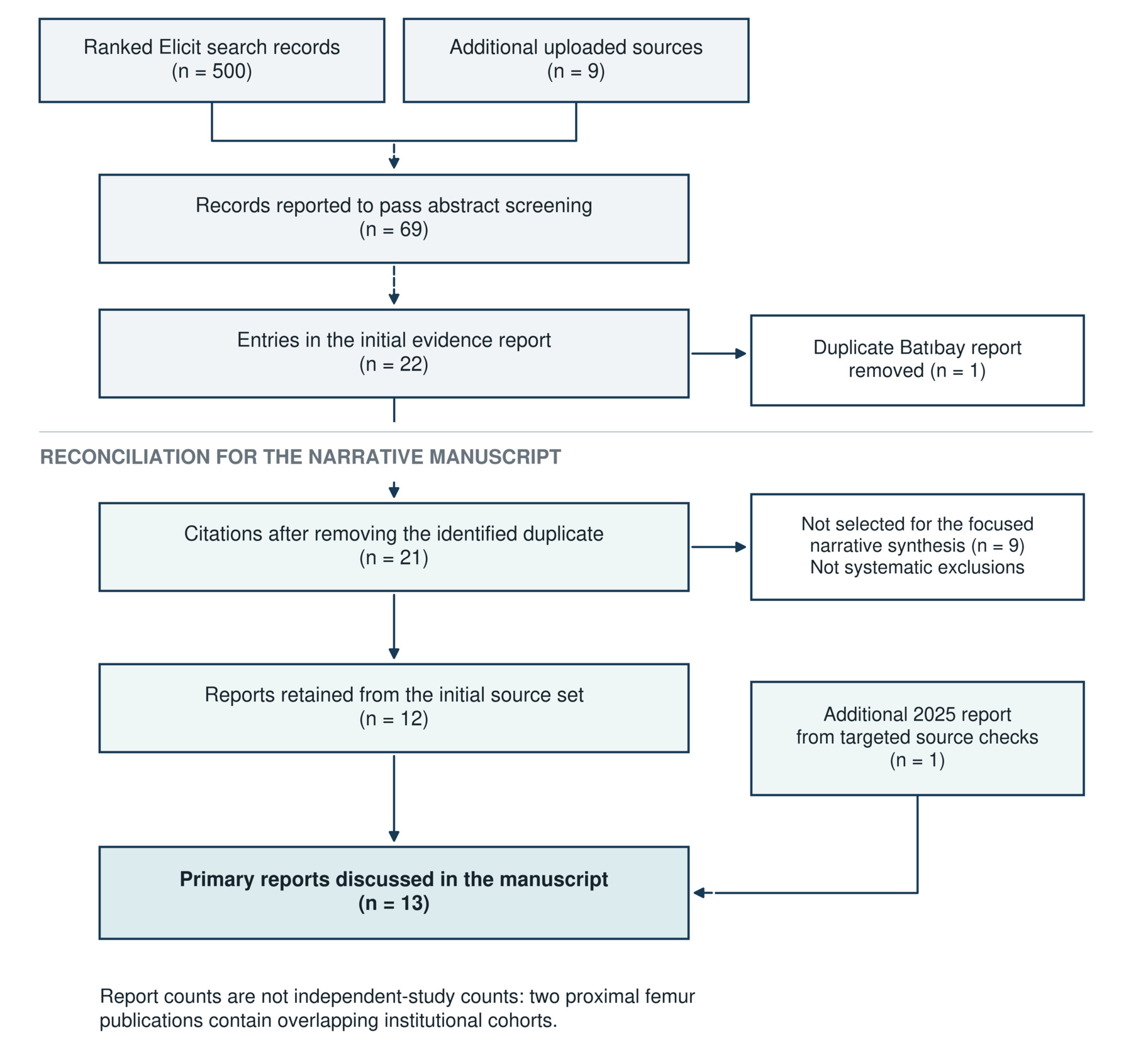
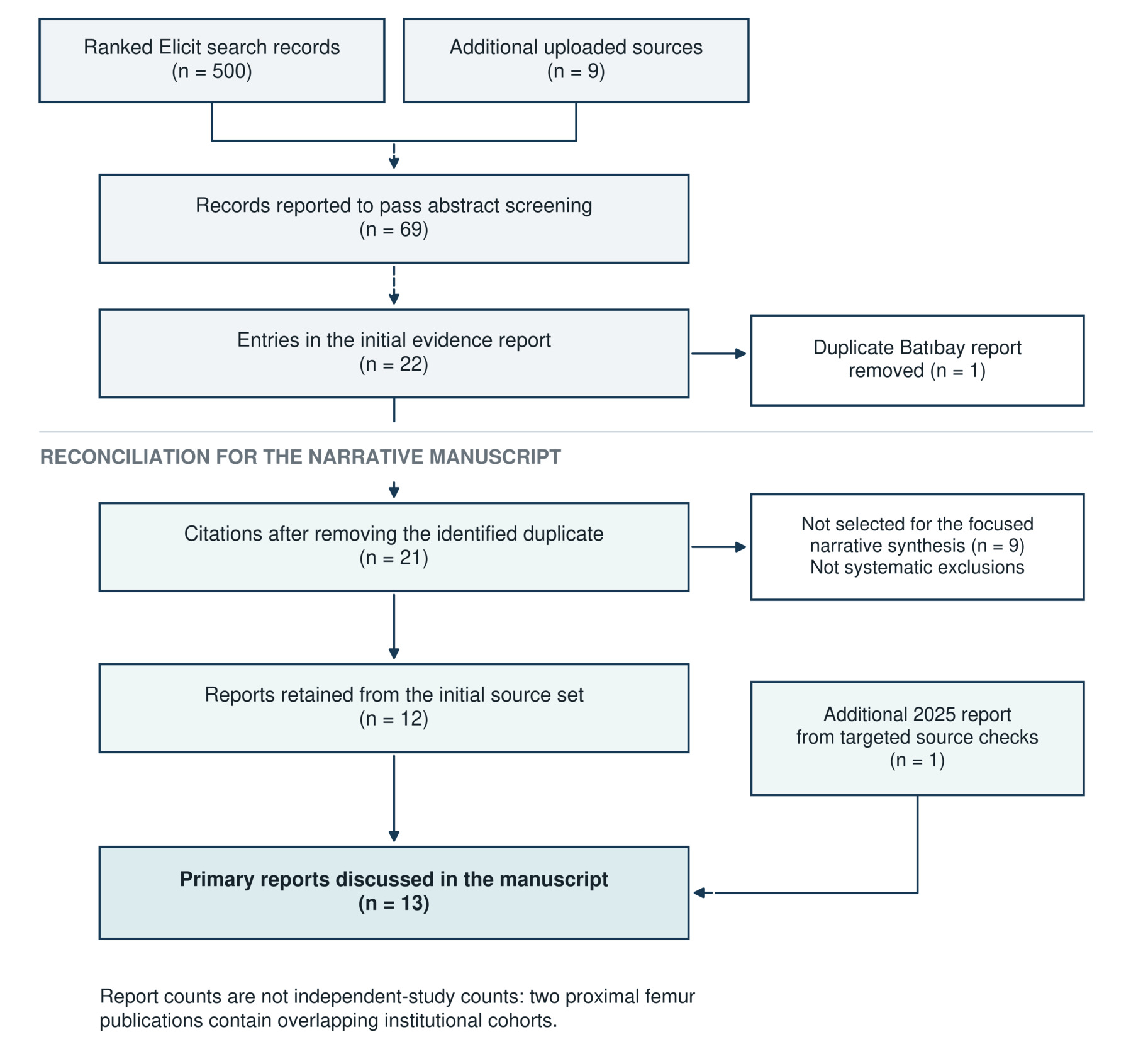
This is a focused narrative review rather than a systematic review or meta-analysis. The starting material was an Elicit-assisted evidence report addressing the following question: “Among adult trauma patients with acute long-bone fractures, which route of tranexamic acid administration (IV, topical, or combined) most effectively reduces surgical complications and promotes bone healing?” Elicit is an artificial intelligence research assistant (Elicit, elicit.co).11 The report describes a ranked semantic search returning 500 records and the addition of nine uploaded sources. Its original search date was January 6, 2026.
The report listed 69 records after abstract screening and 22 entries after full-text screening. These figures were not treated as a validated study-selection flow: duplicate entries, incomplete bibliographic fields, and uncertainties about eligibility and full-text retrieval were identified. Targeted searches of PubMed and publisher websites were used during manuscript preparation on October 2, 2026, to check selected study identities, intervention comparisons, and findings. A relevant 2025 route-comparison report was added. These checks were selective and do not constitute an exhaustive search update.
Scope and synthesis
The synthesis prioritizes comparative clinical studies of perioperative intravenous, topical, or combined TXA in adults undergoing femoral or tibial fracture surgery. Outcomes of interest were blood loss, transfusion, thromboembolic events, wound complications, mortality, and fracture healing. Arthroplasty for an acute femoral neck fracture was included for blood-conservation outcomes, but it was not treated as evidence of fracture union. Mixed pelvic, acetabular, and femoral cohorts were used only as contextual evidence. A uniform injury-to-surgery interval of 24 to 48 hours could not be verified and was not imposed retrospectively.
The initial report used large-language-model-assisted extraction. For this narrative synthesis, selected findings were checked against primary article text or indexed abstracts, as available. Duplicate citations were consolidated, comparisons were described within their original procedural context, and unsupported pooled counts and route rankings were removed. No pooled effect estimates, formal risk-of-bias ratings, or certainty-of-evidence grades were calculated. The study flow is summarized in figure 1.
Results
Intravenous administration
Intravenous TXA has been evaluated in several randomized fracture-surgery trials. Zhou et al randomized 100 patients undergoing intertrochanteric fracture fixation and reported total blood loss of 563.37 versus 819.25 mL with TXA and control, respectively. Postoperative transfusion was required in 5 versus 27 patients.12 These findings support efficacy in that setting, but the magnitude of transfusion reduction should not be extrapolated to populations with different baseline hemoglobin concentrations or transfusion practices.
Ekinci et al studied 102 patients undergoing proximal femoral nailing. A preoperative intravenous dose of 15 mg/kg reduced total blood loss from 971.2 to 684.6 mL; intraoperative measured loss did not differ significantly. Transfusion occurred in approximately 8% versus 23.5% of patients.2 Chen et al evaluated a three-dose regimen in 176 patients and reported lower perioperative blood loss and transfusion frequency than placebo.1 Neither trial establishes that repeated doses outperform a single dose, because dosing schedules were not compared directly.
In the randomized trial by Watts et al involving 138 patients undergoing arthroplasty for acute femoral neck fracture, intravenous TXA reduced blood loss, but the difference in transfusion frequency was not statistically significant: 17% versus 26% (P=.22).3 This distinction matters when interpreting the clinical importance of blood-loss reductions. Hanke et al also reported lower blood loss and transfusion frequency in a retrospective comparison with historical controls, although the apparent benefit differed between the two participating centers.13 Changes in perioperative care and institutional practice remain potential explanations for part of that association.
Topical administration
Topical treatment is not a single standardized intervention. Wound application, intra-articular delivery, and medullary instillation differ in the tissue exposed, timing, and opportunity for systemic absorption. Costain et al analyzed 65 patients in a randomized trial of topical TXA versus placebo during hip-fracture surgery. Hemoglobin was higher on postoperative days 1 and 2, but not day 3. The apparent reduction in transfused units was no longer significant after excluding units given intraoperatively before topical treatment, and the proportion of patients receiving transfusion did not differ significantly.4 The trial supports an early blood-conservation effect without establishing a reliable reduction in transfusion incidence.
Direct comparisons and combined administration
The main route-comparison studies are summarized in Table 1. Wang et al reported a retrospective analysis of prospectively collected trial data from 90 patients with complex tibial plateau fractures. Intravenous treatment produced lower calculated blood loss than the topical regimen, but clinical and safety outcomes did not establish an overall advantage across all endpoints.5 In a retrospective hemiarthroplasty series, Yerli et al found less blood loss with either intravenous or topical TXA than with no TXA, without a significant difference between routes. Transfusion was required in 5 of 25 topical recipients, 6 of 25 intravenous recipients, and 30 of 50 controls.6 These small, nonrandomized groups cannot demonstrate equivalence.
Xiao et al randomized local medullary TXA or saline during tibial nailing in patients receiving intravenous TXA. Among 97 analyzed patients, adding medullary TXA reduced calculated total blood loss from 417.03 to 252.10 mL.7 The comparator was intravenous TXA plus local saline, not a group receiving no TXA. The result supports an incremental effect of local treatment in this protocol, but cannot determine whether local treatment alone would achieve the same result or whether the additional reduction improves recovery.
Fenwick et al examined multiple routes in a retrospective cohort of 1,479 proximal femur fracture patients and suggested that combined treatment could be advantageous in selected procedures.8 However, a subsequent extension of the same institutional cohort reported the lowest calculated blood loss with topical treatment in the femoral neck fracture arthroplasty subgroup.9 These reports overlap and must not be counted as independent confirmation. Their conflicting rankings, nonrandom treatment allocation, and differences in procedure mix prevent a general conclusion that combined TXA is superior.
Thromboembolic events wound complications and mortality
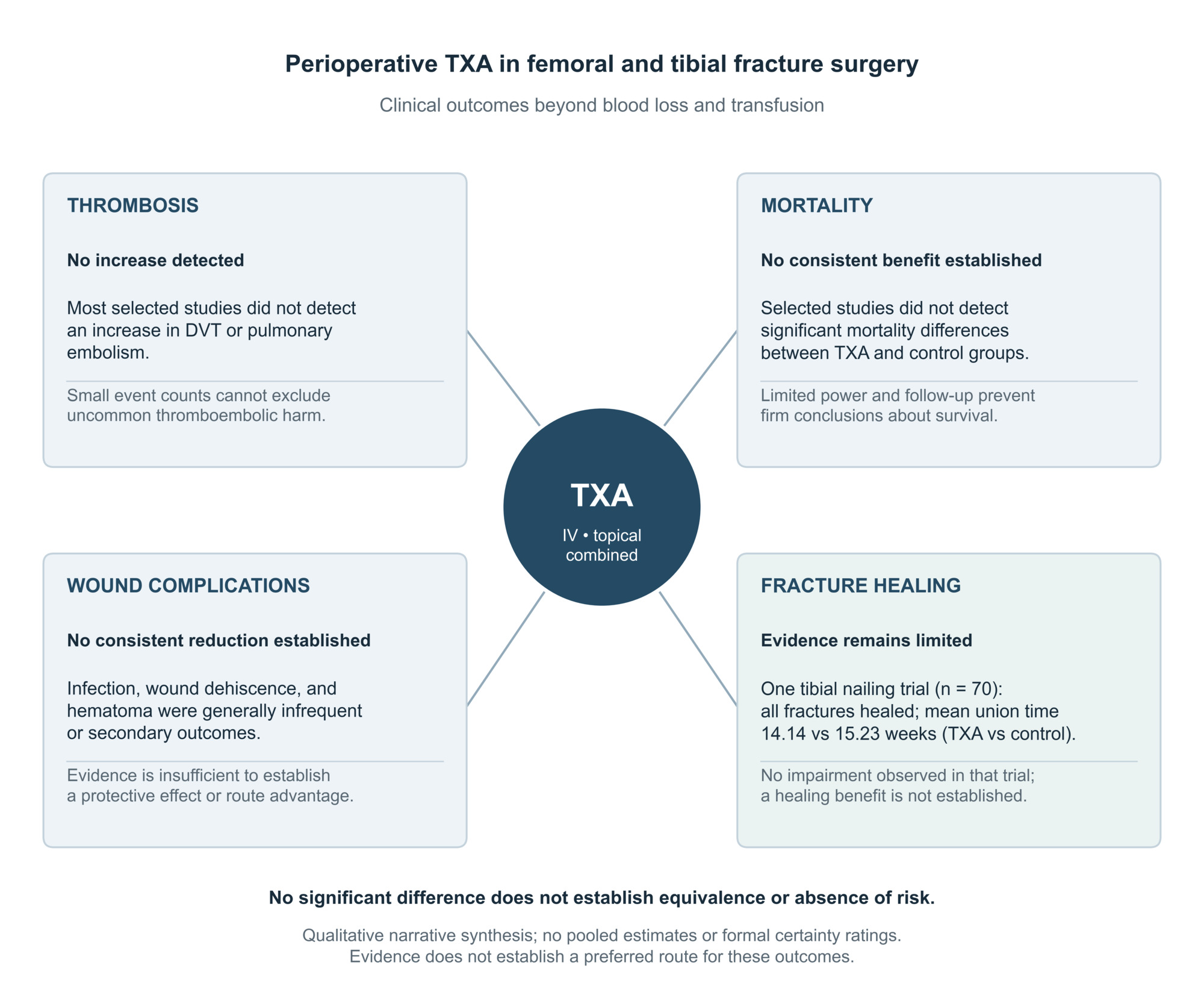
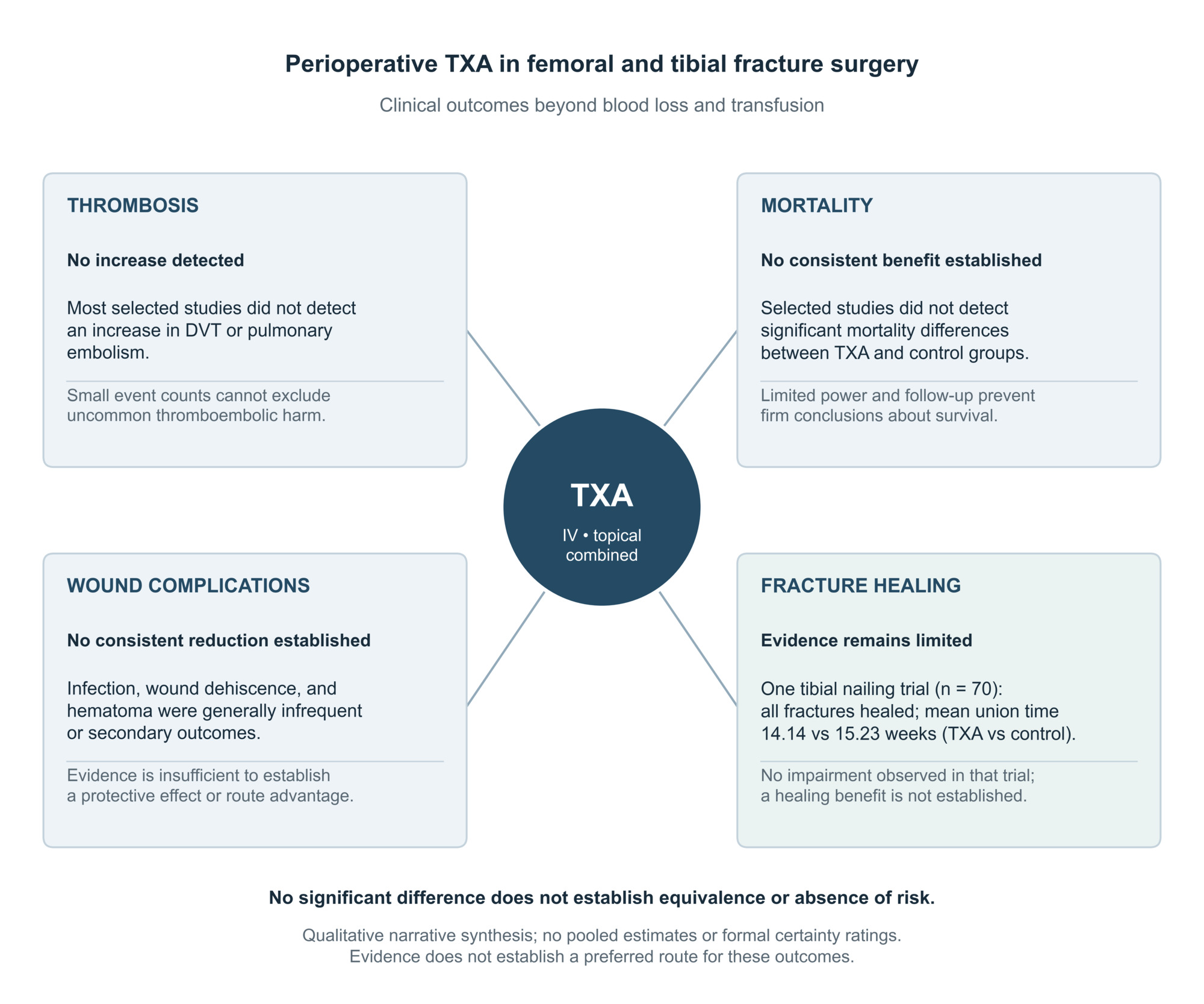
Across the selected trials, statistically significant increases in thromboembolic events were generally not detected.1–7,10,12 This is reassuring, but it is not evidence that the routes have identical safety profiles. In the tibial nailing study by Xiao et al, deep venous thrombosis occurred in 2 of 47 combined-treatment recipients and 3 of 50 intravenous-only recipients.7 Event counts of this size leave substantial uncertainty about clinically important differences. Wound complications and mortality were also infrequent or secondary endpoints in many studies.
Patient selection affects interpretation. Costain et al excluded several higher-risk groups, including patients with previous venous thromboembolism and recent anticoagulant exposure.4 Conversely, the observational Fenwick cohort included patients receiving anticoagulants.8 Evidence from selected trials and broader observational cohorts should therefore be interpreted separately. The available studies do not justify choosing topical treatment solely on the assumption that it eliminates systemic risk, nor do they establish TXA as a treatment to prevent infection, thrombosis, or death in isolated fracture surgery.
Fracture healing
Batıbay et al provide direct clinical evidence relevant to union. In their randomized study of 70 patients undergoing tibial intramedullary nailing, all fractures healed. Mean healing time was 14.14±1.48 weeks with intravenous TXA and 15.23±2.30 weeks in controls (P=.042).10 The finding does not suggest impaired union in this cohort, but a small single study is insufficient to establish an osteogenic effect or a reproducible acceleration of healing. The two Batıbay entries in the initial evidence report describe the same publication and therefore do not represent independent studies.
Blood-loss outcomes, early inflammatory markers, pain scores, and short-term functional measures cannot substitute for radiographic union, nonunion, or reoperation. Likewise, femoral neck fracture arthroplasty studies cannot establish union of the replaced femoral neck. The studies provide no robust direct comparison of intravenous, topical, and combined TXA using fracture healing as the primary endpoint. Route selection to promote union is therefore unsupported. Figure 2 summarizes clinical outcomes.
Discussion
Interpretation for orthopedic practice
The clearest conclusion is that TXA can improve perioperative blood conservation in selected femoral and tibial fracture procedures. The strength and clinical relevance of that benefit vary with the endpoint and operation. Calculated blood loss is sensitive to laboratory timing, fluid administration, and the formula used, whereas transfusion also depends on baseline anemia, symptoms, and institutional thresholds. A reduction in calculated blood loss should therefore be reported alongside the absolute transfusion risk and recovery outcomes, rather than treated as sufficient evidence of fewer surgical complications.
Direct route comparisons answer a different question from TXA-versus-control trials. Evidence that intravenous TXA works during closed reduction and nailing does not establish that a single intravenous dose is optimal. Similarly, a lower mean blood loss after combined treatment does not isolate a route effect when the combined group receives a larger total dose. Future comparative protocols must account for dose, timing, local dwell time, and surgical exposure. Table 2 separates conclusions supported by the reviewed findings from questions that remain unresolved.
Fracture anatomy is another source of heterogeneity. Intracapsular femoral neck fractures treated with arthroplasty, extracapsular fractures treated with a nail, and tibial plateau fractures requiring plate fixation should not be treated as interchangeable populations. In a randomized mixed cohort of 93 patients with pelvic, acetabular, or proximal femoral fractures, Spitler et al found lower calculated blood loss with intravenous TXA but no significant reduction in overall transfusion measures.14 Because pelvic and acetabular fractures are not long-bone fractures and separate femoral estimates were unavailable in the indexed abstract, these results provide context rather than a femur-specific effect estimate.
Research priorities
Future trials should compare routes within a defined fracture and procedure, prespecify transfusion thresholds, and report both calculated and measured blood loss. Absolute event counts and confidence intervals are needed for transfusion, symptomatic venous thromboembolism, infection, and reoperation. Similarity of P values across separate trials cannot establish equivalence between regimens. Observational analyses should address treatment selection, baseline anemia, anticoagulant exposure, renal function, and overlapping institutional cohorts.
Fracture healing requires a distinct research framework. Trials should prespecify clinical and radiographic union criteria, use blinded assessment where feasible, and maintain follow-up long enough to identify delayed union, nonunion, and revision procedures. Functional recovery and return to weight bearing should be reported alongside union rather than assumed from reduced bleeding. Such data are necessary before any administration route can be recommended specifically to improve healing.
Limitations
This review is limited by its narrative design. Formal risk-of-bias assessment was not performed. Selective inclusion, publication bias, heterogeneous outcomes, and nonrandom treatment allocation may influence the synthesis. The evidence emphasized here is concentrated in femoral and tibial procedures and should not be generalized to all upper-extremity long-bone fractures, pediatric injuries, pathological fractures, or major hemorrhage resuscitation. These limitations preclude pooled estimates and definitive route recommendations.
Conclusions
Intravenous, topical, and combined TXA can reduce perioperative blood loss in selected femoral and tibial fracture operations. Evidence for transfusion reduction is less uniform, and direct comparisons do not establish a universal hierarchy of routes. Available safety findings are reassuring but cannot exclude uncommon harms or establish comparative safety in high-risk patients. Evidence concerning union remains insufficient to support TXA as a means of accelerating fracture healing. Administration protocols should be evaluated in the context of the specific procedure, patient population, and outcomes they were designed to improve.