
INTRODUCTION
Osteoarthritis is a major cause of pain, disability, and impaired mobility worldwide. It affects approximately 6.7% of the global population, with projections suggesting an increase of 60% to 100% by 2050.1 Hip and knee osteoarthritis are among the most common forms of the disease, and when nonoperative treatment fails, total hip arthroplasty (THA) and total knee arthroplasty (TKA) remain the definitive surgical options. Demand for these procedures continues to rise with population aging and increasing life expectancy. In British Columbia, Canada, 18.4% of the adult population had osteoarthritis that significantly affected quality of life in 2021.2
Although THA and TKA are highly effective operations, the immediate postoperative period is frequently characterized by substantial pain. Analgesia is a core component of perioperative care,3 and TKA generally requires increased analgesia compared to THA.4 Contemporary arthroplasty pathways rely on multimodal pain management that often necessitate opioids.5 That reliance is not benign. Opioids are associated with sedation, delirium, constipation, nausea, respiratory depression, and the risk of persistent use or addiction. These issues are particularly relevant in arthroplasty populations, which are often older and more vulnerable to medication-related adverse effects.6,7 Identifying safe, inexpensive adjuncts that may reduce opioid exposure after THA and TKA is therefore clinically important.
Vitamin C has been explored as a pain-modulating therapy in a number of settings. Reported benefits have been described in chronic pain conditions such as post-herpetic neuralgia and endometriosis.8–10 In orthopaedics, vitamin C has been studied for prevention of complex regional pain syndrome after distal radius fracture and foot and ankle procedures.11 In perioperative care, both oral and intravenous vitamin C have been associated with lower pain scores and reduced opioid requirements in gynecologic, general surgical, and orthopaedic cohorts.12–17 Arthroplasty-specific studies have suggested that vitamin C may reduce postoperative inflammatory markers such as C-reactive protein (CRP) and erythrocyte sedimentation rate (ESR).18–20
Despite this emerging literature, the effect of adding perioperative vitamin C to a real-world arthroplasty multimodal analgesia pathway has not been well characterized in mixed THA and TKA cohorts within routine practice. The purpose of this study was to determine whether a single postoperative dose of 5 g intravenous vitamin C, added to an established multimodal pain management protocol, was associated with reduced inpatient hydromorphone (HMP) use following THA and TKA. We hypothesized that patients who received intravenous vitamin C would demonstrate lower postoperative hydromorphone consumption than patients who were treated before implementation of the vitamin C protocol.
METHODS
Ethical considerations
Ethics approval was obtained from our institution’s Clinical Research Ethics Board [H25-01944] prior to data collection, and the study was conducted in accordance with the Declaration of Helsinki. Given the retrospective design and deidentified nature of the data, the requirement for individual patient informed consent was waived by the institutional review board.
Patient selection and exposure
This study was conducted as a retrospective single-surgeon before-after cohort analysis.
All consecutive patients who underwent primary TKA or THA performed by a single arthroplasty surgeon at a large, urban teaching hospital between March 1 2024 and July 31 2025 were eligible for inclusion. Patients were excluded if they had a documented history of regular preoperative opioid analgesic use, which was defined operationally as any opioid prescription filled in the 90 days prior to the index procedure. This exclusion was used to reduce confounding from opioid tolerance on postoperative analgesic consumption.
In March 2025, the operating surgeon incorporated a single intravenous dose of 5 g vitamin C into the postoperative multimodal analgesia protocol based on contemporary literature suggesting an opioid-sparing effect of perioperative vitamin C. This dose is on the lower end of what has been reported in similar studies.19,20 No studies investigating a dose range of vitamin C or the timing of vitamin C administration were available for guidance. Other components of the multimodal protocol, including regional anesthetic techniques, intraoperative local anesthetic, scheduled acetaminophen, cyclooxygenase-2 inhibition, in addition to scheduled and as-needed opioid administration, remained unchanged throughout the study period. Patients treated prior to the introduction of vitamin C comprised the control cohort, and those treated after the introduction of vitamin C comprised the vitamin C cohort.
Total hip arthroplasty was performed through posterior, lateral, or direct anterior approaches as clinically indicated. Total knee arthroplasty was performed through a standard medial parapatellar arthrotomy with tourniquet use for cementing at the surgeon’s discretion. Patients received spinal anesthesia or general anesthesia in addition to local analgesia with bupivacaine at the incision site for THA and into the posterior capsule for TKA during surgery. Given the higher pain levels following TKA compared to THA and the availability of nerve blocks, TKA patients routinely received an adductor canal nerve block preoperatively. The block generally lasted until the morning of POD1. For patients in the intervention cohort, 5 g of vitamin C (ascorbic acid) was administered intravenously in the immediate postoperative period prior to transfer from the post-anesthetic care unit.
Immediately following surgery, patients were taken to the recovery room for approximately two to six hours under the anesthetist’s treatment protocol, which may have included pro re nata (PRN, i.e., as needed) doses of fentanyl, HMP, ketorolac, or ketamine. Once the patient was moved from recovery to a hospital room, pain management and control was under the guidance of the orthopaedic surgeon. Patients were given a regular dose of 1 mg of HMP every four hours that could be withheld if the patient was not in pain, and patients were ordered an additional 1-2 mg of HMP every four hours PRN. In addition, all patients received acetaminophen, celecoxib, pregabalin, and topical 10% diclofenac. All patients were encouraged to weight bear as tolerated while in hospital. Inpatients with THA followed standard postoperative hip precautions and were encouraged to mobilise at their own pace with range of motion and strength training guided by physiotherapy. Inpatients with TKA were encouraged to obtain adequate analgesia to be able to passively move their knee.
Data collection
Retrospective chart review was performed by two independent reviewers. Baseline demographic and operative variables included age, sex, BMI, procedure type (TKA or THA), surgical approach for THA (anterior, lateral, or posterior), anesthetic type, operative time, and tourniquet time for TKA. Preoperative analgesic use and prior vitamin C use were also recorded. Race and ethnicity were not documented in the medical record and therefore were not collected.
Postoperative data were collected for POD 0, 1, and 2 and included all administered analgesic medications (acetaminophen, celecoxib, diclofenac, HMP, ketamine, ketorolac, and pregabalin), antiemetic medications (dexamethasone, ondansetron, dimenhydrinate, and metoclopramide), hemoglobin, and serum creatinine. Medications administered in the recovery room were included. Hospital length of stay (LOS) was recorded for all patients.
Outcomes
The primary outcome was total HMP consumption during the index hospital admission. Because hospital LOS varied across patients, HMP consumption was additionally expressed as HMP/hour, calculated as total milligrams of HMP divided by total hours of hospital stay, to provide a normalized comparison across admissions of different duration. Pain scores were not routinely collected and as such could not be included.
Secondary outcomes included antiemetic use and changes in serum creatinine and hemoglobin during the postoperative hospital stay as short-term surrogate markers of tolerability and perioperative safety.
Statistical analysis
Baseline characteristics and PRN HMP by day between groups were compared using independent-samples t-tests. Chi-squared tests were used for categorical variables. A linear mixed-effects model was constructed with HMP/hour as the dependent variable to evaluate the association between vitamin C administration and HMP use while controlling for age, sex, BMI, procedure type, anesthetic type, operative time, tourniquet time, and concomitant analgesic medication use. Statistical significance was defined as a two-sided p-value < 0.05.
RESULTS
Of 193 patients initially identified, 24 were excluded because of preoperative opioid use, yielding a final analytic cohort of 169 patients: 123 in the non-vitamin C group (control) and 46 in the vitamin C group (intervention). The control group underwent 79 (65%) TKA and 43 (35%) THA procedures, whereas the vitamin C group underwent 21 (45%) TKA and 26 (55%) THA procedures (p=0.002 for type of procedure in the control versus vitamin C groups).
The control and vitamin C cohorts were similar for age, sex, THA surgical approach, surgical side, and length of stay (Table 1). The control group had a lower BMI than the vitamin C group (p=0.037). The vitamin C cohort had a longer mean operative time (128.9 ± 28.8 minutes) compared with the control cohort (116.9 ± 21.4 minutes, p=0.004), and a greater proportion of general anesthesia (vitamin C: 44.7%; control: 23.8%, p=0.013; Table 1).
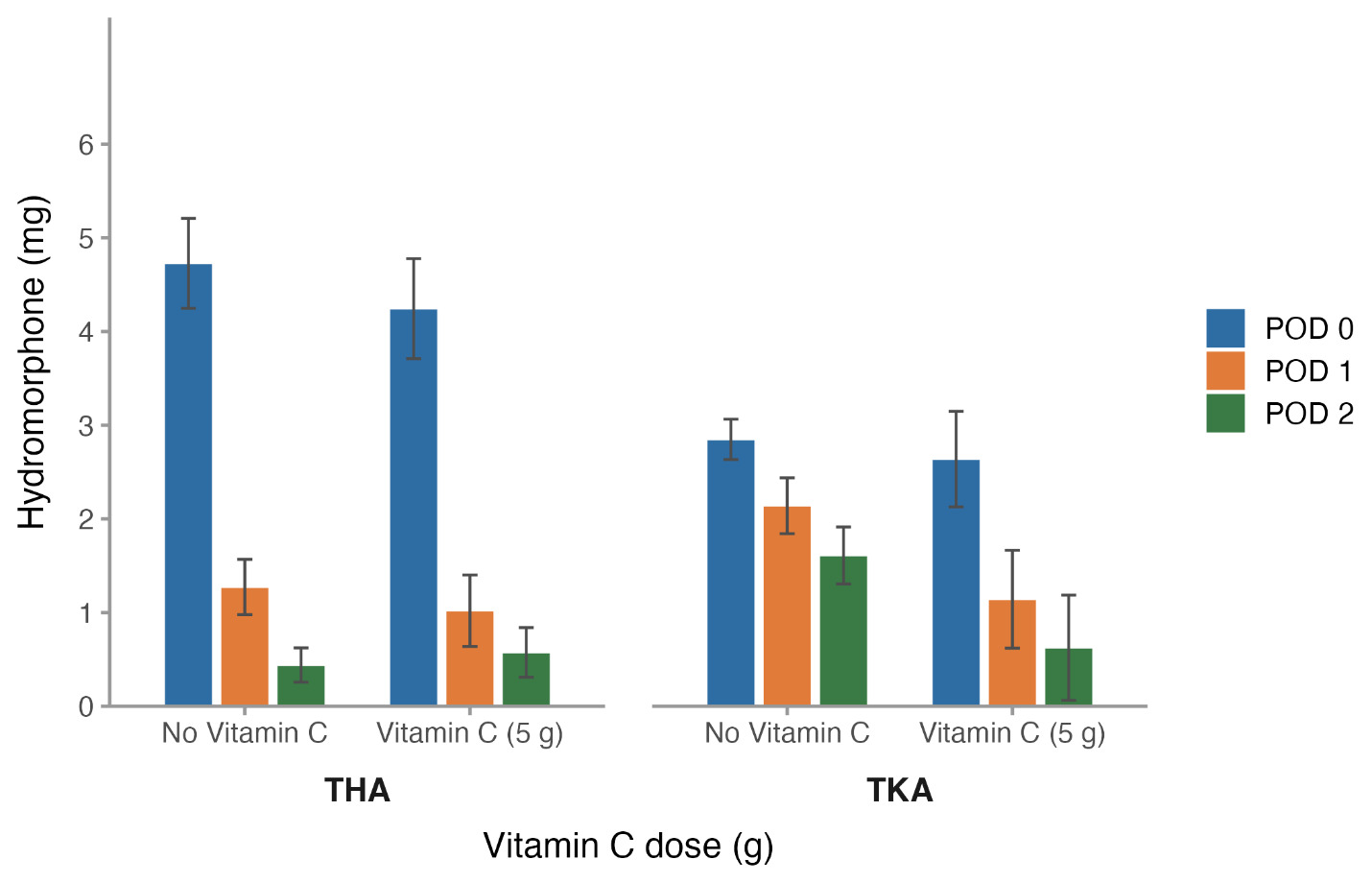
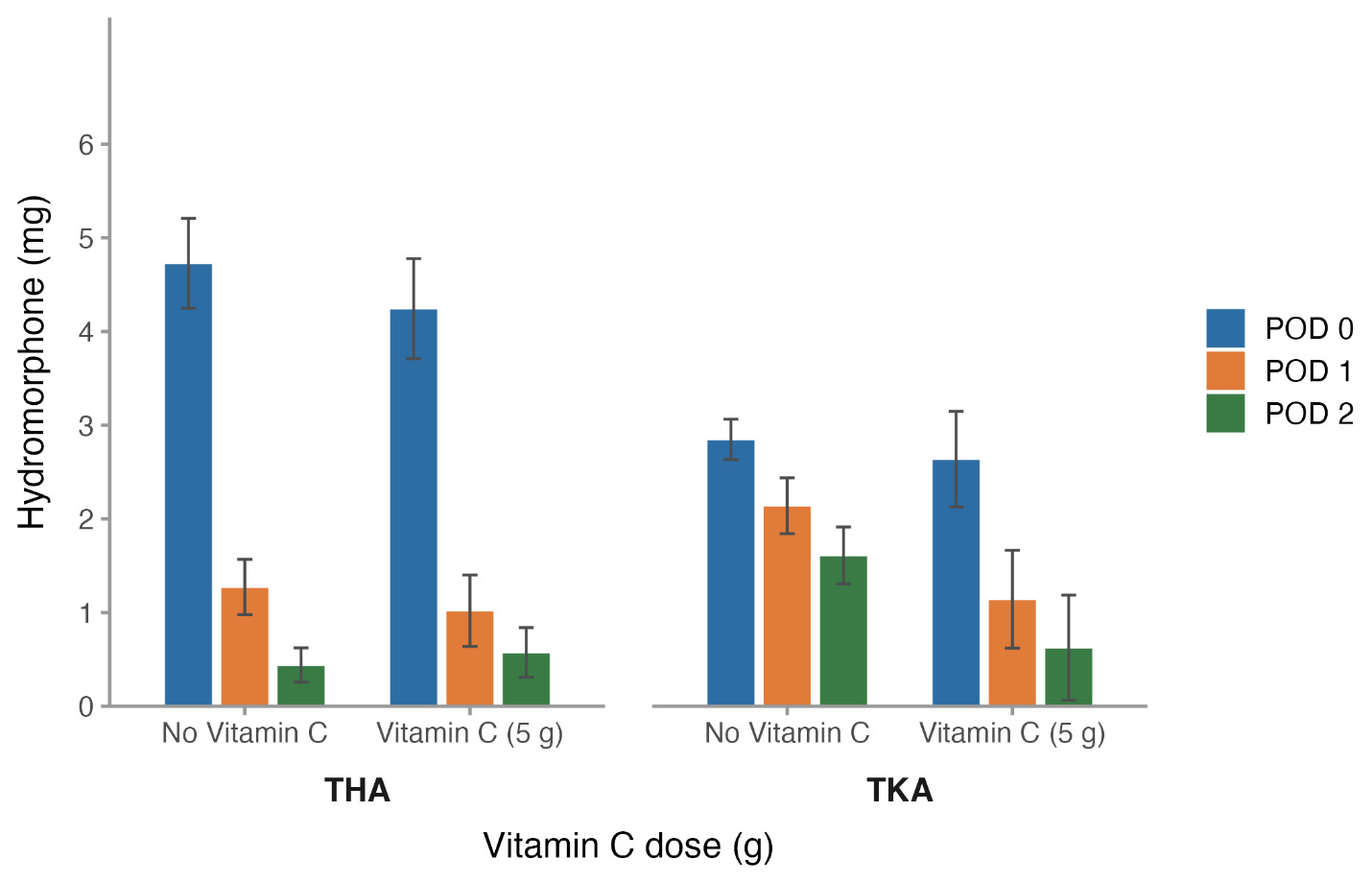
Total HMP use over three postoperative days ranged from 10.6 ± 7.2 mg to 14.6 ± 6.3 mg (Table 2). Patients who underwent TKA required significantly less HMP on POD0 than patients who underwent THA (control: p=0.001; vitamin C: p=0.003, Table 2). Total daily HMP was similar for both surgical procedures on POD 1 and 2, in the control cohort and in the vitamin C cohort (Figure 1). When stratified by surgical procedure, total daily HMP was similar for the control and vitamin C cohorts on each of POD 0, 1, and 2 for patients who underwent THA (Table 2). However, for patients who underwent TKA, total daily HMP was similar for control and vitamin C cohorts only on POD 0 and 2. In contrast, on POD1, after the nerve block had worn off, TKA patients in the control group required significantly more HMP (6.1 ± 3.2 mg) compared to those in the vitamin C cohort (4.4 ± 3.0 mg, p=0.036).
Since hospital stay varied across patients, we calculated HMP/hour. Unadjusted values of hourly HMP use were similar across control and vitamin C cohorts and across surgical procedures (Table 3). In a linear mixed-effects model with HMP/hour as the dependent variable (Table 4) and controlling for age, sex, BMI, procedure type, anesthetic type, operative time, tourniquet time and concomitant analgesic medication, intravenous vitamin C administration on POD0 was associated with reduced HMP/hour (beta coefficient -0.0159, p = 0.003).
No significant between-group differences were identified in changes in postoperative creatinine or hemoglobin. Hemoglobin was in the normal range preoperatively for both control (mean 139.7 ± 12.1 g/L) and vitamin C (mean 135.2 ± 14.5 g/L) cohorts. Postoperatively, mean hemoglobin levels were below normal levels for both cohorts on POD1 (control: 116.7 ± 13.0 g/L; vitamin C: 111.4 ± 14.5 g/L; p=0.024) and POD2 (control: 109.0 ± 14.2 g/L; vitamin C: 102.3 ± 19.8 g/L; p=0.083). Creatinine levels were normal preoperatively and remained in the normal range on POD1 and POD2 for both cohorts.
No patients required transfusion, and no acute kidney injuries were recorded in either group.
DISCUSSION
In this retrospective, single-surgeon, before-after cohort, the addition of a single postoperative 5 g dose of intravenous vitamin C was associated with significantly lower inpatient hydromorphone consumption following primary TKA, but not following THA. No differences were observed between the control and vitamin C groups for antiemetic use, hemoglobin change, or creatinine change during the index hospitalization.
These findings are consistent with prior literature suggesting that vitamin C may have perioperative opioid-sparing effects.4,21,22 Previous randomized and observational studies in general surgery, gynecology, and orthopaedics have reported reduced pain scores or lower postoperative opioid use with oral or intravenous vitamin C supplementation.12–17,19,23,24 In a meta-analysis of three randomized clinical trials (307 patients) of perioperative vitamin C supplementation, total morphine consumption after THA was significantly reduced at 24 hours.25 In another systematic review and meta-analysis of vitamin C supplementation in 6 TKA and 2 THA studies, Liu et al., reported that postoperative visual analogue scale scores were significantly reduced at 24 hours, but not at 48 hours, and no difference in cumulative morphine consumption was observed.26 It should be noted that this analysis did not distinguish between THA and TKA outcomes. In a systematic review of ten randomized controlled trials of vitamin C supplementation in TKA, Vosoughi et al.,27 reported that vitamin C administration varied substantially in dose (0.5 to 15 g), route (intravenous, parenteral, oral), timing (before, during and/or after surgery), and duration (single dose, 3 doses, or for 28 to 50 days); consequently, findings for postoperative pain reduction were inconsistent. The present study extends the current literature by examining implementation of a single-dose intravenous vitamin C protocol within routine arthroplasty practice in a real-world mixed THA/TKA cohort.
The day-to-day differences in HMP use between control and vitamin C groups were more apparent on POD1, particularly among TKA patients. Patients in both the control and vitamin C cohorts who underwent TKA required significantly less HMP on POD0 compared with patients who underwent THA. This was expected, as TKA patients received an adductor canal nerve block preoperatively on POD0. Interestingly, TKA patients who received a single bolus of intravenous vitamin C on POD0 required significantly less HMP compared to controls on POD1 (p=0.036), suggesting an opioid-sparing effect one and perhaps two days later. While this pattern should be interpreted cautiously, it is consistent with the concept that vitamin C acts less as an immediate rescue analgesic and more as a modulator of postoperative inflammatory or oxidative stress pathways one or two days later. Vitamin C demand has been shown to increase after TKA,18 and vitamin C supplementation has been associated with lower CRP and ESR after arthroplasty.20 Likar et al., have proposed that high-dose intravenous vitamin C may reduce inflammatory pain through attenuation of surgery-induced oxidative stress.28 Vitamin C is also a necessary cofactor for peptidylglycine α-amidating monooxygenase, an enzyme involved in peptide amidation, including processing within endogenous opioid pathways. A perioperative depletion state could therefore, in theory, alter endogenous endorphin signaling and influence opioid requirements. These mechanistic considerations remain speculative in the context of the present clinical data.
In this study, the standard protocol for THA and TKA included perioperative administration of dexamethasone, primarily to mitigate postoperative nausea and vomiting, which are symptoms of systemic inflammatory response syndrome.29 Dexamethasone has been shown to reduce dynamic pain following THA30 and to reduce total narcotic use at 12, 24, and 48 hours following TKA.31 In a randomized controlled trial of patients who underwent THA, patients who received perioperative intravenous dexamethasone (n=38) or vitamin C (n=35) had significantly lower morphine consumption on POD0 and POD1 compared to controls (n=34),32 suggesting that vitamin C may be a safe and effective substitute for dexamethasone following THA. In the current study, the pain-reducing effect of dexamethasone may have reduced or masked the full capacity of vitamin C to reduce pain and HMP use following TKA and THA.
From a short-term inpatient safety perspective, no sign of renal or hematologic harm was identified in this cohort. Creatinine and hemoglobin changes did not differ between groups, no patient required transfusion, and no acute kidney injuries were recorded. These findings are reassuring, but they should not be overinterpreted. The present study was not designed or powered to evaluate uncommon adverse events, and the measured safety outcomes were limited to routine inpatient laboratory data. Concerns about intravenous vitamin C have been raised in other clinical contexts, most notably in the LOVIT trial of critically ill patients with septic shock, in which high-dose intravenous vitamin C was associated with worse outcomes.33 That population differs substantially from an elective arthroplasty cohort receiving a single 5 g postoperative dose. Other critical care trials have not shown the same mortality signal,34 and broader reviews suggest that clinically significant toxicity is uncommon, although oxalate-related complications remain a theoretical concern.28,35 The present data therefore support only a narrow conclusion: no obvious short-term inpatient renal or hematologic adverse signals were detected in this elective surgery cohort.
This study has practical strengths. It reflects a real-world protocol change within a contemporary arthroplasty practice, all procedures were performed by a single surgeon, and the intervention itself is inexpensive, simple, and biologically plausible.
Limitations
As a retrospective, historical-control study performed at a single institution by a single surgeon, this study is vulnerable to residual confounding and secular changes in practice over time. Although the multimodal protocol was intended to remain otherwise unchanged, the cohorts differed in operative time, anesthetic type, and procedure distribution. Unmeasured differences in perioperative care, nursing administration, or discharge practices may also have influenced opioid exposure. The vitamin C cohort was smaller than the control cohort, which reduces precision, particularly after further stratification by surgical procedure, which limits the generalizability of the results. The study focused on inpatient HMP administered during the index admission and did not capture opioid consumption after discharge. The use of HMP/hour helped normalize for variable length of stay, but it does not eliminate discharge-related censoring. Finally, pain scores were not recorded, thus reduced HMP use cannot be assumed to solely reflect reduced pain rather than differences in medication use patterns or analgesic-seeking behavior.
CONCLUSION
The addition of a single postoperative 5 g dose of intravenous vitamin C was associated with significantly lower inpatient hydromorphone consumption following primary TKA, but not THA, in this retrospective, single-surgeon study. These findings are useful as preliminary data supporting prospective evaluation of the effect of vitamin C supplementation on a larger scale, particularly for TKA.
Acknowledgements
The authors thank Dagmar Gross for assistance with preparation of the manuscript.
Author Contributions
BS: Data acquisition and interpretation; statistical analysis; drafting, revision, and final approval of manuscript
AV: Study conceptualization and design; data acquisition and interpretation; revision and approval of manuscript
LA: Data acquisition and interpretation; statistical analysis; revision and approval of manuscript
KS: Study conceptualization and design; data acquisition and interpretation; statistical analysis; revision and approval of manuscript
Conflicts of Interest
BS, LA, and KS have no conflicts of interest to declare.
AV received fellowship research support from Arthrex, Zimmer, Acumed, and Synthes; honoraria for lectures, presentations, speaker bureaus or educational events from Synthes, Arthrex, and Smith and Nephew; and support for attending meetings and/or travel from Synthes, Arthrex, and Smith and Nephew.