
Introduction
Artificial intelligence (AI) has moved rapidly from a largely experimental technology to a practical component of healthcare delivery. AI-enabled systems now support image interpretation, risk prediction, clinical documentation, administrative workflows, and other data-intensive tasks.1–4 This expansion is especially visible in documentation. Ambient AI scribes can listen to clinical encounters, generate structured draft notes, and reduce some of the clerical work that contributes to physician cognitive burden. In chronic pain care, where visits often involve longitudinal symptom review, medication monitoring, procedural planning, and extensive documentation, AI-assisted scribing has been proposed as a way to preserve more physician attention for the patient while maintaining a detailed record.5 Real-world studies of ambient scribes similarly suggest modest reductions in documentation time and electronic health record burden, although adoption and benefit vary among clinicians.6 However, these systems remain imperfect. Ambient tools may inadvertently capture unrelated conversations occurring in the examination room and can generate inaccurate, incomplete, or misleading documentation. Physicians therefore remain responsible for reviewing, correcting, and approving AI-generated notes before they become part of the medical record. Additional workflow and privacy concerns arise when the scribe is not fully integrated into the electronic health record, as the generated documentation must then be securely transferred into the record through a process that maintains patient confidentiality and complies with HIPAA requirements.
The reach of AI also extends beyond direct clinical decision support. AI methods can be used to organize large datasets, analyze consumer behavior, identify patterns in healthcare markets, and automate portions of research and quality-improvement workflows. For example, an AI-powered analysis of online pain-relief products demonstrated how automated data collection and analytic methods can examine pricing, popularity, and customer satisfaction at a scale that would be cumbersome using traditional manual approaches.7 These examples illustrate an important point for medical education: AI is not replacing a single physician task. It is progressively changing the bundle of tasks that define clinical work.
This creates a difficult workforce question. If AI meaningfully reduces the amount of physician labor required for certain activities, should graduate medical education continue expanding residency positions in the same way it has historically? The answer is not straightforward. Residency programs must prepare trainees for decades of future practice, yet workforce planning is necessarily based on imperfect projections. Premature contraction could worsen existing access problems, while unchecked expansion could expose future physicians to tighter labor markets in specialties where technology substantially increases productivity. There is no perfect solution, but continuous specialty-specific reassessment seems the most logical.
Radiology as an Early Model of AI Disruption
Radiology provides one of the clearest examples of how AI can reshape a medical specialty without simply eliminating it. Medical imaging is highly digitized, image volumes are large, and many tasks are well suited to pattern recognition. AI systems can assist with detection, prioritization, segmentation, measurements, and workflow organization, and radiology has represented a substantial proportion of approved AI- and machine learning-enabled medical devices.3,8 These capabilities create understandable concern that the number or type of radiologists needed in the future could change if individual physicians are able to interpret larger volumes of studies with AI assistance.
At the same time, image interpretation is only one component of radiologic practice. Radiologists integrate imaging with clinical history, prior examinations, disease probability, procedural considerations, and multidisciplinary decision-making. AI output can also be wrong, incomplete, or misleading. Current legal and professional frameworks continue to place substantial responsibility on physicians who incorporate AI into patient care, reinforcing the need for human oversight and verification rather than passive acceptance of algorithmic output.9 Thus, the most plausible near-term effect of AI may be a redistribution of work: fewer minutes spent on some repetitive tasks and greater emphasis on supervision, review, consultation, procedures, quality assurance, and communication.
That distinction matters for residency planning. A technology can reduce the time required for a task without proportionally reducing the number of physicians needed. Rising imaging volume, new clinical indications, subspecialization, population growth, and demand for faster turnaround may absorb some productivity gains. Conversely, if productivity rises faster than clinical demand for a sustained period, the workforce implications may eventually become measurable. Residency programs should therefore focus on observed labor-market signals rather than assuming either that AI will have no workforce effect or that current technical performance guarantees future physician displacement.
Which Specialties Are Most Exposed?
The potential impact of AI is likely to vary substantially across specialties. Fields with large volumes of standardized digital information and repetitive classification tasks such as radiology, pathology, and dermatology may experience earlier task automation. However, even in these fields, AI is more likely to alter task composition before it eliminates complete professional roles. In contrast, specialties that rely heavily on physical examination, procedures, rapid adaptation to unstable conditions, longitudinal relationships, nuanced preference-sensitive decisions, or emotionally complex communication may be less susceptible to direct substitution, although they will still use AI to improve efficiency.
Interventional specialties provide a useful contrast. A system may help identify an anatomic target, draft a note, predict procedural risk, or generate a differential diagnosis, but it cannot independently reproduce the full combination of patient selection, informed discussion, tactile skill, real-time procedural judgment, complication management, and longitudinal accountability that defines procedural medicine. Primary care, psychiatry, emergency medicine, surgery, and pain medicine may therefore see substantial workflow transformation without experiencing the same degree of task substitution as highly digitized diagnostic fields. The relevant question is not whether a specialty “uses AI,” but which components of its work AI can reliably perform and how much physician time those components consume.
The Residency Workforce Dilemma
Arguments for continued residency growth remain compelling. The United States continues to face maldistribution of physicians, particularly in rural and underserved communities, and an aging population is expected to increase the prevalence of chronic disease, multimorbidity, disability, and healthcare utilization.10 Training capacity also cannot be adjusted instantaneously. A decision to reduce positions today may influence the practicing workforce many years later, after medical school, residency, fellowship, and geographic specialization have occurred. Since AI adoption is uneven and its clinical effectiveness remains specialty and workflow dependent, aggressive reductions in residency positions based on technological forecasts alone could create shortages that are difficult to reverse.
The opposing concern is also legitimate. Residency training represents a major investment by trainees, institutions, and the healthcare system. Physicians commit years to highly specialized education with the expectation that their expertise will remain economically and clinically valuable. If AI substantially increases productivity in selected specialties, expanding training capacity without reassessing future demand could eventually produce greater competition for positions, geographic mismatch, or underemployment. This is particularly relevant because AI development is nonlinear: capabilities that appear limited during one recruitment cycle may become routine before a trainee completes residency or fellowship.
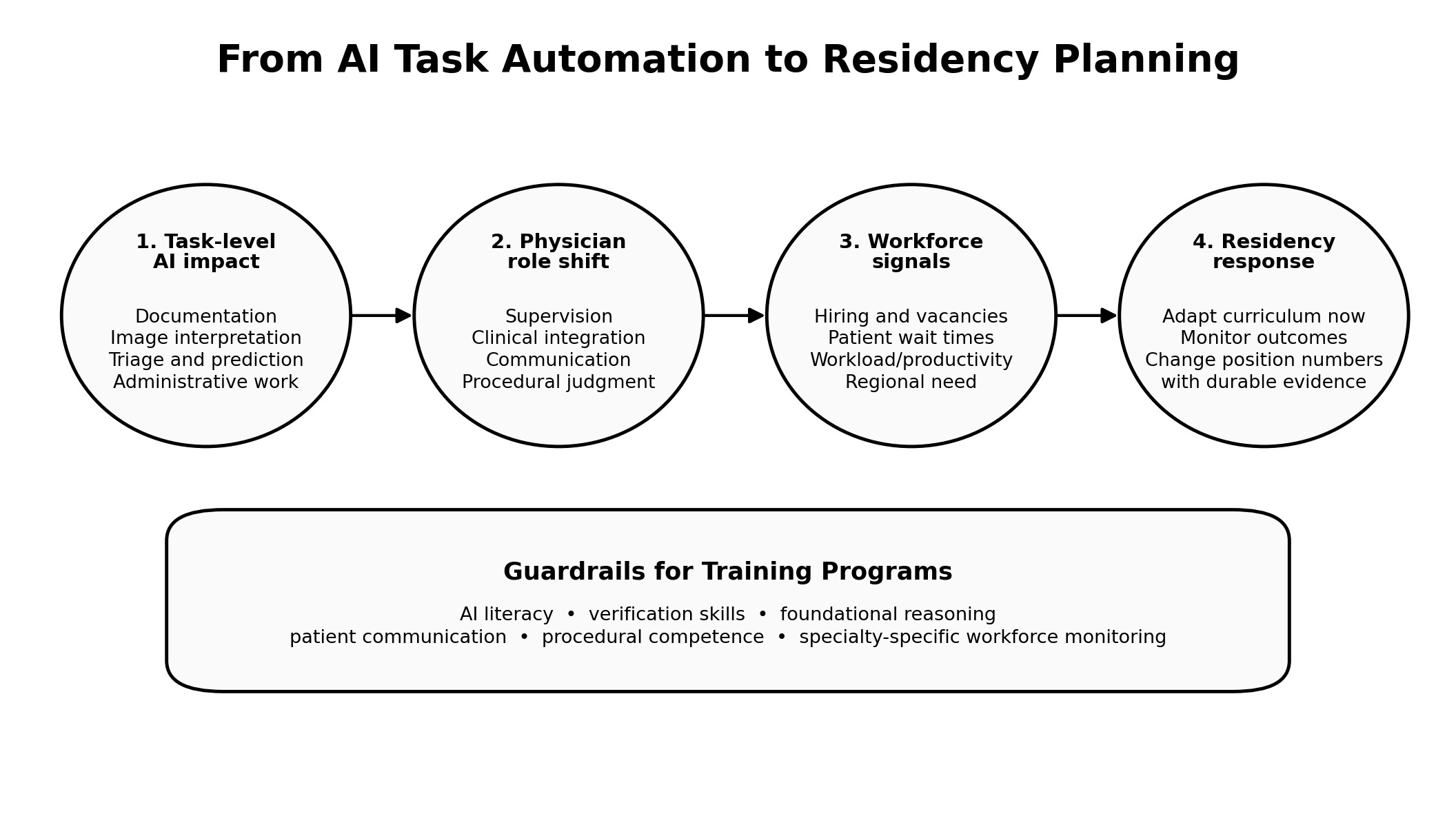
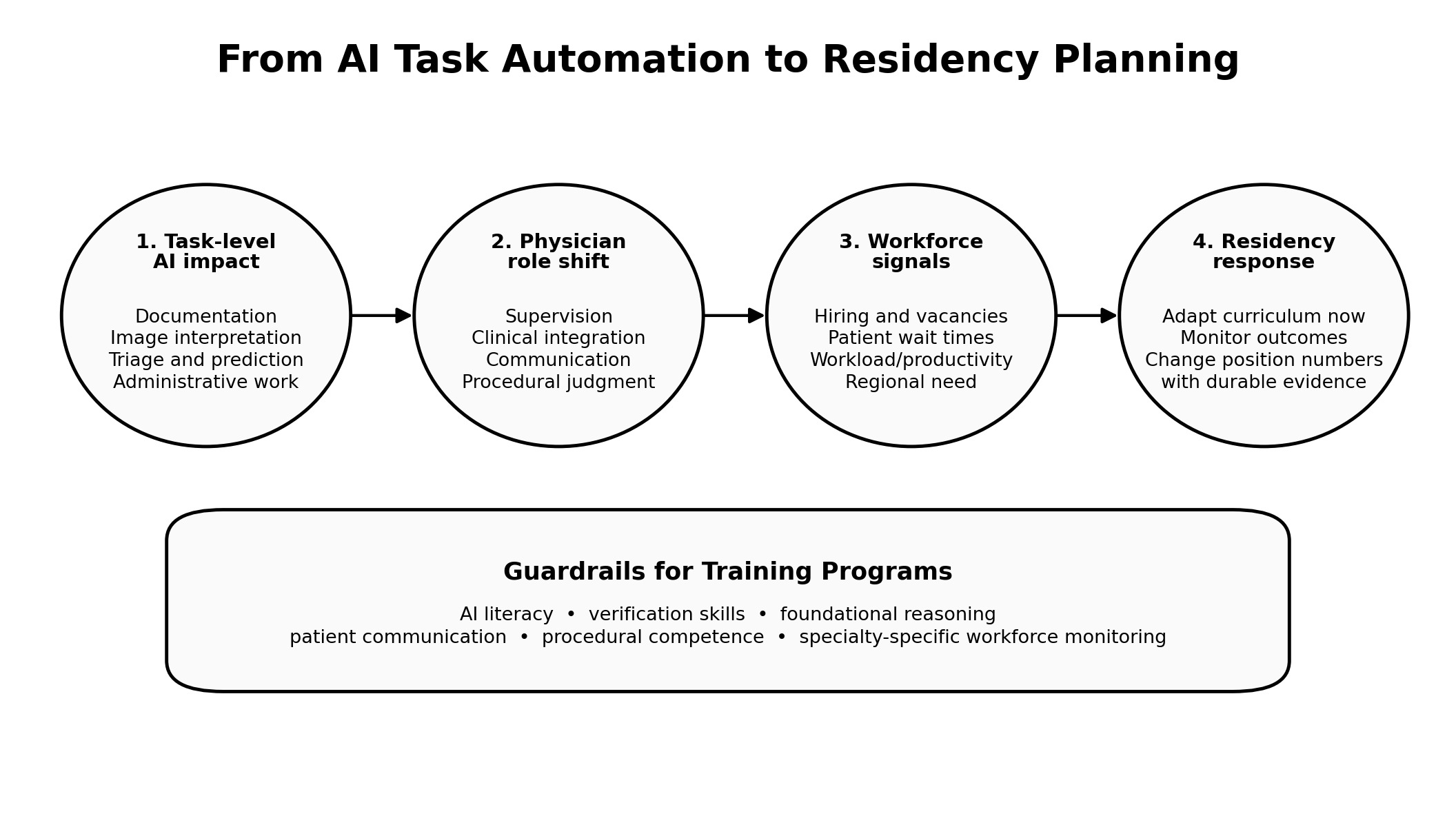
For this reason, the central policy mistake would be to treat residency numbers as static. Workforce planning should become more dynamic and should distinguish short-term enthusiasm from durable changes in clinical labor requirements. Relevant indicators could include specialty-specific vacancy rates, time to hire, use of temporary staffing, patient wait times, geographic access, physician workload, procedural volume, productivity trends, retirement rates, and the degree to which AI actually substitutes for physician time rather than merely adding another tool to existing workflows. No single metric should determine residency capacity, but a consistent pattern across several measures would be more informative than speculation about future automation.
Residency Programs Should Redesign Training Before Reducing Positions
Even if the ideal number of residency positions remains uncertain, the educational response is more immediate: residents need formal preparation for AI-integrated practice. Medical education literature increasingly argues that physicians should be trained not only to use AI tools but also to understand their limitations, recognize bias and hallucination, evaluate performance, protect patient privacy, and know when human judgment should override automated recommendations.11 AI literacy should therefore become a practical competency rather than an elective interest.
Training programs can begin by identifying tasks that residents are likely to perform differently in the next decade. Documentation may increasingly involve reviewing and editing AI-generated notes rather than composing every sentence manually. Diagnostic work may include comparing personal interpretation with algorithmic output and resolving disagreements. Quality improvement may involve AI-assisted data extraction and pattern detection. Patient communication may become more important as physicians explain how automated tools contributed to a recommendation. These changes should not reduce the expectation that trainees understand the underlying medicine. Instead, they shift emphasis toward verification, synthesis, uncertainty management, and responsibility for the final clinical decision.
Residency programs should also guard against deskilling. If trainees become dependent on AI before developing foundational diagnostic reasoning, they may be less capable of recognizing subtle errors or functioning when automated systems are unavailable. The educational sequence matters: trainees should first learn core principles and then learn how AI can augment them. Similar concerns apply to documentation. AI-assisted scribing may improve efficiency, but residents still need to understand what constitutes an accurate, clinically useful, and defensible medical record.5,6 The goal should be supervised augmentation, not substitution of education itself.
A Practical Approach for Graduate Medical Education Leaders
A reasonable strategy is to separate curriculum decisions from workforce-size decisions. Curriculum changes should occur now because AI is already present in clinical practice. Programs can teach safe AI use, verification of generated content, data literacy, human factors, and communication around algorithm-supported care. However, abrupt changes in residency class sizes should be avoided until long term data is available on how AI will impact each specialty. Temporary productivity gains or predictions of automation should not be enough to close training positions that may later be difficult to restore.
Graduate medical education leaders should also avoid a one-size-fits-all national response. AI may change a radiology residency differently from a surgical residency, and it may change an academic tertiary center differently from a rural health system. Specialty organizations, accrediting bodies, and training institutions could benefit from periodic workforce reviews that explicitly include AI adoption as one of several variables. Such reviews would allow programs to expand, hold steady, or contract based on observed need while preserving the ability to respond when technology or patient demand changes.
This framing also protects patients. The primary purpose of residency training is not to preserve physician jobs, nor is it to maximize the adoption of new technology. It is to ensure a sufficient workforce of competent physicians capable of delivering safe, accessible, high-quality care. AI should be evaluated according to whether it advances that goal. If AI reduces administrative burden and restores time for patient interaction, it may increase the value of physicians rather than diminish it. If it reliably substitutes for a substantial portion of specialty work, workforce planning should eventually reflect that reality. Both outcomes are possible, and different specialties may experience them at different rates.
Conclusion
AI is likely to reshape medical practice substantially, but the more immediate threat to residency programs is not sudden physician replacement. It is training physicians for a model of practice that may already be changing. Radiology demonstrates how AI can automate or accelerate important tasks while simultaneously increasing the need for oversight, integration, accountability, and new forms of expertise. Other specialties will follow different trajectories depending on how much of their work can be digitized and standardized.
Residency programs should therefore adapt in two stages. First, they should redesign curricula now so that trainees become skilled supervisors and users of AI rather than passive recipients of its output. Second, they should reassess residency numbers using durable, specialty-specific workforce data as AI adoption matures. The central question is not whether physicians will compete with AI, but how medical training can ensure that future physicians remain indispensable where human judgment, responsibility, communication, and procedural skill add value.