
Introduction
Lacrosse combines running, changes of direction, stick handling, and ball propulsion, with injury patterns studied across school and collegiate settings. Prospective surveillance and collegiate injury reports have described injuries in both male and female participants.1–3
The orthopedic literature includes anterior cruciate ligament injuries and injuries associated with contact, cutting, and throwing. Head, face, and eye injuries are also clinically relevant and overlap with research on protective equipment and sport-specific exposure. A systematic review and meta-analysis has summarized injury incidence among lacrosse athletes.4–6
Bibliometric work in this area already exists. Gross and colleagues examined the 50 most-cited lacrosse publications and identified a strong emphasis on concussion and traumatic brain injury. Wallace and colleagues subsequently conducted a systematic mapping review of player safety, sport science, and clinical care, while Ripley and colleagues reviewed match demands, physical performance, and injury surveillance. These studies provide a foundation for examining subsequent publication and citation patterns.7–9
The present study extends this context by characterizing a July 2026 Web of Science export across all eligible retrieved records rather than restricting the analysis to a most-cited list. The objectives were to describe publication output, citation distribution, publication venues, author participation, geographic representation, and keyword patterns, and to assess how inclusion of records linked only through Keywords Plus affects descriptive findings. The analysis addresses the structure of a search-defined literature; it is not a systematic review of treatment efficacy or injury incidence.10
Methods
Data source and search strategy
A descriptive bibliometric analysis was performed using the Web of Science full-record and cited-reference export dated July 22, 2026. The supplied citation report documented a search timespan of 1965–2026 and exclusion of meeting abstracts, editorial material, and proceedings papers. The topic query combined lacrosse terms with injury, trauma, musculoskeletal, orthopedic, and anatomical terms, followed by exclusions for “La Crosse virus,” “La Crosse encephalitis,” and “encephalitis.” The complete query is provided in Appendix A. No language restriction was added during reanalysis.
The dataset comprised the full-record file, a citation-report workbook, and separate summaries of publication years, document types, subject categories, sources, countries, and affiliations. The full-record file contained 458 distinct Web of Science accession identifiers, with no duplicate accession identifiers. All analyses used the exported records; the database search was not rerun. The recorded date therefore represents the export snapshot, not a new search date.
Corpus definition and relevance assessment
The broad search retrieves more than lacrosse-specific musculoskeletal studies. It includes multisport investigations, concussion research, equipment testing, rehabilitation, biomechanics, and sports-performance studies because the query contains general injury and anatomical terms. These clinically or biomechanically related sports records were eligible even when lacrosse was one of several sports or appeared in background discussion. No inference was made that every retained record reported a separate lacrosse sample or a lacrosse-specific clinical outcome.
Metadata review excluded 24 clearly out-of-scope records: 10 concerning virology or prion research, five concerning lacrosse balls used as massage tools, two concerning coronary devices named Lacrosse, one concerning environmental biology, and six concerning history, material culture, or social behavior without a clinical or biomechanical focus. The primary corpus then required the word lacrosse, case-insensitively, in the title, abstract, or author-keyword field. Forty-six additional records contained lacrosse only in Keywords Plus and were omitted from the primary analysis because the available author-supplied metadata did not establish that connection. These records were not classified as clinically irrelevant; they were retained in a broader sensitivity corpus.
This process produced a primary corpus of 388 records and a broader sensitivity corpus of 434 records. Eligibility was assessed from exported metadata, without full-text review or independent duplicate screening. The screening decisions and accession identifiers are recorded in the accompanying analysis audit. Records were counted as publications rather than independent clinical studies; reviews and a correction notice were retained.
Data reconciliation and bibliometric indicators
The full-record export was the source of record for all recalculated results. Its Times Cited field summed to 16,780 citations across the initial 458 records, whereas the citation-report summary reported 16,771. The cause of this nine-citation discrepancy could not be established from the supplied files. The citation workbook contained detailed rows for only 50 publications, so its annual citation columns were not used to estimate calendar-year citation totals for the entire corpus. After corpus selection, citation totals, means, and h-indices were recalculated directly from record-level Times Cited values. Citations were not adjusted for publication age or self-citation.
Publication year was taken from the full-record PY field, including years supplied for early-access records. The separate final-publication-year summary had three missing values and was therefore not mixed with PY-based counts. The 2026 interval ended at the export date and was treated as incomplete. Source titles were retained as exported labels; document types and Web of Science categories were counted as nonexclusive assignments. Early Access and Book Chapter were treated as additional labels rather than mutually exclusive publication types.
Authors were represented by the exported surname-and-initials identifiers, with each identifier counted once per record. These identifiers were not treated as verified unique individuals. Affiliation labels were counted once per record but were not merged across university systems, campuses, hospitals, or departments. Country counts required an explicit country or region name in the address field; countries were not inferred from cities or postal codes. Each record could contribute to multiple countries. Percentages used the primary corpus as the denominator unless otherwise specified.
Keyword and coauthorship analysis
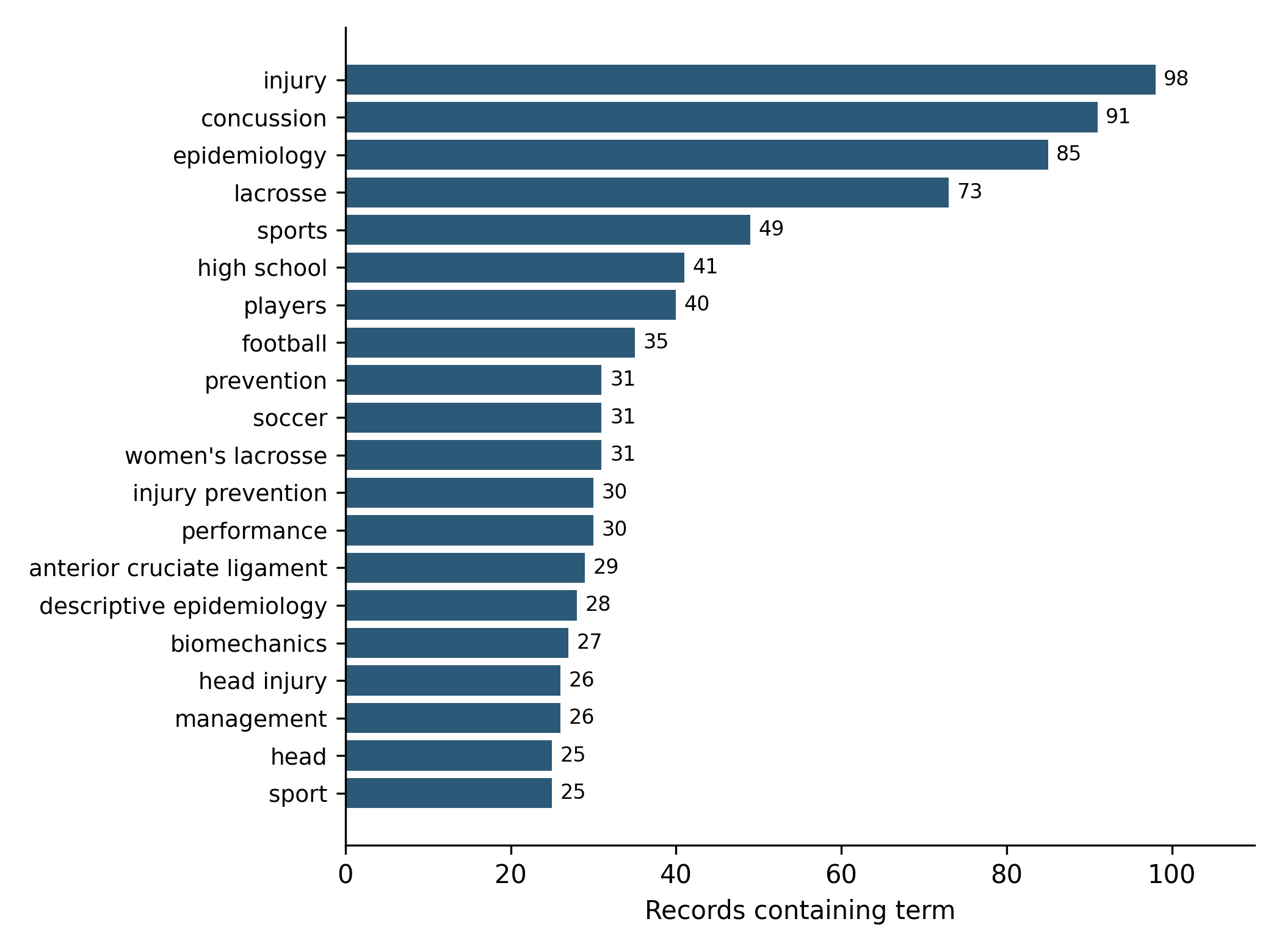
Author keywords and Keywords Plus were combined and counted once per record after conversion to lowercase and normalization of spacing and apostrophes. An explicit thesaurus merged selected variants, including concussion/concussions, injury/injuries, head injury/head injuries/head-injuries, fracture/fractures, helmet/helmets, high school/high-school, women’s lacrosse/womens lacrosse, and ACL/anterior cruciate ligament. Other terms remained separate; for example, prevention was not automatically merged with injury prevention. The complete normalization mapping is included in the analysis audit.
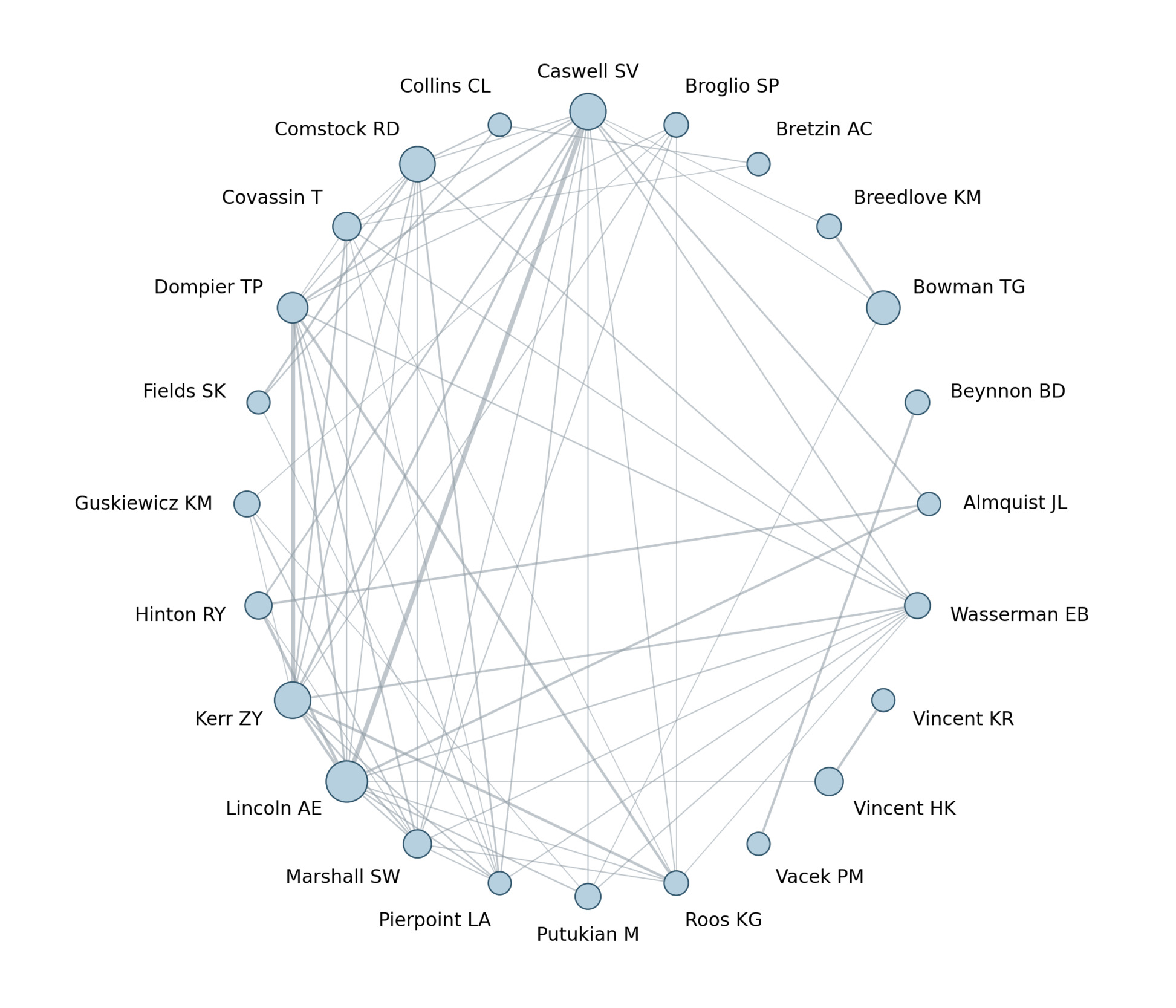
The coauthorship graph used full counting: an edge weight equaled the number of retained records shared by two author identifiers. For a readable display, only identifiers appearing in at least six primary-corpus records were included, with every shared-publication edge among those identifiers retained. Node size represented publication count and edge width represented shared-publication count. A circular display with alphabetically ordered author identifiers was generated in Python using NetworkX. Node position has no substantive interpretation. No community-detection, centrality-ranking, or VOSviewer clustering results were inferred from the display. Analyses were descriptive, with no hypothesis tests or pooled clinical effect estimates.
Results
Corpus characteristics and publication output
The 388 primary-corpus records were all indexed in English and spanned 1987–2026. The corpus contained 343 Article labels, 44 Review labels, and one Correction label. Three of the articles also carried an Early Access label and one carried a Book Chapter label. There were 141 source-title labels and 1,472 distinct surname-and-initials author identifiers. The records accumulated 14,987 citations, with a mean of 38.63 and an h-index of 61 (Table 1).
Counts derive from the supplied full-record export. The 2026 publication interval is incomplete; publication-year values include early-access records.
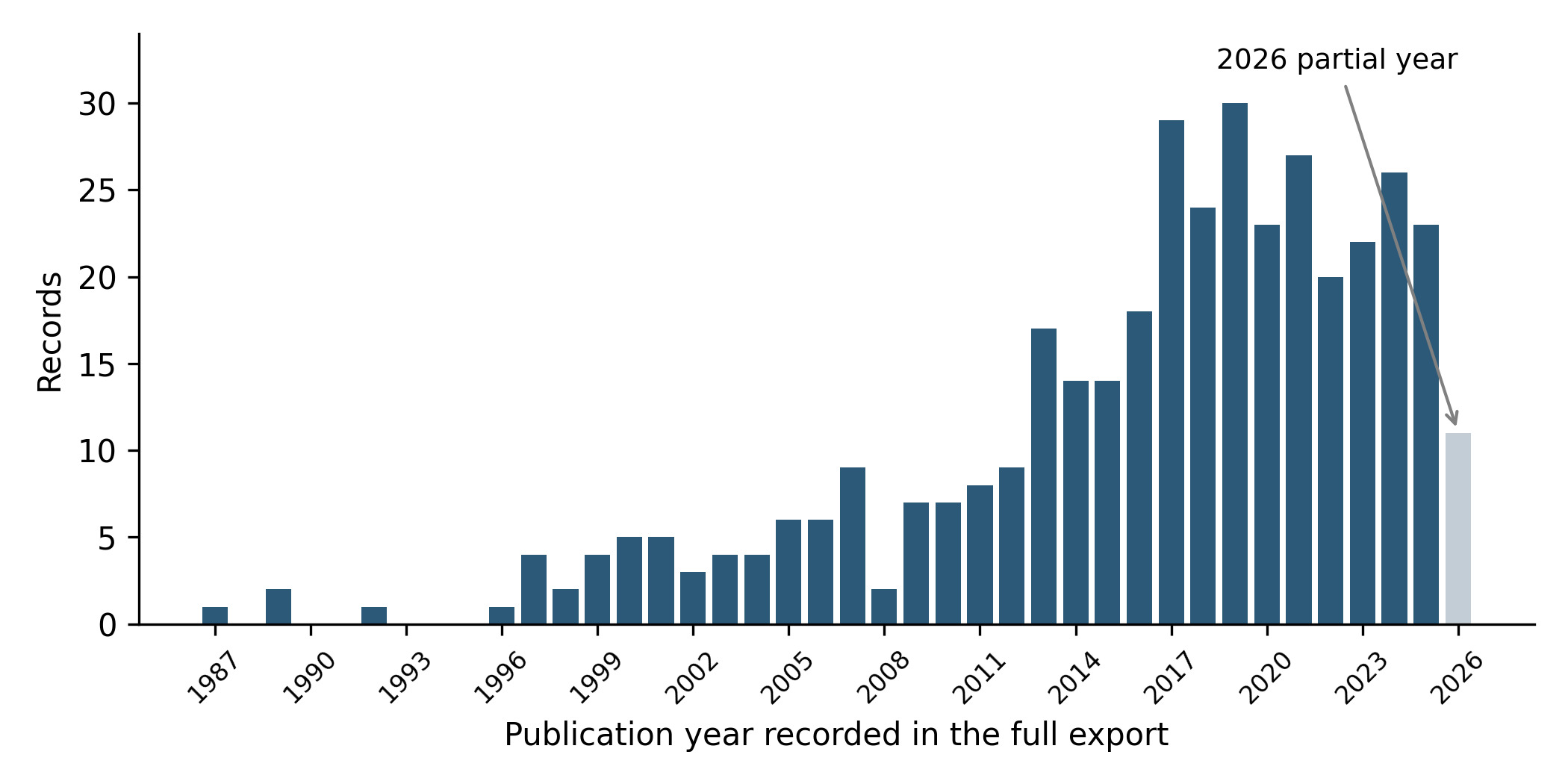
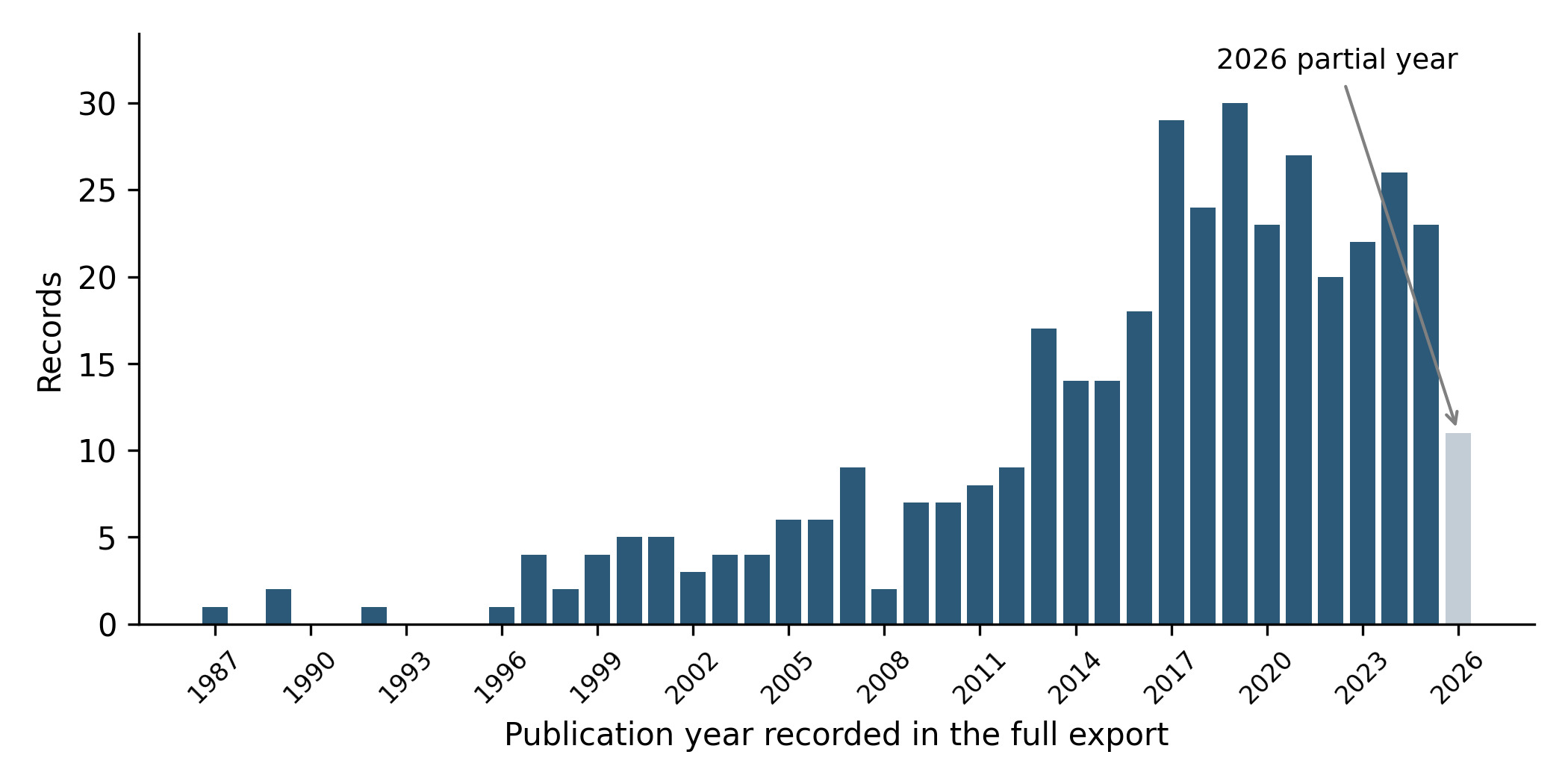
Annual output was higher in the later part of the study period than in the early years (Figure 1). The largest annual count in the primary corpus was 30 records in 2019, followed by 29 in 2017 and 27 in 2021. Records dated 2017–2026 accounted for 235 publications (60.6%). Eleven records were dated 2026; this partial-year count should not be interpreted as evidence of declining output.
Publication venues and geographic representation
The American Journal of Sports Medicine and Journal of Athletic Training each contributed 44 records (11.3%), followed by Orthopaedic Journal of Sports Medicine with 20 (5.2%). Sport Sciences was assigned to 275 records (70.9%), Orthopedics to 120 (30.9%), and Engineering, Biomedical to 28 (7.2%). These overlapping categories describe journal indexing and do not establish the clinical topic of each article (Table 2).
Categories and countries are nonexclusive. Country values require an explicit label in the full-record address field. Six records had no recoverable explicit country label. Source labels are presented with typographic capitalization for readability.
An explicit USA address label appeared in 343 records (88.4%), followed by Canada in 20 (5.2%), Japan in 12 (3.1%), England in 11 (2.8%), and Australia in 10 (2.6%). Six records had no explicit recoverable country label. These values represent author affiliations, not study locations or participant nationalities.
The exported affiliation labels included University of North Carolina in 43 records, University of North Carolina Chapel Hill in 39, University System of Ohio in 30, and George Mason University in 22. Because the export simultaneously includes system and campus labels, these values are overlapping indexing counts rather than a ranking of independent institutions.
Authors and highly cited publications
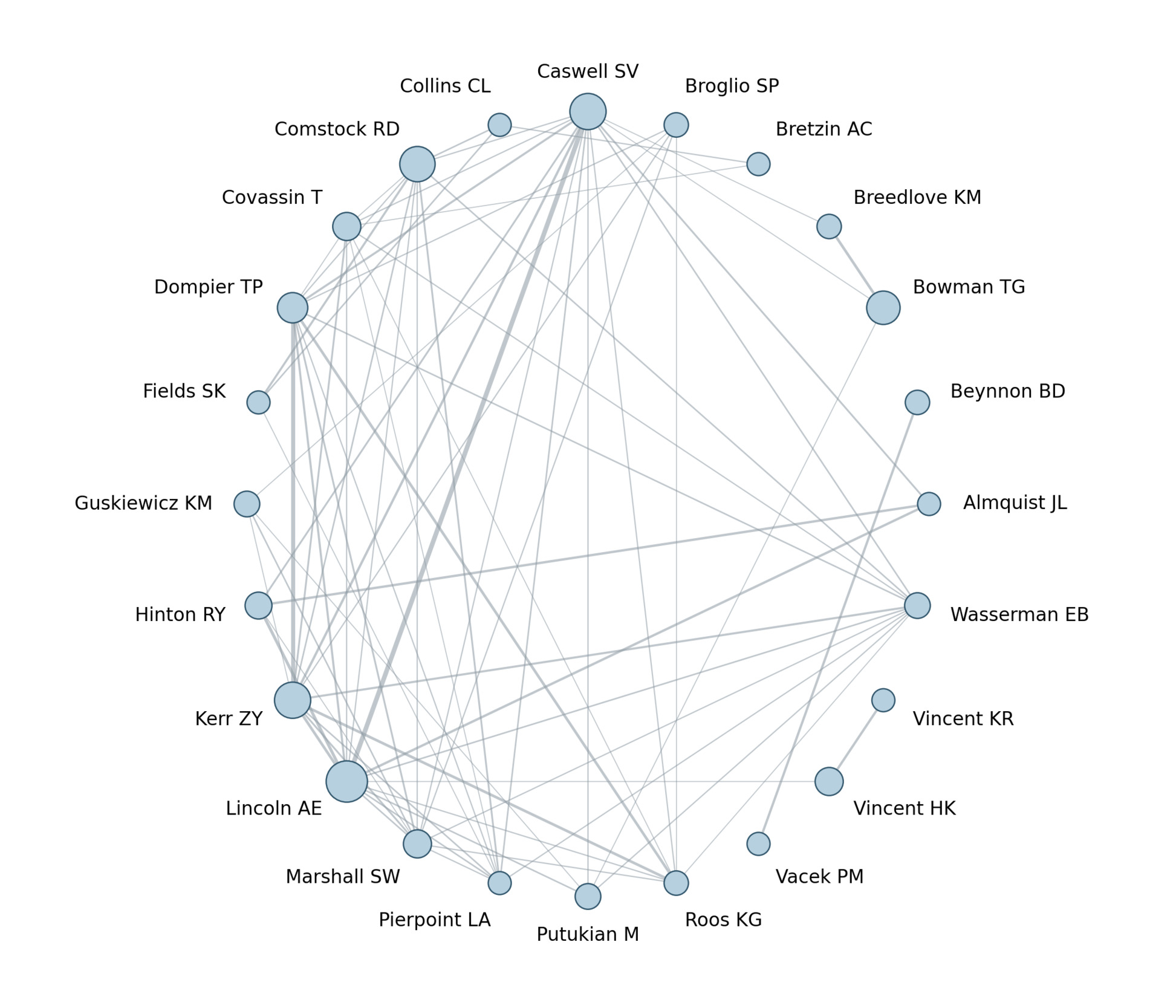
The most frequent author identifier was Lincoln AE (24 records), followed by Kerr ZY and Caswell SV (18 each), Comstock RD (17), and Bowman TG (15). The displayed coauthorship graph included 24 identifiers and 72 edges across 2 connected components; its largest component contained 22 identifiers (Figure 2). These counts are conditional on the six-record display threshold and the use of exported author identifiers.
The most-cited record was the 2013 American Medical Society for Sports Medicine concussion position statement (794 citations), followed by the 2012 study of concussion epidemiology across 20 US high school sports (720 citations). The top ten records included multisport concussion, injury-prevention, and physical-demand research (Table 3). Their citation counts represent citations to the entire publications, not citations specifically attributable to their lacrosse content.
Topics are abbreviated for readability. Exact titles, accession identifiers, and exported citation counts are provided in the analysis audit. These are publication-level citation counts at the export snapshot.
Keyword patterns and sensitivity analysis
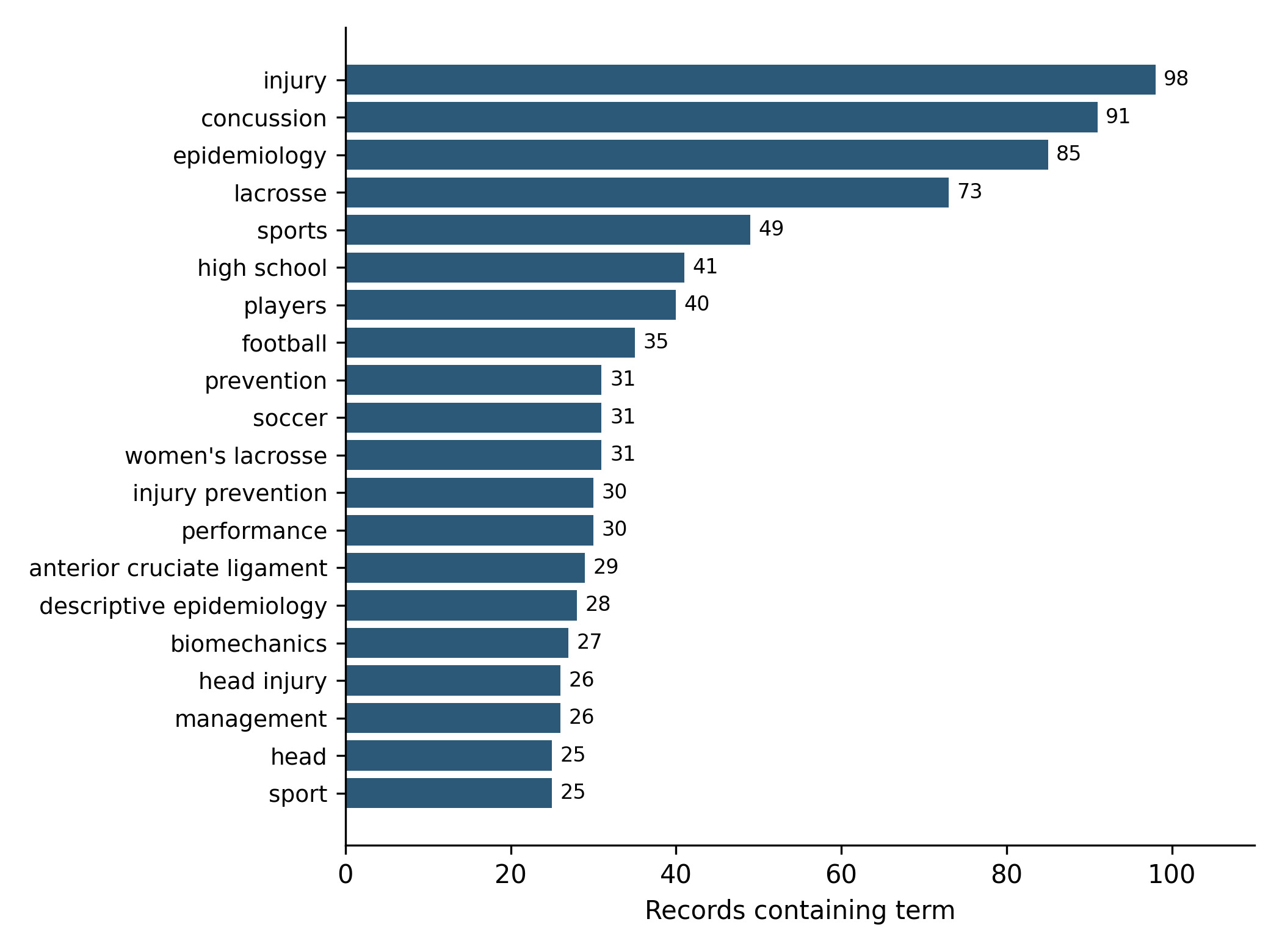
The most frequent normalized terms were injury (98 records), concussion (91), epidemiology (85), and lacrosse (73). Women’s lacrosse occurred in 31 records, injury prevention in 30, anterior cruciate ligament in 29, biomechanics in 27, and head injury in 26. These frequencies reflect the combination of author keywords and Keywords Plus and are not counts of studies dedicated exclusively to those subjects (Figure 3).
Including the 46 records linked to lacrosse only through Keywords Plus increased the corpus to 434 records, the total citations to 16,352, and the h-index to 65. In that broader corpus, the leading keyword labels were concussion (104), injury (103), and epidemiology (97); Journal of Athletic Training and American Journal of Sports Medicine contributed 47 and 46 records, respectively. The persistence of these broad patterns supports the prominence of concussion and epidemiology within the search-defined landscape, while the change in counts demonstrates sensitivity to the eligibility rule.
Discussion
This analysis identifies a substantial body of lacrosse-linked injury and sports medicine publications, with most records dated in the later years of the observation period. The leading venues and indexing categories connect the literature to athletic training, sports medicine, and orthopedics. However, the corpus should not be characterized as 388 lacrosse-specific musculoskeletal injury studies: it includes multisport publications, concussion research, performance and biomechanics studies, reviews, and a correction notice.
The prominence of concussion is consistent with the earlier most-cited analysis by Gross and colleagues. The present study adds a broader publication and collaboration profile and makes the effect of Keywords Plus-only inclusion explicit. It complements, rather than replaces, the systematic mapping review by Wallace and colleagues, which classified study populations and designs, and the scoping review by Ripley and colleagues, which examined performance and injury-surveillance questions. Different database coverage, search terms, eligibility rules, and time windows mean that absolute publication counts cannot be interpreted as directly comparable estimates of field size.7–9
Broader bibliometric studies provide context for these patterns. Kalidindi and Ganti found that sports injury prevention research was concentrated in high-income countries and recurrent author networks.11 Hoon and colleagues identified surgical-method terminology as prominent in the wider anterior cruciate ligament literature.12 These studies help distinguish the prevention and orthopedic components of lacrosse research, although their search scopes and included populations differ from those of the present analysis.
The annual distribution does not identify the cause of changes in publication output. In particular, web-based surveillance predates the 2017–2019 period of high publication counts. The first-decade surveillance studies analyzed collegiate lacrosse data beginning in 2004–2005 and high school lacrosse data beginning in 2008–2009. Publication peaks therefore should not be equated with the initiation of surveillance systems.13,14
The geographic concentration in explicit USA affiliations is a property of this dataset. It does not establish the geographic distribution of lacrosse participation, clinical need, or injury burden. Multinational collaborations may help broaden the populations represented, but the present analysis did not count participants, competition formats, or study settings. Likewise, a recurrent group of author identifiers in the coauthorship graph demonstrates repeated collaboration within the selected corpus; it does not show that collaboration has restricted research topics or reduced quality.
Relevance to orthopedic practice and research
Orthopedic relevance is evident in lacrosse-specific and multisport studies of ligament injury and in the representation of Orthopedics as a journal category. Sex- and competition-specific surveillance studies show why lacrosse findings need to be interpreted in their original populations. Bibliometric counts cannot replace assessment of those study methods or provide an injury-risk estimate for an individual athlete.15,16
The coexistence of concussion and musculoskeletal terminology should not be treated as a scope error in itself. The dataset includes a study examining anterior cruciate ligament injury after concussion in collegiate female lacrosse, illustrating a direct connection between these research areas. Nevertheless, keyword overlap alone does not establish a causal relationship between concussion and subsequent orthopedic injury.17
Clinical recovery also warrants attention beyond counts of acute injuries. In a prospective emergency-department cohort, Ganti and colleagues evaluated postconcussive symptoms at one week and one month after mild traumatic brain injury.18 Although that cohort was not lacrosse-specific, it illustrates the importance of assessing symptom persistence and functional recovery when evaluating the clinical literature relevant to concussion.
Prevention and rehabilitation are already represented in the published literature. Examples include evaluations of the women’s protective-eyewear mandate, checking-related rule modifications in boys’ lacrosse, and the association between headgear mandates and concussion rates in girls’ lacrosse. Rehabilitation-oriented publications address upper-extremity demands and core and back function. These publications illustrate intervention evaluation and clinical translation that are not captured by citation rank alone.19–23
A useful next step would be a dedicated content review that separates lacrosse-specific studies from multisport studies and classifies injury location, population, intervention, study design, and follow-up. Such a review could determine whether particular areas, including postoperative outcomes, recurrent injury, or rehabilitation effectiveness, warrant further investigation. The current bibliometric analysis generates questions for that work but does not quantify those gaps or assess the effectiveness of existing interventions.
Strengths and limitations
Strengths include access to the complete 458-record export, accession-based deduplication, recalculation of all reported indicators from record-level fields, explicit keyword normalization, and a sensitivity analysis of the metadata eligibility rule. The analysis also distinguishes nonexclusive indexing labels from independent publications and separates author-affiliation geography from participant geography.
Several limitations affect interpretation. Only one supplied database export was analyzed, so database coverage and the original query determine which publications could enter the study. The injury and anatomical search terms can retrieve performance studies, while the exclusion of encephalitis and the requirement for an explicit lacrosse term may omit relevant records. The precise subscription index configuration was not documented in the supplied search report. No search rerun, full-text eligibility review, independent duplicate screening, or risk-of-bias assessment was performed.
The requirement for lacrosse in the title, abstract, or author keywords improves transparency of the connection to the sport but may exclude relevant multisport articles with incomplete abstracts or indexing. Conversely, a mention of lacrosse does not necessarily indicate that the article reports lacrosse-specific data. The broader sensitivity analysis addresses one aspect of this uncertainty but cannot validate the clinical relevance of every retained record.
Citation counts favor older publications and vary with database updates, document type, and field. The discrepancy between the supplied citation summary and full records prevents attributing the recalculated values to an exactly matching citation-report snapshot. The PY field can include early-access years, and 2026 was incomplete. Source-title variants, surname-and-initials author identifiers, and overlapping affiliation labels were not comprehensively disambiguated. Explicit-country extraction left six records unclassified and should not be interpreted as a complete geographic reconstruction.
Finally, keyword frequencies depend on indexing and the stated thesaurus. They cannot establish when a research topic first appeared, whether its importance is increasing, or whether a specific intervention has been adequately tested. The coauthorship display is threshold-dependent and describes shared publications rather than the quality or extent of collaboration outside this corpus.
Conclusion
The July 2026 Web of Science export yielded 388 records with an explicit lacrosse connection in the title, abstract, or author keywords after removal of clearly out-of-scope records. The corpus was concentrated in US-affiliated sports medicine publications, with concussion, injury, and epidemiology prominent in keyword and citation patterns. These findings describe a broad research landscape that includes orthopedic questions and multisport evidence. Clinical recommendations and specific research-gap claims require separate assessment of study content and quality.