
Introduction
Degenerative lumbar spinal stenosis causes neurogenic claudication, radicular symptoms and restricted activity. Decompression is an option when disabling symptoms persist despite non-operative treatment. The choice of procedure depends on obtaining adequate neural decompression while limiting tissue injury and preserving stability.1
Uniportal endoscopy uses one corridor for viewing and instruments; biportal surgery uses separate viewing and working portals. Microscopic tubular decompression is non-endoscopic when a microscope provides visualisation, whereas tubular microendoscopic surgery remains endoscopic. These distinctions matter when comparing outcomes. Index fusion introduces a further difference in treatment and recovery.
Recent reviews have included mixed study designs or endoscopic comparators; an October 2026 review focused on single-level biportal surgery.2–4 The newer multicentre biportal-versus-microscopic laminectomy trial (ENDO-BS) adds randomised 12-month outcomes.5 We assessed adult randomised comparisons of endoscopic and non-endoscopic decompression without fusion, distinguishing sustained functional outcomes from early recovery and harms. We also examined how procedure classification, follow-up and reporting quality affect the conclusions.
Methods
Ethical considerations
This review used published aggregate data and involved no new participants or identifiable information. Ethical approval and participant consent were not required.
Registration and reporting
The review was retrospectively registered with the Open Science Framework (OSF; https://osf.io/qb9a6/) on 6 October 2026. On 7 October, the scope changed from older-adult comparative studies to adult randomised trials after a feasibility assessment. Earlier findings and selected trial results were already known. We reused existing trial reports and references, screened the new database export against the revised criteria, and rechecked extraction and assessments. The protocol supplement and Supplementary Table S16 describe the dated changes, including post-results analyses. Reporting follows the Preferred Reporting Items for Systematic Reviews and Meta-Analyses (PRISMA) 2020, its search extension (PRISMA-S), and Synthesis Without Meta-analysis (SWiM) guidance.6–8
Eligibility and search
Adults aged at least 18 years with symptomatic degenerative central, lateral-recess or foraminal stenosis were eligible. Randomised controlled trials (RCTs) had to compare endoscopic bony decompression with open, microscopic or microscopic tubular decompression without index fusion. Stable low-grade degenerative spondylolisthesis was permitted when treated with decompression alone. Nonrandomised comparisons, primary disc-herniation populations, index fusion, endoscopic-versus-endoscopic comparisons and non-English full texts were excluded. Procedures were classified from their operative descriptions rather than their labels.
A clinical evidence specialist searched MEDLINE and Embase through Ovid, CINAHL through EBSCO and the Cochrane Library, including the Cochrane Central Register of Controlled Trials, on 23 September 2026. Subject headings and free-text terms covered lumbar/spinal stenosis and endoscopy, including endoscop*, microendoscop*, full-endoscop*, biportal, uniportal and monoportal. No age, language, design or date filters were applied to the searches; English eligibility was applied during selection. The complete strategies and deduplication record are supplied separately. We checked reference lists and used Europe PMC for forward citations on 9 October; citation information was available for ten of twelve trials. ClinicalTrials.gov was searched on 9 October. Targeted public web-index checks of Chinese and Korean registrations and an attempted World Health Organization (WHO) portal search on 10 October did not amount to comprehensive native-registry searches because of access limitations. Methods and records are in Supplementary Tables S11–S12. The database searches were not rerun after 23 September.
Selection and data collection
Two reviewers independently screened titles and abstracts, assessed full texts, extracted and verified data, and assessed risk of bias and certainty, including supplementary citation records. Disagreements were resolved by discussion, with a third reviewer adjudicating when needed. Other co-authors helped with clinical interpretation and checking. ChatGPT/Codex supplied preliminary screening suggestions, data checks and analysis-code assistance; both reviewers independently checked the evidence and outputs.
Protocols and later publications were linked to their parent trials before counting participants. Yagi was excluded because its Methods describes alternating allocation.9 A pooled safety report was excluded because disc-herniation and stenosis events could not be separated.10 Full-text assessment confirmed that You et al. was a retrospective comparison in which surgeons selected the procedure, rather than a randomised trial.11 Full-text decisions and reasons for linking reports are documented in Supplementary Tables S7 and S8.
We extracted allocated and analysed denominators, operative visualisation, follow-up, final scores, measures of variability and event definitions. Published standard errors or confidence intervals were used to reconstruct variance when possible. Medians and graphs without defined numerical variability were summarised descriptively. Relevant checks from the INveStigating ProblEmatic Clinical Trials in Systematic Reviews (INSPECT-SR) tool informed assessment of reporting consistency.12 We did not claim a complete forensic assessment; findings and their treatment are in Supplementary Tables S9 and S13.
Outcomes, risk of bias and certainty
The primary outcome was the final Oswestry Disability Index (ODI; 0–100) at 12 months, within a 9–15-month window. Secondary windows were 4–8 and 18–30 months. Back and leg pain were separate 0–10 outcomes. Harms and reoperation required an explicit definition and compatible observation period. Operative time, hospital stay and blood loss provided recovery context. Early analgesic consumption was an unplanned descriptive observation.
We used the revised Cochrane risk-of-bias tool for randomised trials (RoB 2) for each outcome and the Grading of Recommendations Assessment, Development and Evaluation (GRADE) approach for certainty.13,14 Judgements and signalling-question responses are in Supplementary Table S6. For patient-reported outcomes, patients are the assessors. Park 2020 and Kotheeranurak 2023 reported patient blinding, whereas ENDO-BS could not fully blind participants. Missing-data judgements considered the amount and reasons for missingness and the analysis method, rather than a percentage cutoff. Overall high risk could also arise from concerns across several domains.
GRADE imprecision considered confidence intervals (CIs) and information size. No validated between-group ODI threshold was prespecified. Individual-change thresholds cannot simply be applied to between-group mean differences.15,16 We therefore describe whether intervals include zero and illustrative differences of 5 or 10 points. For the three-trial ODI result, the interval includes both benefits and zero but excludes harm of either size; one level was deducted for imprecision and one for bias. The profiles explain these judgements (Supplementary Table S5). We did not separately grade calculations dominated by Zhang F’s unresolved variance.
Synthesis and sensitivity analyses
We grouped findings by comparator, outcome and follow-up and recorded the endoscopic technique. For the 12-month microscopic comparison, Park 2020 and Kotheeranurak 2023 supplied differences in final-score means; ENDO-BS supplied a model-based estimate with multiple imputation. The visit and scale match, but methods for missing data differ. We checked this combination using ENDO-BS group means and standard deviations (SDs) and by restricting to final-score means. Adjusted change scores and medians were reported separately.
The protocol-planned 12-month analysis includes every eligible trial with usable data. The six-month ODI analysis, comparator grouping, exclusion of high-risk trials and checks using an alternative sparse-event method were also planned. After inspecting the results, we added a sensitivity analysis without Zhang F, which also restricts the ODI comparison to microscopic surgery. Its published ODI SDs were unusually small, it supplied 95.1% of the planned model’s weight, and its printed age summaries were mathematically incompatible. These age errors do not prove that the ODI values are incorrect. The trial remains eligible; both pooled analyses and the published values are shown. Supplementary Tables S14 and S16 identify each analysis as protocol-planned, a planned sensitivity, or a post hoc exploratory analysis, with the timing and rationale.
Mean differences (MDs) were endoscopic minus non-endoscopic surgery. Random-effects models used restricted maximum likelihood (REML) and modified Hartung–Knapp intervals, with a variance multiplier of at least one and t critical values with k−1 degrees of freedom.17,18 We report I2 and between-study variance in the supplement; with very few trials these estimates cannot demonstrate homogeneity. ENDO-BS contributed its designated primary estimate, with an approximate standard error reconstructed from its rounded CI. Prediction intervals used t critical values with k−2 degrees of freedom for at least four trials; none was calculated for the three-trial ODI analysis. Analyses used Python 3.12.14 with NumPy 2.3.5 and SciPy 1.17.0 and were checked in R 4.3.3 (R Foundation for Statistical Computing, Vienna, Austria), using metafor 4.4-0.
Six-month ODI used the planned approach, reporting the five-trial calculation and the post hoc microscopic-comparator sensitivity together. Compatible 24-month numerical results were reported individually. Separate pooled 12-month back and leg pain estimates and a normal-interval ODI check were post hoc exploratory additions. Published ENDO-BS model CIs were used for pain. Post hoc checks used its arm summaries and final-score estimates only; all results are in Supplementary Table S14.
Incidental durotomy used log risk ratios (RRs) in the protocol-planned REML model, adding 0.5 to all four cells in single-zero studies. The planned sensitivities excluded trials rated high risk for this outcome and used correction-free Mantel–Haenszel common-effect estimates. Additional post hoc analyses omitted Zhang F alone and restricted the comparison to microscopic surgery. Each check used the same trial set for both models. Prediction intervals are reported for the random-effects models. Overall complications were summarised descriptively where events and patients could not be distinguished. Subsequent fusion and all-cause reoperation were separate outcomes. Recovery findings were described by trial where measurement or care pathways differed. We also examined endoscopic technique and stable spondylolisthesis, but data were insufficient for reliable interactions. Fewer than ten trials contributed to each analysis, so funnel-plot asymmetry was not tested.
Results
Study selection and clinical context
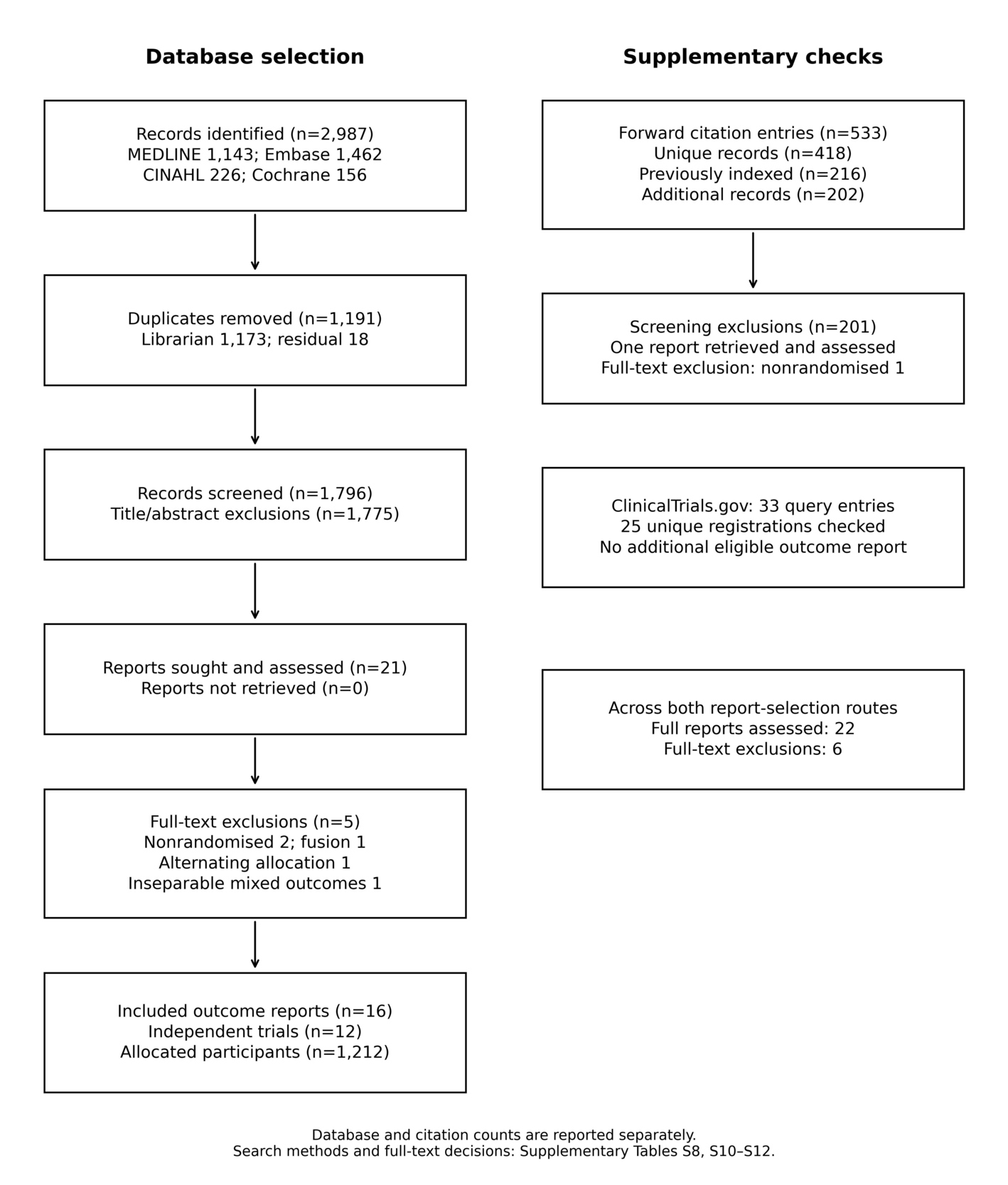
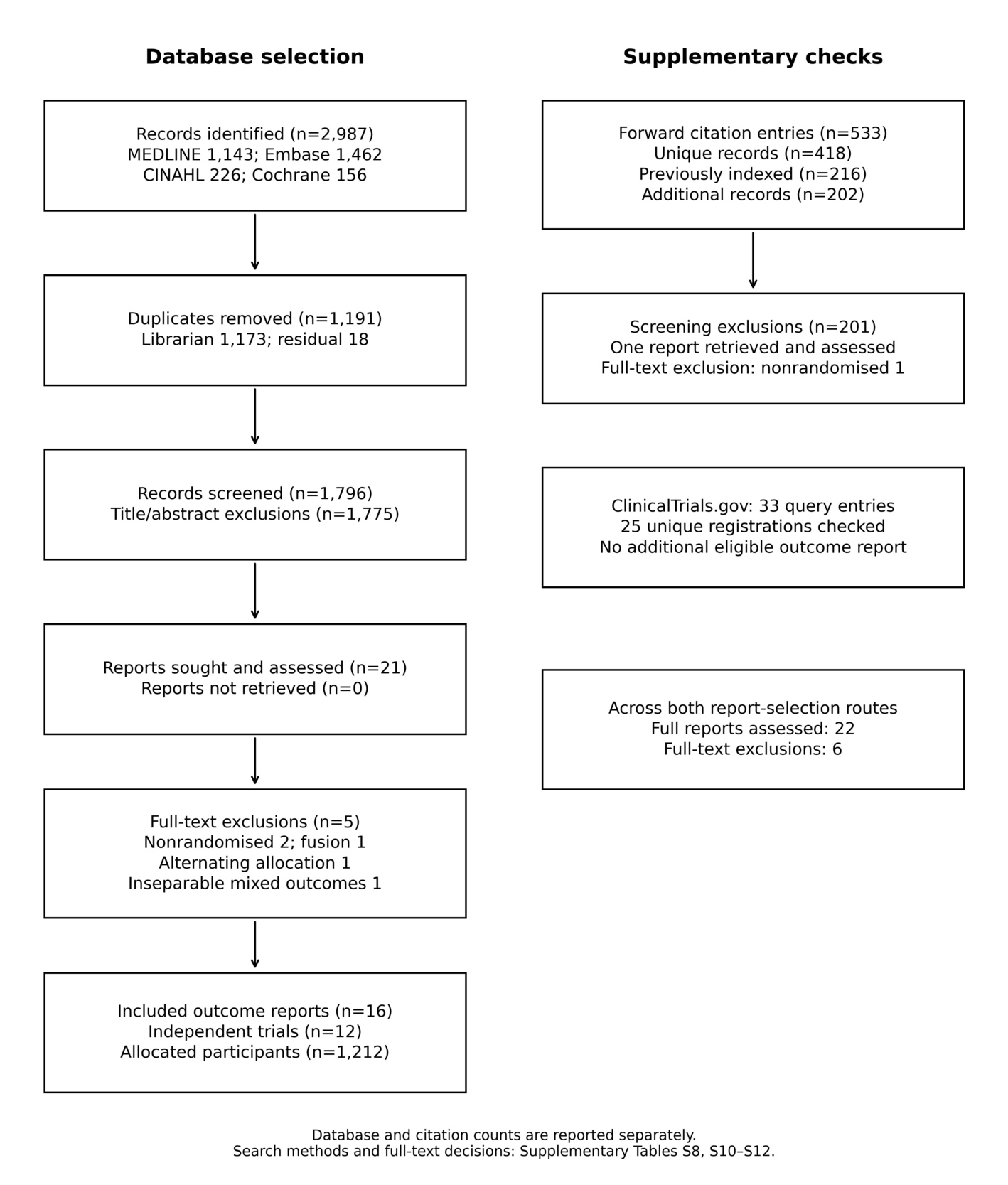
The database searches identified 2,987 records. Librarian deduplication removed 1,173 and a further 18 duplicates were removed, leaving 1,796 records screened. Of these, 1,775 were excluded at title/abstract screening. All 21 database reports sought were assessed; five were excluded, leaving 16 outcome reports from 12 trials. Citation checking identified 202 additional records: 201 were excluded at screening and one was retrieved and excluded after full-text assessment (You et al., nonrandomised). Across both routes, 22 full reports were assessed and six excluded (Figure 1). The database exclusions were two nonrandomised comparisons, one fusion comparison, one alternating-allocation study and one pooled report without separable stenosis events. Registry checking identified no additional eligible outcome report.
The trials allocated 1,212 participants (Table 1).5,19–29 Seven used microscopic comparators, including tubular approaches, and five used open comparators. Uniportal interlaminar, transforaminal, large-channel and biportal techniques were represented. Several cohorts were concentrated in older adults despite all-adult eligibility. Trial-level findings are summarised in Table 2.
Park’s preliminary report and the Carrascosa/Süner three-year follow-up were linked to their parent trials.30,31 The ENDO-BS protocol and post hoc analysis were also linked; the protocol calls the study ENDO-B, while the parent report uses ENDO-BS.32,33 The two Wu reports were treated as one trial because their centre, recruitment period, 40-person groups, procedures and perioperative summaries matched.34 No linked report added independent participants.
Disability
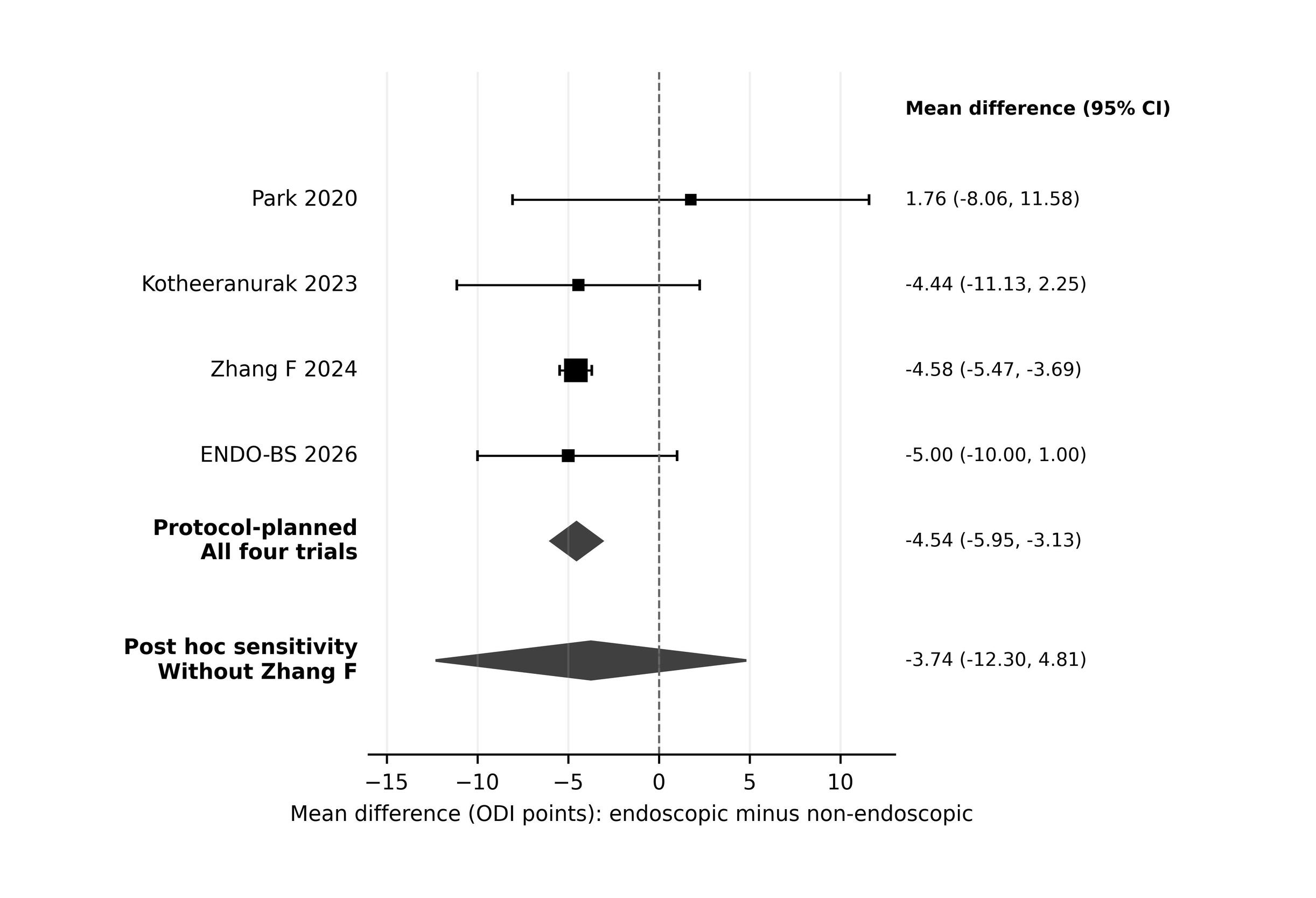
Four trials supplied the protocol-planned 12-month ODI analysis for 302 analysed participants. The three microscopic-comparator trials contributed 234 of 244 allocated participants: Park 2020 (biportal), Kotheeranurak 2023 (uniportal interlaminar) and ENDO-BS (biportal).5,22,26 Their individual differences were 1.76, −4.44 and −5 points, respectively. All had some risk-of-bias concerns. The first two treated single-level disease; ENDO-BS included multilevel stenosis. Zhang F 2024 added 68 participants with an open comparator and multilevel disease.29
The protocol-planned four-trial estimate was −4.54 ODI points (95% CI −5.95 to −3.13); Zhang F supplied 95.1% of its weight. The post hoc sensitivity without Zhang F, restricted to microscopic comparators, was −3.74 (−12.30 to 4.81; Figure 2, Table 3). This interval includes zero and benefits exceeding 5 or 10 points. It supports neither superiority nor equivalence. The post hoc ENDO-BS arm-summary check gave −3.72 (−12.37 to 4.94). The post hoc normal-interval check gave −3.74 (−7.64 to 0.15), illustrating the effect of allowing for uncertainty with few trials. Other checks are in Supplementary Table S14.
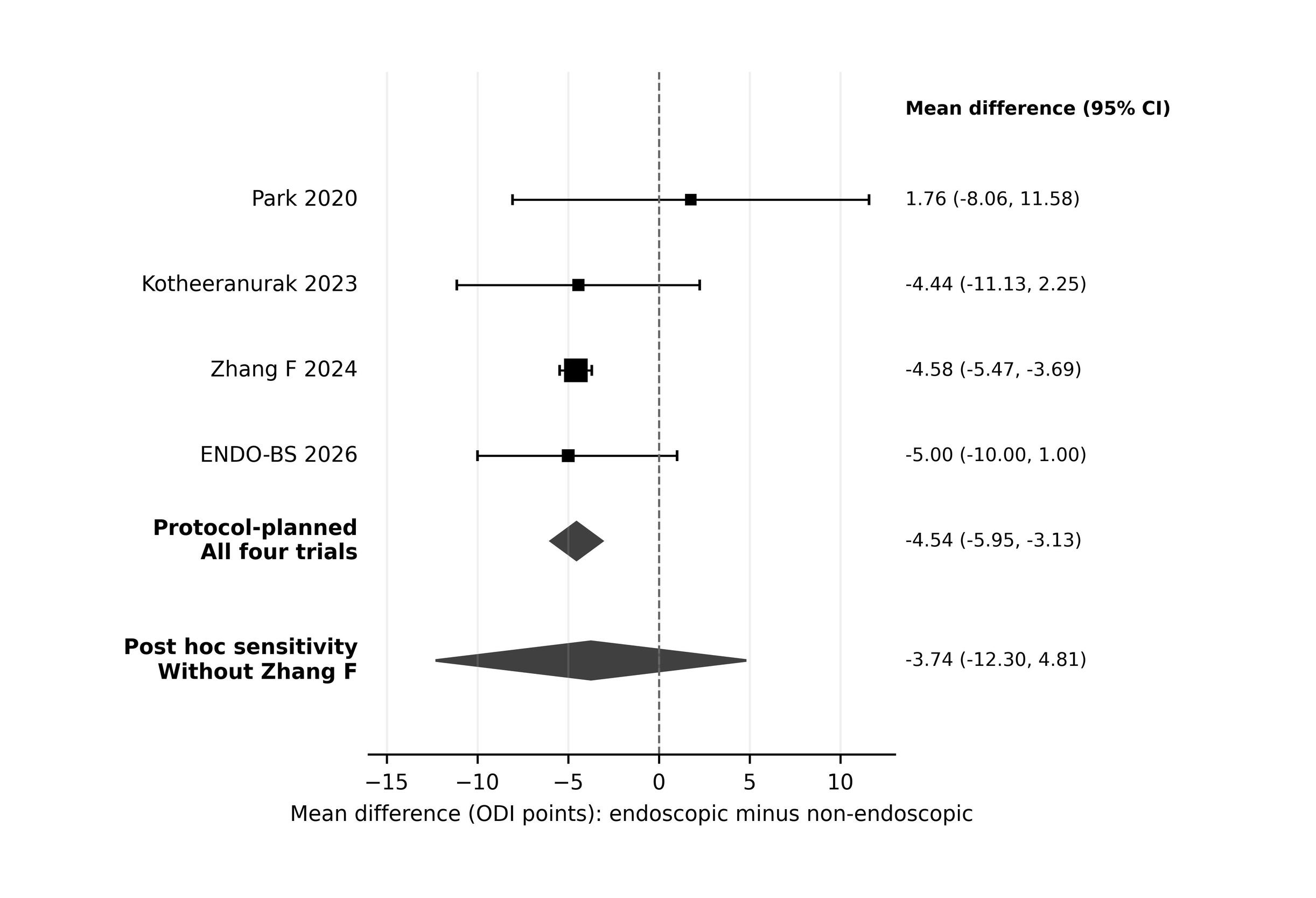
Zhang F’s printed age SDs exceed the maximum possible values for the stated ranges. Its ODI SDs are not mathematically disproved by that finding, but the estimate’s dependence on this report limits confidence in the narrow pooled interval. The published values remain in Table 2 and Supplementary Table S2; source checks are in S9.
ENDO-BS reported a primary 12-month ODI difference of −5 (95% CI −10 to 1) and a secondary table estimate of −4 (−10 to 1). We used the designated primary estimate. The rounded interval is asymmetric about its reported point estimate, making the reconstructed standard error approximate; the arm-summary check produced a similar overall interpretation.
At six months, the protocol-planned five-trial estimate was −6.38 ODI points (95% CI −7.77 to −4.99; n=347), with 93.3% of the weight from Zhang F. The post hoc sensitivity restricted to three microscopic comparisons gave −4.75 (−13.85 to 4.35; n=234). At 24 months, Kotheeranurak’s intention-to-treat final means were 9.48 versus 11.53; the adjusted difference in improvement was −1.31 (−9.30 to 6.68).26 Adjusted changes and final scores were reported separately.
Carrascosa reported six-month medians of 6 versus 3 with baseline imbalance, and Süner supplied later medians.31 Ruetten and Komp presented functional graphs without adequately defined numerical variability. Their reported 24-month leg-pain relief proportions came from selected follow-up populations after attrition or revision exclusions. Kang supplied six-month ODI means of 5 versus 4 without usable variability data.21 Zhang Y and Cuo described early improvements, but incomplete or inconsistent numerical reporting limited synthesis.24,25
The biportal microscopic subset contained two trials and the uniportal subset one, limiting comparison between techniques. All three trials permitted stable grade-I spondylolisthesis. In ENDO-BS’s exploratory subgroup of 40 participants with grade-I disease, the adjusted ODI difference was −2.98 (−12.69 to 6.72).33
Pain, harms and reoperation
The exploratory microscopic-comparator estimates were −0.53 for back pain (95% CI −2.31 to 1.25) and −0.75 for leg pain (−2.13 to 0.63), each from three trials and 234 participants. Both intervals include benefit and zero. Individual estimates and published ENDO-BS model intervals are in Supplementary Table S2.
The protocol-planned durotomy analysis included nine trials reporting eight endoscopic and 15 non-endoscopic perioperative events among 892 participants: RR 0.61 (95% CI 0.23 to 1.59; prediction interval 0.23 to 1.63). The planned Mantel–Haenszel sensitivity gave RR 0.54 (0.23 to 1.26). The post hoc exclusion of Zhang F left eight trials and 824 participants: random-effects RR 0.66 (0.24 to 1.86), Mantel–Haenszel RR 0.63 (0.26 to 1.49). The planned exclusion of all high-risk trials left six microscopic comparisons and 606 participants: random-effects RR 0.79 (0.22 to 2.76), Mantel–Haenszel RR 0.79 (0.30 to 2.10). All checks remained uncertain. Small event counts and differences in ascertainment and analysis populations limit safety conclusions; other complication definitions did not support an overall rate.
Park 2020 reported all-cause reoperation at 12 months in 1/29 versus 2/30 participants.22 Kang 2019 reported 1/32 versus 1/30 by six months.21 Subsequent fusion in Kotheeranurak 2023 occurred in 1/30 versus 2/30 by 18 months.26 ENDO-BS did not provide a complete unique-patient all-cause reoperation count in its parent event table. These endpoints were not combined.
Recovery and certainty
Operative-time findings differed by trial; Wu reported longer endoscopic surgery, while some biportal trials favoured endoscopy. Hospital stay reflected local pathways, ranging from approximately two to ten days in microscopic comparisons. Zhang Y’s stay table contradicted its narrative, so that estimate was omitted. Blood-loss estimates were not combined because irrigation, drain measurements and direct measurements represented different quantities. Ruetten and Komp could not quantify blood loss reliably during irrigation; Kotheeranurak used an irrigation-haematocrit method.
As an unplanned descriptive observation, Park’s preliminary report found lower early surgical-site pain and fentanyl consumption (6.6±5.9 versus 10.4±6.6 µg/kg; 31 versus 32 participants).30 Its stay table reported P=.067 rather than the abstract’s P=.048, so a demonstrated stay benefit was not inferred. Kang reported lower opioid use, but its unit was not suitable for combining with fentanyl.21 These findings concern immediate recovery rather than sustained back or leg pain.
Certainty was low for the three-trial microscopic comparisons of 12- and six-month ODI and exploratory back and leg pain. It was very low for durotomy, reoperation, operative time and hospital stay (Table 3; Supplementary Table S5). Eight trials lacked a compatible primary numerical estimate because of follow-up, outcome format or incomplete reporting. The planned ODI calculations dominated by Zhang F are shown without a separate certainty rating.
Discussion
The planned analyses show small average ODI differences favouring endoscopy, but over 90% of the weight comes from one high-risk report with numerical inconsistencies. The microscopic-comparator sensitivity is less precise and includes zero. Its result is similar when ENDO-BS arm summaries replace the rounded model estimate. With only three trials, zero estimated heterogeneity cannot show that the procedures, populations or missing-data methods are equivalent.
For shared decision-making, the sensitivity estimate of −3.74 points represents an average between-group difference on the 0–100 ODI scale, not the improvement an individual patient should expect. Its size is modest, but the CI of −12.30 to 4.81 spans a larger benefit, no difference and a small disadvantage. Individual-change thresholds cannot establish whether this between-group difference matters to patients.15,16 Patients can therefore be told that endoscopy has not shown a dependable additional long-term disability benefit over microscopic decompression, while a worthwhile benefit remains possible. Discussion should focus on whether the proposed procedure can address their stenosis, the surgeon’s experience and the local recovery pathway. The single-trial early analgesic observation is exploratory and should not determine long-term counselling.
Earlier reviews answer different questions (Supplementary Table S15). Yang pooled six reported RCTs at final follow-up between 6 and 24 months, reporting a leg-pain difference of −0.20 (95% CI −0.30 to −0.10).35 That review included comparisons with fusion or microendoscopic controls that do not meet our criteria. Chin combined randomised and nonrandomised designs and reported a 12-month ODI difference of −2.03 (−4.81 to 0.75).2 Pérez-Román likewise included broader comparative evidence.36 Song compared biportal surgery with both tubular and uniportal endoscopic procedures.3 The October Zhang review included two RCTs and restricted synthesis to single-level biportal surgery, excluding the multilevel ENDO-BS trial.4 Our review includes uniportal and multicentre randomised trials, groups studies by comparator, and uses defined follow-up windows. Mohamed’s fragility review included disc disease and addressed a different statistical question.37
Most contributing cohorts were middle-aged or older, limiting applicability to younger adults. The comparisons also differed in operative access and disease extent. Uniportal and biportal procedures use different viewing and working corridors; microscopic tubular and open approaches differ in exposure. These differences may matter for access to the central canal, lateral recess or foramen and for the decompression required across multiple levels. In the three-trial ODI sensitivity, Park 2020 and Kotheeranurak 2023 treated single-level disease, whereas ENDO-BS included multilevel disease; Zhang F compared endoscopy with open multilevel decompression.5,22,26,29 The sensitivity therefore changes both the reporting quality and the comparator. Stenosis severity was not reported consistently enough to determine whether it modified the relative effect. The small number of trials prevents reliable separation of technique, severity and level effects.
Surgeon experience further limits generalisability. Kotheeranurak’s trial used a single surgeon with more than 200 cases in each technique, and ENDO-BS reported that all participating surgeons had performed more than 500 cases in each technique.5,26 These trials primarily compare procedures delivered by experienced operators. During adoption, familiarity with endoscopic orientation, instrument handling and decompression through the chosen corridor may affect operating time, completeness of decompression and complications. The trials do not quantify those effects or define a safe case-number threshold. Services introducing endoscopy should consider training, supervision and local outcome monitoring; the pooled findings should not be presented as a prediction of results during the learning period.
Hospital stay ranged from approximately two to ten days in trials with microscopic comparators, limiting the relevance of an average difference to a particular service. Comparisons of blood loss were also limited by continuous irrigation and differing measurement methods. For counselling about repeat surgery, the trials need to distinguish all-cause reoperation from later fusion and report each over the same follow-up period.
Safety remains uncertain. With only 23 durotomies, the pooled CI allows both a substantial reduction and an increase in relative risk. A nonsignificant result therefore does not establish comparable safety. Durotomy is also only one complication, and inconsistent definitions and follow-up prevented a dependable overall complication or reoperation comparison. Consent discussions should retain procedure-specific risks and avoid describing either approach as safer on the basis of these data.
Limitations
Registration and scope and analysis changes occurred after earlier findings were known. The planned ODI analyses depend heavily on Zhang F’s reporting, while the sensitivity answers a narrower microscopic-comparator question. English-only eligibility, the lack of regional bibliographic databases and incomplete registry and forward-citation coverage may miss evidence. Eight trials lacked a compatible numerical 12-month ODI estimate. The pooled microscopic trials mix uniportal and biportal surgery, single- and multilevel disease and different missing-data methods; ENDO-BS’s rounded intervals give approximate variances. Small trial and event counts limit heterogeneity and reporting-bias assessment. Some publication links rely on aggregate rather than participant-level identifiers.
Conclusion
In adults undergoing decompression without fusion for degenerative lumbar spinal stenosis, the randomised evidence remains insufficient to establish better sustained disability, pain or safety outcomes with endoscopic surgery. The planned analyses favoured endoscopy, but the disability estimates were dominated by one trial with reporting concerns; analyses excluding that trial remained uncertain. These findings support counselling patients about the uncertainty of additional benefit from endoscopy, while selecting the approach according to the decompression required and the surgeon’s expertise. They do not establish equivalence between the procedures.
Author contributions and declarations
Author contributions (CRediT): Srinath Pammi: conceptualisation, methodology, investigation, data curation, formal analysis, validation, writing—original draft. Jithuram Jayaram: investigation, data curation, validation, writing—review and editing. Praveen Rajan: methodology, validation, supervision, writing—review and editing. Bhargava Krishna Balineni and Maheswara Akula: clinical interpretation, writing—review and editing. Kelsey Landes: methodology (search design and execution), writing—review and editing. Srinath Pammi and Jithuram Jayaram independently selected studies, extracted and verified data, and assessed risk of bias and certainty; Praveen Rajan adjudicated disagreements. All authors approved the manuscript and accept responsibility for the work.
Competing interests
All authors declare no competing interests. Funding: This research received no funding.
Data availability
Study-level aggregate data, source locations, extraction decisions, outcome-specific risk-of-bias assessments and certainty profiles are supplied in Supplementary Tables S1–S16. The search strategies, protocol and dated amendments, and executable analysis code with its input files and numerical validation are provided as separate supplementary files for publication with the article. The OSF project is https://osf.io/at4ku/; the retrospective registration is https://osf.io/qb9a6/. Editorial view-only links are provided in the cover letter while the registration remains under embargo.
AI assistance
We used ChatGPT/Codex (OpenAI) for preliminary screening suggestions, data and reference checks, analysis-code preparation, and drafting and language editing. Two reviewers independently assessed eligibility and extracted and verified the data. The authors checked the outputs and take responsibility for the manuscript.
Registration
Open Science Framework, https://osf.io/qb9a6/. Retrospectively registered update; the original protocol, amendment and later deviations are in the protocol supplement.
Acknowledgements
None.