
Introduction
Periprosthetic joint infection (PJI) is a serious complication of hip and knee arthroplasty and may require repeated surgery, prolonged antimicrobial therapy, and complex reconstruction.1,2 Outcomes are influenced by local tissue condition, implant stability, microbiological characteristics, host morbidity, and treatment strategy. A classification that captures these domains could improve case description, risk stratification, and comparison between studies.
The PJI-TNM classification was proposed as a multidimensional framework incorporating tissue and implant conditions (T), microbiological and biofilm-related characteristics (N), host morbidity (M), and reinfection status (r).3,4 Subsequent studies have supported its feasibility and interobserver reliability.5,6 Evidence for prognostic validity is less consistent. Higher T categories have been associated with surgical complexity, implant survival, and functional outcome, whereas findings for the N and M components have varied.7–9
Previous outcome studies have differed in treatment setting, time origin, endpoint, and analytical unit. Analyses beginning after completion of staged treatment address a different clinical question from analyses beginning at each infection-control operation. In addition, patients may contribute multiple surgical episodes, and failure-prone patients may therefore be overrepresented if within-patient dependence is ignored. We therefore evaluated the component-specific associations of PJI-TNM with subsequent infection-related reoperation from each infection-control operation while explicitly accounting for repeated episodes within patients. We also examined the association between severe local tissue compromise and subsequent reoperation.
Materials and Methods
Ethical Considerations
The study was conducted in accordance with the Declaration of Helsinki and was approved by the Institutional Review Board of Kobe University Graduate School of Medicine (approval no. B230173). The requirement for individual written informed consent was waived because existing clinical information was used. Study information was disclosed publicly, and patients were provided with the opportunity to opt out. Data confidentiality was protected in accordance with institutional policy; individual-level data are not publicly released because they contain potentially identifiable clinical information.
Study design and participants
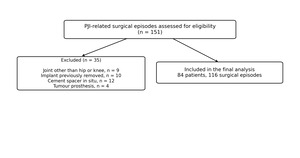
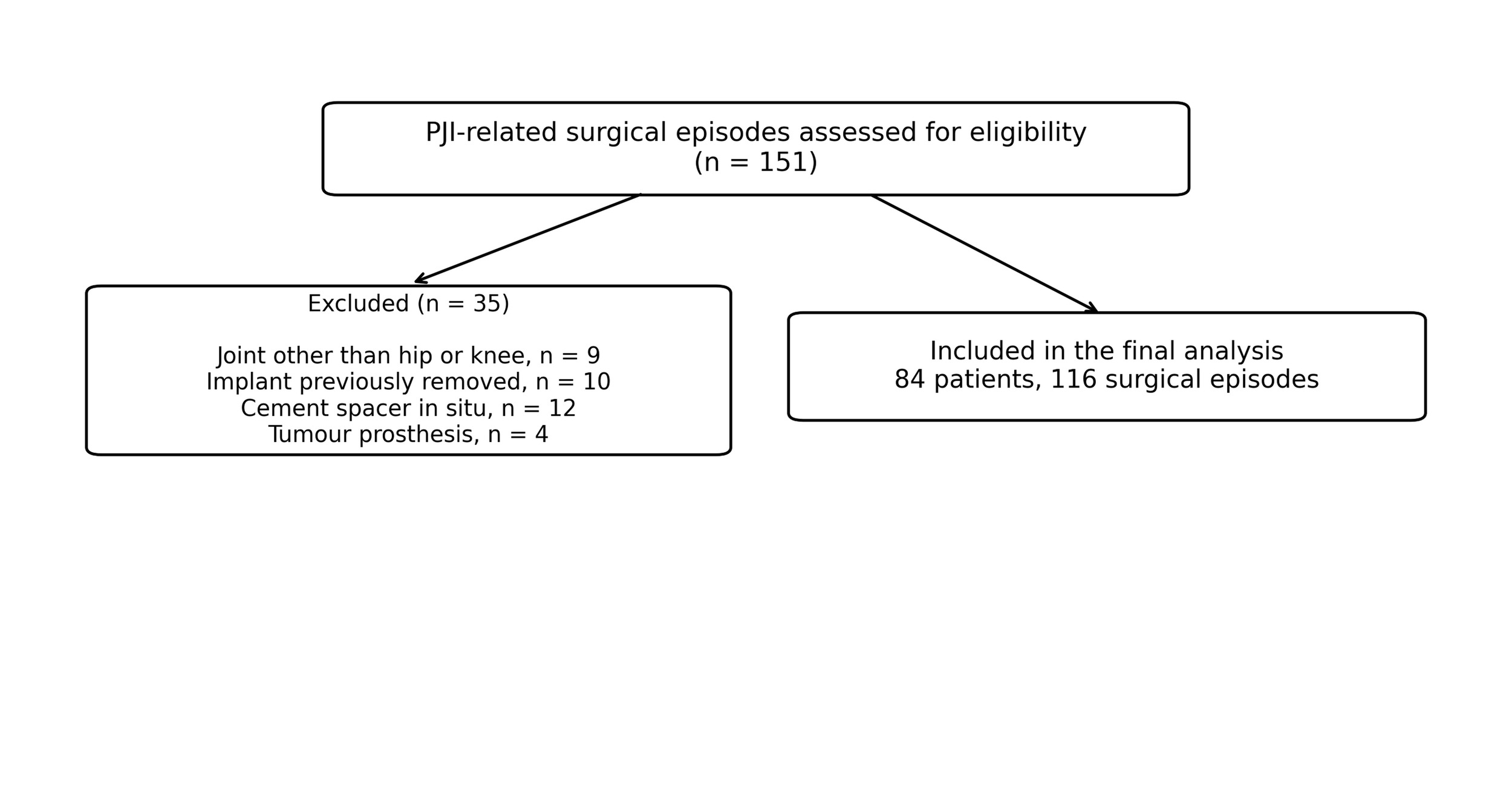
This single-centre retrospective cohort study included operations performed for hip or knee PJI between April 2016 and February 2026. Of 151 PJI-related surgical episodes assessed, 9 involving another joint, 10 in which the prosthesis had already been removed, 12 with a cement spacer in situ, and 4 involving a tumour prosthesis were excluded. The final cohort comprised 116 surgical episodes in 84 patients (Figure 1).
PJI was diagnosed according to the 2018 evidence-based definition for hip and knee PJI.10 Eligible prostheses included total hip arthroplasty, hip hemiarthroplasty, total knee arthroplasty, and unicompartmental knee arthroplasty. An episode was included when an operation was undertaken for infection control and sufficient information was available to assign PJI-TNM categories and determine follow-up outcome.
PJI-TNM classification and covariates
PJI-TNM categories were assigned retrospectively from medical records, radiographs, operative reports, microbiological findings, and comorbidity data according to the published framework.3,5 T0 indicated no major soft-tissue defect and a stable implant; T1 indicated no major soft-tissue defect with implant loosening; and T2 indicated a severe soft-tissue defect requiring plastic surgical reconstruction or flap coverage to achieve durable closure. The N component was grouped as N0, N1, or N2 according to biofilm maturity and microbiological complexity, including difficult-to-treat organisms, polymicrobial infection, and fungal infection. Host morbidity was classified using the Charlson Comorbidity Index (CCI): M0, CCI 0-1; M1, CCI 2-3; and M2, CCI >=4.11 This represented a study-specific modification because no separate operative category is provided for surgically treated patients with CCI >5.
A difficult-to-treat organism was defined as one for which an established biofilm-active antimicrobial option was unavailable, including rifampicin-resistant staphylococci, fluoroquinolone-resistant Gram-negative bacilli, and enterococci.12 Previous infection-related surgery was recorded when the same prosthetic joint had undergone an earlier operation for PJI. Other recorded covariates included the affected joint, debridement, antibiotics, and implant retention (DAIR), and continuous local antibiotic perfusion (CLAP).13,14
Outcome and follow-up
The primary outcome was the first unplanned infection-related reoperation after the index surgical episode. Events included repeat debridement, implant removal or exchange, spacer exchange, amputation, or another operation undertaken to control persistent or recurrent infection. A scheduled second-stage reimplantation was not considered an event. Time at risk began on the date of each index operation and ended at the first infection-related reoperation or the last documented follow-up. All eligible surgical episodes were retained in the primary analysis because each represented a distinct clinical state and treatment decision.
Statistical analysis
Categorical variables are presented as counts and percentages. Age and sex were summarized at the patient level using the first observed episode; other variables were summarized at the surgical-episode level. Reoperation-free survival was estimated using the Kaplan-Meier method and compared descriptively using log-rank tests. Associations with infection-related reoperation were examined using Cox proportional hazards models and are reported as hazard ratios (HRs) with 95% confidence intervals (CIs).
Because multiple episodes contributed by the same patient were correlated, patient identity was specified as a cluster and robust sandwich standard errors were calculated.15 The primary parsimonious multivariable model included previous infection-related surgery and T category. Previous infection-related surgery was analysed as an approximate proxy for the original r modifier because the dataset did not reliably distinguish recurrent infection after a completed treatment course from every subsequent operation within an ongoing treatment course. It was therefore not interpreted as a formally reconstructed r category. M2 was not included in the primary model because it contained only three episodes; an exploratory extended model added M2 as a binary variable. The N and M components and treatment-related covariates were evaluated in secondary clustered models. A patient-level sensitivity analysis used the first observed episode for each patient and included previous surgery, T category, and M2. Tests were two-sided, and no adjustment for multiple comparisons was made because the study was exploratory.
Results
Cohort characteristics
The cohort comprised 116 surgical episodes in 84 patients. At the first observed episode, mean age was 73.9 years and 49 patients (58.3%) were female. Median clinical follow-up was 574.5 days (interquartile range, 164.8-1073.0). Forty-two episodes (36.2%) were followed by an infection-related reoperation. The distribution of the PJI-TNM components was highly unbalanced: T2 comprised 8 episodes from 7 patients, and M2 comprised 3 episodes from 2 patients (Tables 1 and 2).
Survival and Cox analyses
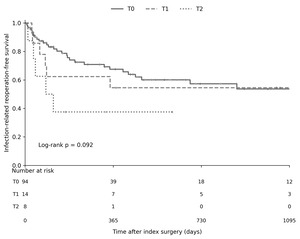
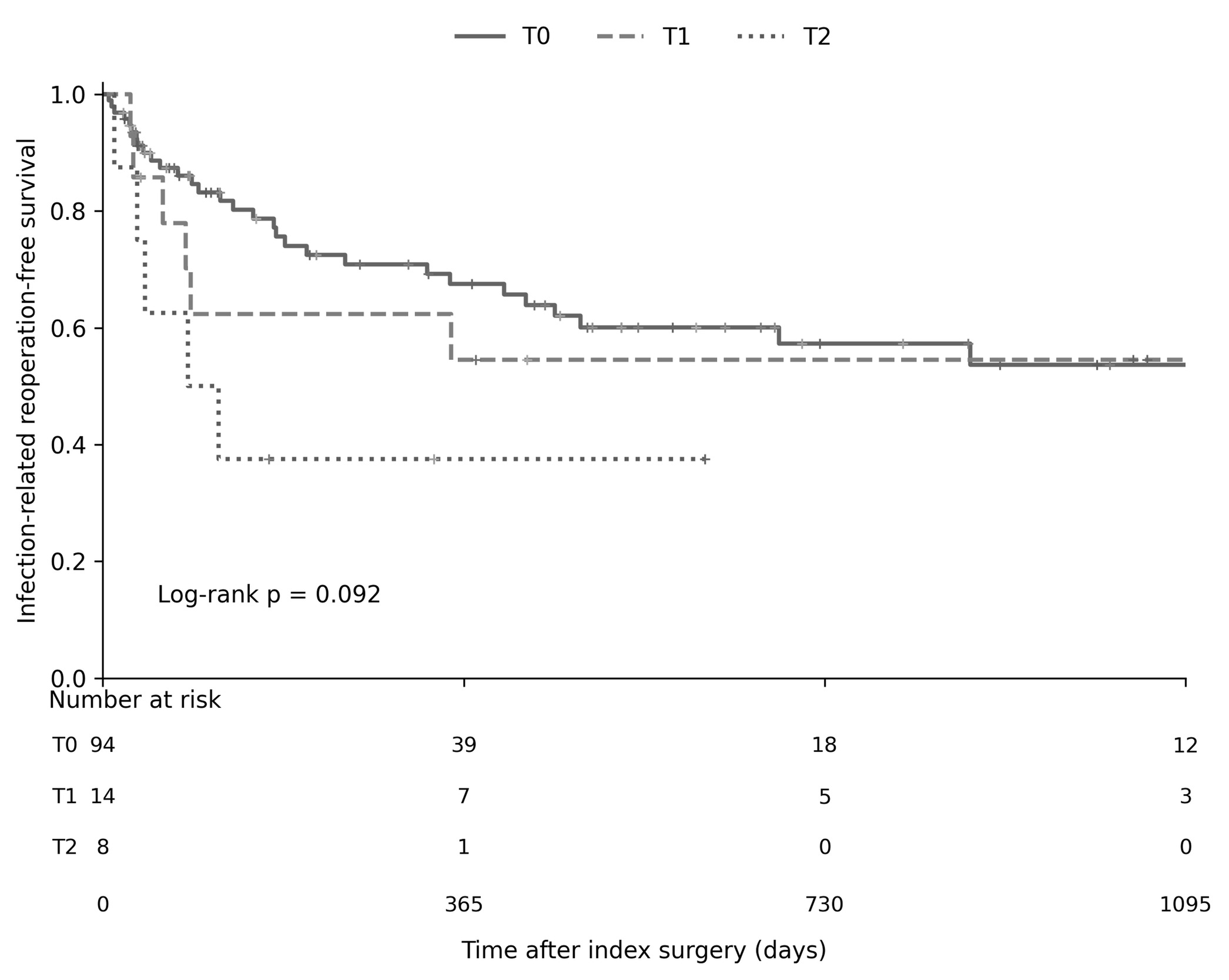
Overall infection-related reoperation-free survival was 70.8% at 180 days, 63.1% at 1 year, and 55.1% at 2 years. Episodes with previous infection-related surgery had lower survival than first infection-related operations (log-rank p=0.040). Survival differed visually among T categories, with the lowest survival in T2, although the overall log-rank comparison was not statistically significant (p=0.092; Figure 2).
In clustered univariable analyses, T2 showed an elevated hazard relative to T0 (HR 2.78, 95% CI 0.89-8.71), whereas T1 did not. Neither N1 nor N2 showed a clear association with reoperation. M2 was associated with a high hazard estimate (HR 5.69, 95% CI 1.88-17.25), but this estimate was based on three episodes from two patients. CCI analysed continuously, difficult-to-treat organisms, CLAP, DAIR, and affected joint were not clearly associated with the outcome (Table 3, Panel A).
In the primary patient-clustered model containing previous infection-related surgery and T category, the HR was 1.83 (95% CI 0.94-3.55) for previous surgery, 1.16 (0.41-3.28) for T1 versus T0, and 2.61 (0.89-7.72) for T2 versus T0 (Table 3, Panel B). In the exploratory extended model, adding M2 produced similar estimates for previous surgery and T category; M2 had an HR of 5.03 (95% CI 1.56-16.20). In the patient-level sensitivity analysis of 84 first observed episodes and 24 events, T2 was associated with infection-related reoperation (HR 4.78, 95% CI 1.05-21.81), whereas previous surgery was not; M2 had an HR of 8.69 (95% CI 0.89-84.64) and was represented by two patients.
Discussion
The main finding was that prognostic information within PJI-TNM was not distributed uniformly across its components. Severe soft-tissue compromise (T2) showed the most consistent adverse signal across clustered episode-level and patient-level analyses, whereas implant loosening without major soft-tissue compromise (T1) and the N component did not clearly discriminate subsequent infection-related reoperation. This pattern suggests that the prognostic value of the framework may be concentrated in selected domains rather than operating as a simple ordinal score across all categories.
The association between T2 and reoperation is clinically plausible. Major soft-tissue compromise may limit debridement, impair durable closure and perfusion, increase dead space, expose implants, and necessitate flap reconstruction. Previous studies have linked higher T categories to surgical complexity, implant survival, and functional outcome.7–9 Our results refine this interpretation by showing that T1 and T2 did not behave as a simple stepwise risk sequence: implant loosening alone was not clearly associated with reoperation, whereas major soft-tissue compromise repeatedly showed an adverse direction.
The absence of a clear N-component association is broadly consistent with previous outcome studies.7,9 The N component combines heterogeneous features such as biofilm maturity, culture-negative infection, antimicrobial resistance, polymicrobial infection, and fungal infection. Their clinical effects may depend on surgical strategy and the availability of effective antimicrobial therapy rather than forming a single ordinal risk gradient.
The high M2 estimate is best interpreted as a signal for further study rather than stable evidence. M2 comprised only three episodes from two patients, and two episodes belonged to the same patient. Moreover, CCI was developed to summarize mortality-related comorbidity rather than PJI-specific host impairment,11 and CCI as a continuous variable was not clearly associated with outcome. Future refinements of the host domain may need to incorporate frailty, nutritional status, immunosuppression, renal function, and glycaemic control in addition to comorbidity burden.
Using surgical episodes as the analytical unit allowed PJI-TNM status to be reassessed when the clinical state and treatment decision changed, but it also allowed patients with repeated treatment failure to contribute multiple observations. Patient-clustered robust variance estimates addressed within-patient dependence and reduced the apparent precision of several associations, particularly previous infection-related surgery. Investigators should therefore define whether the target of inference is the patient, joint, treatment course, or individual operation, because this choice can materially influence precision and interpretation.
Limitations
This study was retrospective and single-centre, treatment strategies were clinically selected and heterogeneous, and the number of events was limited. Sparse T2 and M2 categories produced wide confidence intervals and restricted multivariable adjustment. Classification was assigned retrospectively, and previous infection-related surgery was used only as an approximate proxy for the r modifier rather than a formally reconstructed r category. The study therefore should not be interpreted as a definitive validation of the framework. Nevertheless, it provides clinically aligned, component-specific estimates and directly demonstrates how repeated episodes influence inference, identifying priorities for future multicentre validation.
Conclusion
In this real-world cohort, prognostic information within PJI-TNM was concentrated unevenly across its components. T2, representing major local soft-tissue compromise, showed the most consistent adverse signal, whereas T1 and the N component did not clearly discriminate subsequent infection-related reoperation; M2 remained too sparse for stable inference. Accounting for repeated episodes reduced the apparent precision of several associations. These results identify specific components and methodological choices that can guide refinement and more informative multicentre validation of PJI-TNM.
Acknowledgments
None.
Authors’ contributions
YK designed the study, collected and analysed the data, and drafted the manuscript. KS, YM, TF, TM, and SH collected the data. RK and KO contributed to the study design and critically reviewed the manuscript. All authors read and approved the final manuscript.
Conflicts of interest
The authors declare that they have no competing interests.
Funding
This research received no external funding.
Use of artificial intelligence
During manuscript preparation, the authors used ChatGPT (OpenAI) to assist with statistical code generation, English-language editing, and manuscript formatting. The authors reviewed the source data, analytic decisions, numerical output, references, and final text and take full responsibility for the integrity of the work. The tool was not listed as an author.
Data availability
The datasets used and analysed during the current study are not publicly available because of institutional and ethical restrictions related to potentially identifiable clinical information, but de-identified data may be available from the corresponding author on reasonable request and with approval from the relevant institutional review board.