
Introduction
The COVID-19 pandemic rapidly disrupted conventional outpatient care and accelerated the use of telemedicine video visits across the United States. National reports described an abrupt increase in telehealth use during early 2020, while health systems developed new workflows, technology support, and reimbursement processes to maintain clinical access.1,2 Pain medicine was particularly affected because temporary restrictions on elective procedures and in-person clinic operations threatened continuity for patients with chronic, disabling conditions. Early reports from pain practices highlighted both the need for rapid operational change and the broader effects of the pandemic on clinical care and fellowship education.3–5
Telemedicine offers several potential advantages for chronic pain care. Video visits may reduce travel burden, improve access for patients with limited mobility or who live far from specialty centers, facilitate review of imaging and treatment response, and preserve continuity when in-person attendance is impractical.6–11 Before the pandemic, telepain programs had already demonstrated feasibility, favorable patient satisfaction, and potential travel-related cost savings, but implementation remained limited.10,11 Pandemic-era regulatory and reimbursement changes reduced several barriers and normalized virtual care within many practices.1,6–9
Chronic pain care also exposes important limitations of virtual evaluation. Pain diagnosis frequently depends on palpation, provocative maneuvers, strength and reflex testing, gait assessment, sensory examination, and correlation of imaging with physical findings. Remote visits may therefore be more appropriate for selected follow-up encounters than for new neurologic deficits, rapidly changing symptoms, or situations in which in-person monitoring is necessary.7–9
The objective of this study, therefore, was to describe annual synchronous video-visit utilization within an academic chronic pain practice from 2020 through 2023. We hypothesized that recorded telemedicine encounters would increase over time as patients, clinicians, and institutional systems became more comfortable with virtual care. Because the practice also underwent substantial physician expansion, we additionally sought to describe workforce changes and explicitly consider their effect on interpretation of utilization trends.
Methods
Study Design and Oversight
This was a single-center retrospective descriptive utilization study conducted within the chronic pain practice at the University of Texas Health Science Center at Houston (UTHealth Houston). The University of Texas Health Science Center at Houston Institutional Review Board approved the study under protocol HSC-MS-24-0814. Only aggregate annual encounter counts are presented in this report.
Study Period and Setting
The analysis included complete calendar years from January 1, 2020, through December 31, 2023. The clinical setting was an academic chronic pain practice providing longitudinal evaluation and management of patients with chronic pain conditions, including medication management, review of diagnostic studies, and planning and follow-up for interventional procedures.
Data Source and Encounter Identification
Synchronous video encounters were identified through the Epic electronic health record video-visit encounter tabs. Encounters attributed to physicians within the chronic pain practice were aggregated by calendar year. The extraction was designed to capture documented video visits only; telephone-only encounters, portal messages, electronic consultations, and in-person visits were not included. Counts represented encounters rather than unique patients, and a patient could contribute more than one encounter during the study period.
Workforce Context
Physician staffing was summarized to contextualize changes in raw encounter volume. At the beginning of the observation period, the practice included two part-time pain physicians. At the end of the period, it included two full-time and three part-time pain physicians. Two additional part-time physicians joined and later left the practice during the study interval. Exact monthly physician full-time-equivalent effort and clinician-specific telemedicine counts were not available for normalization.
Statistical Analysis
The analysis was descriptive. We calculated annual encounter counts, absolute year-over-year changes, and percentage changes when the preceding-year count was greater than zero.
Results
Annual Telemedicine Utilization
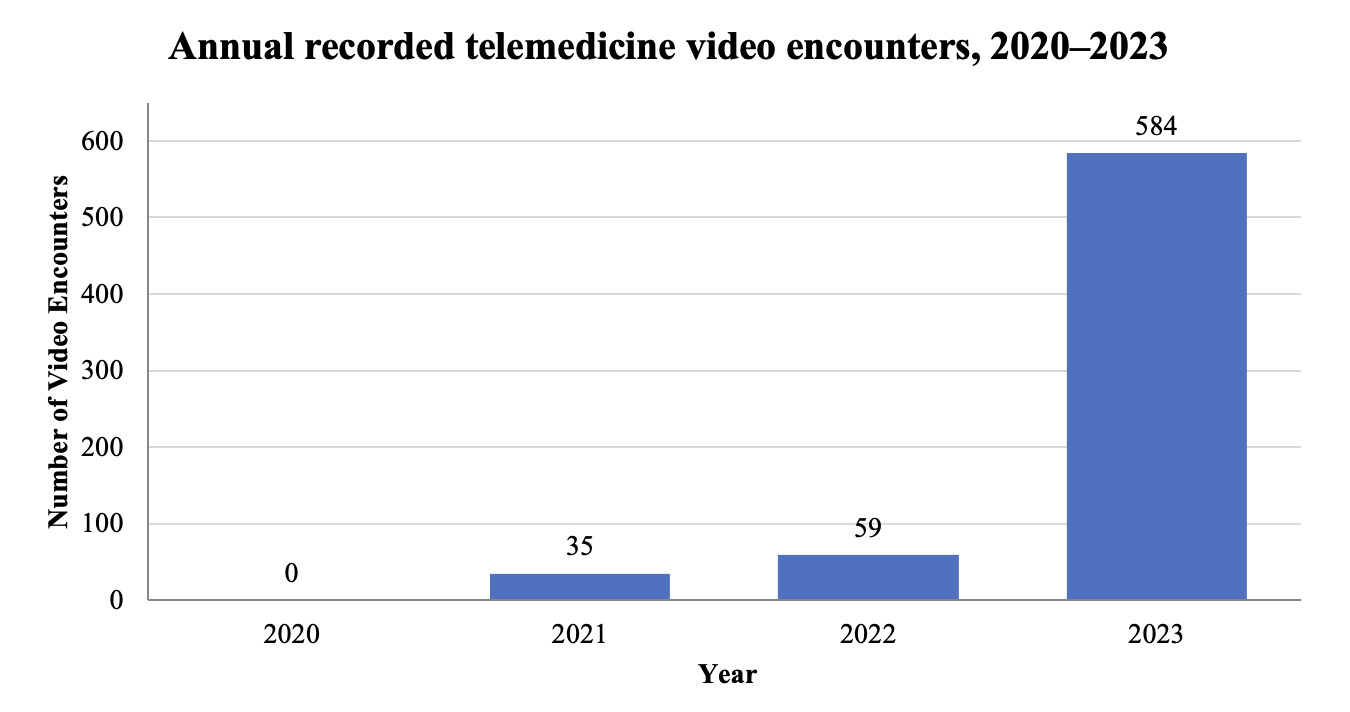
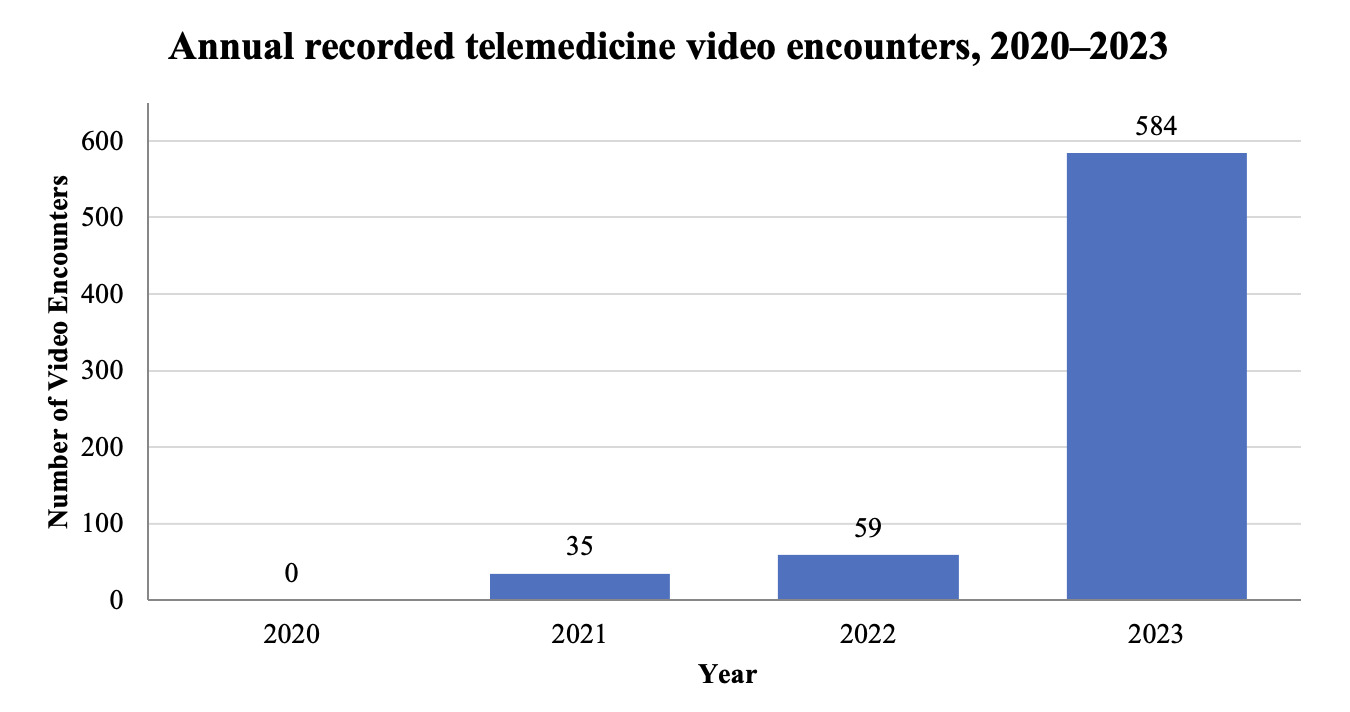
A total of 678 recorded video encounters occurred from 2020 through 2023. No video encounters were recorded in the Epic video-visit encounter tabs in 2020. The first recorded encounters appeared in 2021 with a total of 35 encounters, followed by 59 encounters in 2022 and 584 encounters in 2023 (Table 1).
From 2021 to 2022, video encounters increased by 24 visits, corresponding to a 68.6% increase. From 2022 to 2023, encounters increased by 525 visits, corresponding to an 889.8% increase and a 9.9-fold rise. Compared with 2021, the 2023 volume was 16.7-fold higher. The 584 encounters in 2023 accounted for 86.1% of all recorded video encounters during the four-year study period.
Physician Workforce Changes
Of note, the increase in telemedicine encounters occurred during substantial practice growth. Physician staffing changed dramatically as noted above in the methods section.
Discussion
Principal Findings
This study demonstrates a marked increase in recorded synchronous video visits within an academic chronic pain practice between 2020 and 2023. The trajectory was not an immediate peak during the first pandemic year; rather, no qualifying encounters were recorded in 2020, modest volumes appeared in 2021 and 2022, and utilization accelerated sharply in 2023. This pattern suggests delayed institutional integration followed by rapid operational acceptance. The magnitude of the increase is notable, but raw encounter growth should not be interpreted as a patient-level adoption rate or as evidence that telemedicine replaced in-person care.
Broader national experience showed that pandemic-era infrastructure and policy changes rapidly expanded virtual care.1,2 Pain-specific reports described the need to maintain longitudinal access while balancing the limitations of remote assessment.5–9 Our data extend this literature by showing that utilization can continue to grow after the most acute pandemic disruptions have passed. In our institution, telemedicine services continued to expand well after the peak of the pandemic.
Comparison With Prior Pain-Medicine Experience
Several studies support the acceptability of telemedicine for selected pain encounters. Hanna and colleagues reported favorable patient impressions in an early telepain program, although forming a physician-patient relationship remotely was comparatively challenging.10 Pronovost and colleagues described high satisfaction and potential cost advantages in chronic pain consultation.11 During the pandemic, Bhuva and colleagues found high satisfaction in a spine physical medicine and rehabilitation practice, while Harnik and colleagues reported that a substantial proportion of chronic pain patients accepted telemedicine.12,13 These findings provide a plausible clinical basis for sustained use once local workflows matured.
Recent service-level studies also demonstrate that telemedicine utilization varies substantially by setting and over time. Gofeld and colleagues evaluated whether telemedicine could replace in-person consultation in a prospective chronic pain cohort.14 Vowles and colleagues reported that pain providers adapted across successive pandemic years and commonly anticipated continued telehealth use.15 Abberger and colleagues documented a rapid change in video use within an interdisciplinary pain center, followed by partial rebalancing toward face-to-face care.16 In contrast, the current practice experienced its largest recorded volume in 2023. Differences in infrastructure, reimbursement, scheduling, patient mix, staffing, and institutional implementation likely influence these distinct trajectories.
Potential Benefits in Chronic Pain Practice
Telemedicine can be particularly useful for stable follow-up visits, medication-response assessment, review of imaging, counseling, behavioral and self-management support, and post-procedure follow-up when a hands-on examination is not required.6,7,17–19 Patients with chronic pain may face mobility limitations, long travel distances, missed work, caregiving responsibilities, or transportation barriers. Virtual visits can reduce these burdens and facilitate more frequent or timely contact. Evidence from musculoskeletal telehealth interventions suggests that selected remote strategies can improve pain and disability outcomes, although effectiveness varies by intervention and population.20
The educational and operational effects are also relevant in academic practices. Pandemic-related changes altered pain fellowship experiences and required clinicians and trainees to develop competence in remote history taking, observation-based examination, and virtual communication.3 A mature hybrid model may allow trainees to learn how to select appropriate patients for telemedicine while recognizing when an in-person examination is essential.
Limitations and Risks of Virtual Pain Evaluation
The major clinical limitation of telemedicine in pain practice is the inability to perform a complete hands-on physical examination. Palpation, detailed sensory testing, manual strength assessment, reflexes, and certain provocative maneuvers cannot be replicated reliably through video. Virtual examination techniques, including patient-directed localization of pain and observed movement testing, may provide useful information but should not be considered complete substitutes for an in-person examination.17,21 New focal neurologic deficits, red-flag symptoms, suspected infection, rapidly progressive pain, and uncertain diagnoses may require face-to-face assessment.
Telemedicine may also complicate therapeutic monitoring. Patients receiving controlled medications may require in-person toxicology testing, pill counts, or closer assessment of sedation and functional status. Technology access, broadband reliability, privacy, language needs, and patient comfort can create inequities. Reviews of outpatient pain telemedicine consistently emphasize that virtual care is best used as one component of a hybrid system rather than a universal replacement for in-person evaluation.17–19,22
Interpreting Growth During Practice Expansion
A central interpretive issue is the substantial increase in physician staffing. The practice grew from two part-time physicians to two full-time and three part-time physicians, with two additional part-time physicians entering and leaving during the observation period. More clinicians create more appointment capacity and may increase raw telemedicine encounters even if each physician’s propensity to use video remains unchanged. Conversely, workforce growth may facilitate telemedicine adoption by creating scheduling flexibility, distributing follow-up responsibilities, and increasing institutional familiarity with the platform.
The available data therefore support a conclusion of rapid expansion in recorded telemedicine activity, but not a causal estimate of acceptance independent of practice growth. The current results are best viewed as real-world operational evidence that telemedicine became an actively used modality within a simultaneously expanding academic practice.
Strengths and Limitations
A strength of this study is its use of longitudinal real-world electronic health record data spanning four complete calendar years and extending beyond the early emergency phase of the pandemic. The study also explicitly reports concurrent workforce changes that might otherwise be overlooked when interpreting utilization growth.
Several limitations should be considered. First, the analysis reports aggregate encounters rather than unique patients. Second, total chronic pain visits were unavailable, preventing calculation of telemedicine penetration or comparison with in-person volume. Third, physician full-time-equivalent effort, clinician-specific encounter counts, and the timing of staffing changes were not available for normalization. Fourth, reliance on the Epic video-visit encounter tabs may have missed video visits documented elsewhere, especially during early implementation; the absence of recorded encounters in 2020 may therefore reflect workflow or classification limitations rather than definitive absence of all remote care. Telephone and other remote contacts were not captured. Finally, this was a single academic practice, which limits generalizability. These data demonstrate temporal association and operational growth but cannot establish causality or comparative effectiveness.
Conclusion
Synchronous video visits expanded substantially within the UTHealth Houston chronic pain practice from 2021 through 2023, with the greatest increase occurring in 2023. The findings support continued acceptance and integration of telemedicine after the initial COVID-19 emergency. However, concurrent physician expansion and the absence of total-visit denominators limit causal interpretation. Future analyses should incorporate total clinic encounters and calculate the proportion conducted by video. Telemedicine can serve as an important part of a chronic pain medicine hybrid care model that preserves access and convenience while ensuring in-person evaluation are available and utilized when necessary.
Ethics Approval
This study was approved by the University of Texas Health Science Center at Houston Institutional Review Board (HSC-MS-24-0814).
Funding
This research received no specific grant or financial support from any public, commercial, or not-for-profit funding agency
Conflicts of Interest
The authors have no conflicts of interest to disclose