
Introduction
Epidural access is fundamental to anesthesiology and interventional pain medicine. Although fluoroscopy, contrast administration, ultrasound, and other technologies can assist with epidural procedures, identification of the epidural space frequently continues to involve the loss-of-resistance technique.1–6 Contemporary practice is heterogeneous; a recent survey of physicians performing lumbar interlaminar epidural steroid injections found that 53.3% used LOR to saline and 42.4% used LOR to air.2 Such variation reinforces that trainees must understand the underlying principle rather than simply memorize one technical routine.
LOR is particularly difficult to teach because it is a tactile skill. The trainee must appreciate changing tissue resistance during needle advancement and recognize when resistance decreases as the epidural space is entered. Anatomical variability, including ligamentum flavum and interspinous ligament characteristics, may further alter tactile feedback and contribute to false or equivocal LOR.7,8 Studies of epidural training consistently demonstrate a substantial learning curve, with competence often requiring dozens of procedures rather than a predetermined small number of attempts.9–12
The authors therefore favor a staged model in which learning what LOR feels like precedes independent needle advancement. This article describes our consensus educational approach.
Literature Review and Expert Perspective
A focused review of PubMed-indexed literature was performed regarding epidural access, LOR, procedural learning curves, simulation, tactile training, and interventional epidural techniques. Relevant studies addressing anatomy, technical variability, procedural education, and simulation were prioritized.
This article is not intended as a systematic review. Rather, the literature is used to contextualize an educational framework developed through the collective clinical and teaching experience of the authors. The recommendations represent expert opinion and are intended for appropriately trained clinicians teaching epidural procedures under direct supervision.
Why LOR Is Difficult to Teach
Most procedural skills combine visual, cognitive, and tactile information. LOR is unusual because an important portion of the endpoint exists almost entirely through touch. A trainee can understand intellectually that resistance should decrease when the epidural space is entered without knowing what that transition actually feels like.
Furthermore, LOR can be difficult to feel in some individual patients. Anatomical studies demonstrate variability in the ligamentum flavum and interspinous structures, including gaps that may contribute to misleading changes in resistance.7,8 False LOR has also been demonstrated clinically, emphasizing that tactile information must ultimately be interpreted alongside anatomy, imaging, and appropriate confirmation techniques.6,13
This creates an educational problem. Asking a novice simultaneously to advance a needle toward a sensitive anatomical space, interpret fluoroscopy if this is being utilized, maintain trajectory, manipulate the syringe, and recognize an unfamiliar tactile endpoint creates substantial cognitive and technical demand. We believe these skills should initially be separated.
Our Stepwise Educational Model
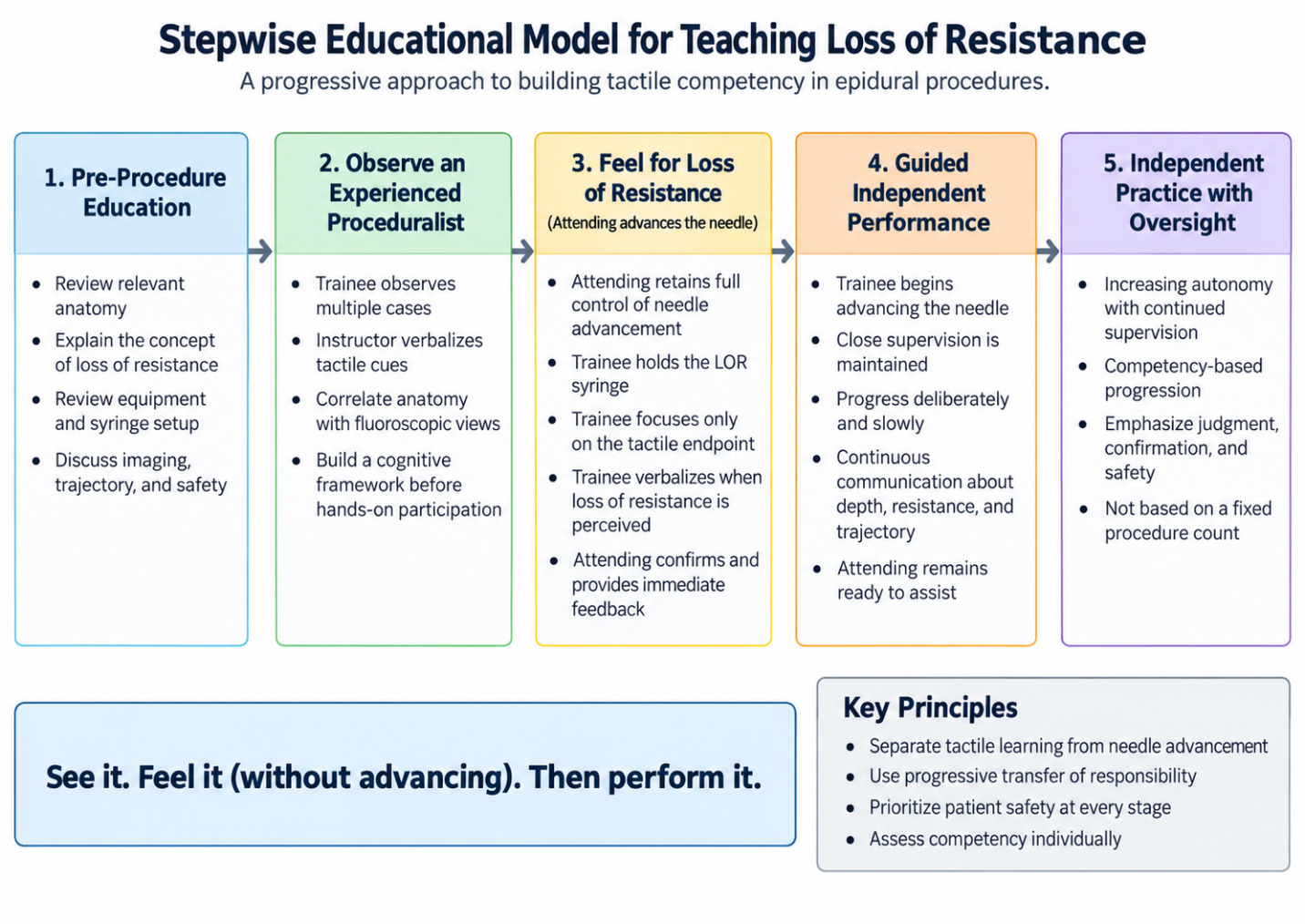
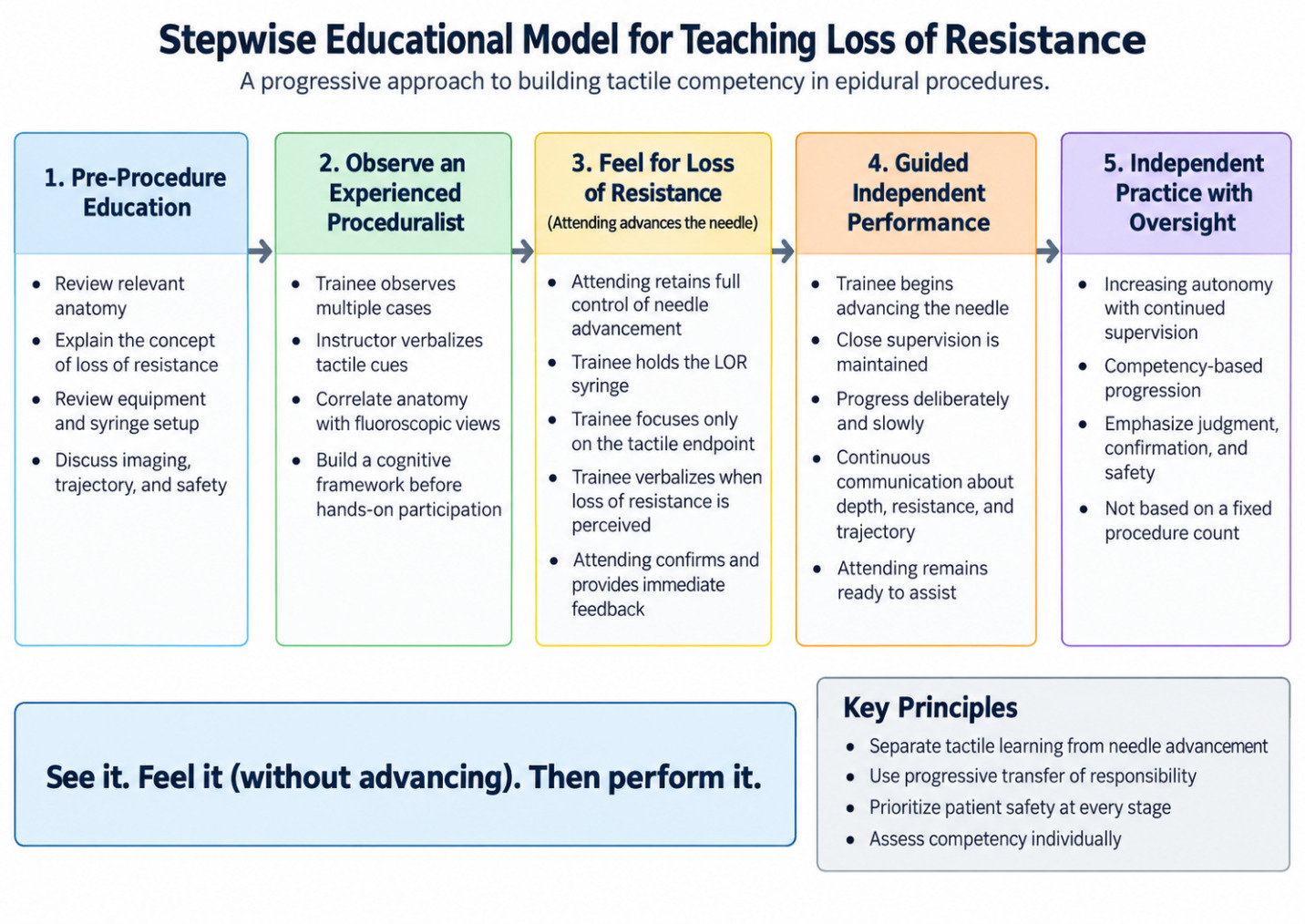
Our approach progresses through five stages.
-
Concept before instrumentation. Before the trainee performs the procedure, we review the relevant anatomy, the expected tissue planes, the purpose of the LOR syringe, and what is meant by “resistance” and “loss of resistance.” We emphasize that LOR is an endpoint to be interpreted rather than a maneuver to be performed mechanically. Preprocedural imaging review and understanding the anticipated trajectory are incorporated into this discussion.1,3,4
-
Observation of an experienced proceduralist. The trainee next watches experienced physicians perform epidural access. During these cases, the instructor verbalizes relevant tactile observations when practical: when resistance is increasing, when the needle is approaching the expected epidural depth, and when convincing LOR is obtained. Observation provides a visual and cognitive framework before tactile responsibility is introduced.
-
Tactile learning without needle advancement. This is the most important feature of our teaching model. During the trainee’s initial hands-on exposure, the supervising physician retains control of the epidural needle and personally advances it. The trainee does not advance the needle. Instead, the trainee controls or feels the LOR syringe and focuses entirely on changes in resistance. When the trainee believes LOR has occurred, he or she verbalizes the finding. The experienced physician simultaneously evaluates the needle position and independently confirms the endpoint before proceeding with routine confirmation.
This arrangement intentionally separates two skills: recognizing LOR and advancing the epidural needle. The trainee can concentrate on developing tactile recognition without simultaneously being responsible for forward needle movement.
-
Progressive transfer of procedural control. After the trainee demonstrates an understanding of the tactile endpoint, responsibility for needle manipulation is gradually transferred. Early attempts remain closely supervised, with deliberate advancement and frequent communication regarding resistance, depth, trajectory, and fluoroscopic appearance. As competence increases, attending intervention decreases. Independent procedural performance should therefore represent the final stage of training rather than the trainee’s first meaningful exposure to the sensation of LOR.
-
Independent practice with continued oversight. Once the trainee demonstrates consistent technical competency, clinical judgment, and appropriate recognition of the LOR endpoint, greater procedural autonomy may be permitted within the established supervisory framework. Progression should remain individualized and competency-based rather than determined solely by procedural volume.
The Role of Simulation
Simulation can supplement this process. Multiple epidural simulators have been designed specifically to reproduce resistance and the LOR endpoint.14–18 These simulation models may improve familiarity and allow trainees to practice without patient risk. Simulation may be particularly useful before the trainee’s first clinical epidural and when procedural volume is limited.
However, we do not consider simulation a complete substitute for supervised tactile learning in patients. Human tissue resistance varies with anatomy, body habitus, degenerative changes, approach, level, and needle trajectory. The educational value of the attending-controlled needle/trainee-controlled LOR stage is that the learner experiences authentic human tactile feedback while procedural risk remains principally controlled by the experienced operator.
Competency Rather Than Procedure Counts
Published learning curves demonstrate considerable variability in acquisition of epidural competence. Early work suggested that improvement becomes apparent after approximately 20-25 epidural procedures and that substantially more may be required to achieve consistently high success rates.9 Other analyses have similarly demonstrated wide interindividual variability and approximately 40-50 attempts before many trainees meet defined competency thresholds.10–12
Accordingly, we do not recommend using a specific number of procedures as the sole determinant of independence. A trainee who has performed many procedures but cannot reliably distinguish convincing from equivocal LOR should not be considered technically independent. Conversely, procedural progression should be individualized according to demonstrated understanding, tactile recognition, imaging interpretation, needle control, and judgment.
Discussion
Traditional procedural teaching is frequently characterized as “see one, do one, teach one.” For LOR, we favor an alternative model: see it, feel it without advancing, then perform it.
The central educational principle is that tactile recognition and needle advancement are related but separable skills. Allowing the trainee to experience authentic LOR while an experienced physician controls the needle reduces the number of simultaneous tasks imposed on the novice and permits focused feedback at the precise moment the epidural space is entered.
This framework is particularly applicable to pain medicine fellows, anesthesiology residents, and other trainees learning interlaminar epidural access. It should complement and not replace appropriate understanding of anatomy, preprocedural imaging, fluoroscopic technique, contrast confirmation, and established procedural safety practices.1–6,19–21
Conclusion
Loss of resistance is best understood through experience rather than description alone. Our preferred teaching sequence is straightforward: teach the concept, allow observation, teach the tactile endpoint while the attending controls needle advancement, and only then progressively transfer needle control to the trainee. Separating tactile recognition from independent needle advancement may provide a practical and reproducible approach to teaching one of the most important psychomotor skills in epidural procedures.
Disclosure Statement
Generative artificial intelligence tools were used to assist with literature searching, grammar, manuscript organization, and figure development. The underlying concept, educational framework, interpretation, and overall concepts and edits were developed by the authors. All cited references were independently reviewed by the authors for relevance and accuracy.