
Introduction
Total hip arthroplasty (THA) and total knee arthroplasty (TKA) are established surgical treatments for patients with advanced degenerative joint disease and substantial pain or functional limitation. As the volume of joint arthroplasty continues to increase, optimizing perioperative care has become increasingly important to facilitate recovery while maintaining patient safety and quality of care. Despite the effectiveness of arthroplasty in restoring joint function, the postoperative period may be accompanied by pain, reduced mobility, and temporary impairment of physical function, potentially delaying recovery and independence. Therefore, strategies that address multiple aspects of perioperative care have gained increasing attention in modern arthroplasty practice.1,2
Enhanced Recovery After Surgery (ERAS) is a multidisciplinary, multimodal approach designed to reduce surgical stress and facilitate postoperative recovery. In hip and knee arthroplasty, ERAS pathways incorporate interventions throughout the perioperative period rather than relying on an isolated intervention. These may include preoperative patient education and optimization, appropriate anesthetic techniques, multimodal and opioid-sparing analgesia, strategies to minimize blood loss, and early postoperative mobilization.1,2 Early mobilization is considered an important component of ERAS, with the overall pathway aiming to promote functional independence and accelerate recovery following surgery.1 In addition to conventional clinical outcomes, increasing attention has been directed toward postoperative mobility, patient satisfaction, and patient-reported outcomes as important indicators of recovery.1
Several studies have reported favorable outcomes associated with ERAS pathways following THA and TKA. A large systematic review and meta-analysis found that ERAS was associated with a shorter hospital length of stay and fewer postoperative complications compared with conventional care, although no significant difference was observed in 30-day readmission rates.3 More recent comparative evidence has also demonstrated improvements in early postoperative mobility following ERAS-based THA, including better performance on mobility assessments and greater walking distances, while pain and patient-reported outcomes were not significantly different between ERAS and conventional pathways.1 Similarly, evidence from TKA has demonstrated improvements in outcomes such as hospital stay, postoperative pain, range of motion, and functional scores following multidisciplinary ERAS implementation.4 Furthermore, studies evaluating muscular recovery after THA suggest that ERAS may reduce postoperative loss of muscular strength; however, these objective improvements have not consistently translated into superior patient-reported functional outcomes or quality of life.2
Despite the increasing adoption of ERAS in THA and TKA, the existing literature remains heterogeneous with respect to the components included in ERAS pathways and the outcomes assessed. Previous research has frequently focused on hospital length of stay, complications, and readmissions, while other clinically meaningful outcomes, including long-term patient-reported outcomes and opioid use, have been evaluated less consistently.1,3 Moreover, variation in ERAS protocols and differences in outcome assessment may contribute to inconsistent findings across individual studies.1,2 A comprehensive synthesis of comparative evidence is therefore warranted to clarify the effects of multimodal ERAS pathways across clinically relevant outcomes following primary THA and TKA. This systematic review aims to evaluate the effects of ERAS pathways compared with conventional perioperative care in adults undergoing elective primary THA or TKA, with respect to length of hospital stay, postoperative complications, readmissions, long-term patient-reported outcome measures, and opioid use.
Methods
Study Design
This study was designed as a systematic review to evaluate the effects of ERAS pathways compared with conventional perioperative care in adults undergoing elective primary THA or TKA. The review included randomized controlled trials and prospective or retrospective comparative cohort studies. Eligible studies were required to compare a multimodal ERAS pathway incorporating at least three defined perioperative components with conventional or standard care and to report at least one outcome of interest, including length of hospital stay, perioperative complications, hospital readmissions, long-term patient-reported outcome measures, or postoperative opioid use. This systematic review was registered with the International Prospective Register of Systematic Reviews (PROSPERO; registration number CRD420261472788). The following deviations from the registered protocol occurred: (1) prospective and retrospective comparative cohort studies were included, in line with the registered eligibility criteria, although the study design field of the registration listed randomized studies only; (2) no language restriction was applied, whereas the protocol specified English-language studies only; (3) risk of bias in non-randomized studies was assessed using ROBINS-I instead of the Newcastle-Ottawa Scale, and randomized trials were assessed using RoB 2 only; (4) because fewer than 10 studies contributed to each meta-analysis, publication bias was assessed by visual inspection of funnel plots rather than by Egger’s test; and (5) the planned sensitivity analyses excluding studies at high risk of bias and restricted to randomized trials were not performed.
Eligibility Criteria
Eligibility was defined according to the Population, Intervention, Comparator, Outcomes, and Study design (PICOS) framework:
Population: Adults (≥18 years) undergoing elective primary THA or TKA for degenerative joint disease or comparable elective indications.
Intervention: A multimodal ERAS, enhanced recovery, or fast-track pathway comprising at least three defined perioperative components spanning the pre-, intra-, and/or post-operative phases (e.g., structured patient education, multimodal analgesia, standardized anesthesia protocols, blood loss management, early mobilization, restrictive fluid therapy, and avoidance of drains and urinary catheters).
Comparator: Conventional or traditional perioperative care without structured ERAS implementation.
Outcomes: Studies were required to report at least one of the following: length of hospital stay (LOS); overall complications or serious adverse events; hospital readmissions; long-term patient-reported outcome measures (PROMs) assessing pain, function, quality of life, or satisfaction at ≥6 or ≥12 months; or opioid consumption/persistent opioid use.
Study designs: Randomized controlled trials (RCTs) and prospective or retrospective comparative cohort studies were eligible. The following were excluded: (1) non-comparative studies (single-group before–after designs without a clear comparator), case series, case reports, editorials, letters, and narrative reviews; (2) studies focusing exclusively on unicompartmental knee arthroplasty or revision arthroplasty without separable primary THA/TKA data; (3) outpatient-only arthroplasty pathways in which LOS was systematically zero days and therefore not comparable with inpatient care; (4) non-elective, trauma, or oncologic arthroplasty; and (5) protocol-only publications without outcome data. No restrictions were applied with respect to language, country, or publication date; non-English publications were assessed using their English abstracts and translated full texts where available.
Information Sources and Search Strategy
A comprehensive literature search was performed in PubMed/MEDLINE, Web of Science, and Google Scholar from database inception to August 2026. The search strategy combined controlled vocabulary and free-text terms relating to the intervention and the surgical population, structured as follows: (enhanced recovery OR ERAS OR “clinical pathway” OR “fast track”) AND (hip arthroplasty OR hip replacement OR THA OR “total knee arthroplasty” OR TKA OR “knee replacement”) AND (randomized controlled trial OR cohort OR “comparative study”). The strategy was adapted to the syntax and indexing terms of each database. In addition, the reference lists of included studies and relevant systematic reviews were hand-searched to identify further eligible records. The search was re-run prior to the final analysis to capture recently published studies.
Study Selection
All retrieved records were exported into the Rayyan web application for systematic reviews (Rayyan Systems Inc., Cambridge, MA, USA), where duplicates were identified and removed. Four reviewers independently screened titles and abstracts against the eligibility criteria, blinded to each other’s decisions. The full texts of all potentially eligible records were then sought and independently assessed in duplicate. Disagreements at either stage were resolved through discussion, with adjudication by a different senior reviewer where consensus could not be reached. Records excluded at the full-text stage were documented with the reason for exclusion. Of 1,435 records identified, 78 duplicates were removed, and 1,357 records were screened by title and abstract. Of 429 reports sought for full-text retrieval, 22 could not be retrieved and 407 were assessed for eligibility; 26 comparative studies fulfilled all criteria and were included in the final synthesis. The study identification and selection process is summarized in the Preferred Reporting Items for Systematic Reviews and Meta-Analyses (PRISMA) 2020 flow diagram (Figure 1).
Data Extraction
Data were extracted independently by four reviewers into a standardized, piloted data extraction template, and discrepancies were resolved by discussion or by a different reviewer. The following variables were collected: study characteristics (first author, year of publication, country, setting, study design, and sample size); population characteristics (age, sex, body mass index (BMI), comorbidities, indication for surgery, THA versus TKA, and unilateral versus bilateral procedures); details of the ERAS intervention (number and type of pathway elements, including patient education, anesthesia and analgesia protocols, blood management, early mobilization, thromboprophylaxis, nutrition, and catheter/drain policy, together with reported adherence or compliance); core components of the comparator (conventional care) pathway; LOS (mean or median with corresponding measures of dispersion and discharge criteria); complications and serious adverse events (definitions and timing); readmissions and reoperations (time frame and cause); PROMs (instrument used, e.g., Western Ontario and McMaster Universities Osteoarthritis Index [WOMAC], Hip disability and Osteoarthritis Outcome Score [HOOS], Knee injury and Osteoarthritis Outcome Score [KOOS], Oxford Hip/Knee Scores, Harris Hip Score, Knee Society Score, EuroQol 5-Dimension [EQ-5D], and assessment time points); pain scores, opioid consumption and persistent opioid use, and time to mobilization; and health-economic outcomes (costs and cost-effectiveness) where reported. Where studies reported outcomes for THA and TKA separately, data were extracted for each joint independently. Corresponding authors were contacted for missing or unclear data where necessary.
Outcomes
The primary outcomes were length of hospital stay, overall complications and serious adverse events, hospital readmissions, and long-term PROMs (pain, function, quality of life, and satisfaction) at ≥6 or ≥12 months of follow-up. Secondary outcomes were persistent opioid use or post-discharge opioid consumption, time to mobilization, discharge destination, and health-economic outcomes where reported.
Risk of Bias Assessment
Risk of bias was assessed independently by two reviewers, with disagreements resolved by consensus or by a third reviewer. Randomized controlled trials were appraised using the Cochrane Risk of Bias 2 (RoB 2) tool across its five domains (randomization process, deviations from intended interventions, missing outcome data, measurement of the outcome, and selection of the reported result), yielding an overall judgement of low risk, some concerns, or high risk of bias. Non-randomized comparative studies were appraised using the Risk Of Bias In Non-randomized Studies of Interventions (ROBINS-I) tool across its seven domains (confounding, selection of participants, classification of interventions, deviations from intended interventions, missing data, measurement of outcomes, and selection of the reported result), yielding an overall judgement of low, moderate, serious, or critical risk of bias. Risk of bias judgements were incorporated into the interpretation of findings.
Data Synthesis and Analysis
The findings of the included studies were synthesized narratively. The characteristics and results of the included studies were summarized in structured evidence tables covering study design and setting, population, ERAS intervention components, comparator details, and reported outcomes. The synthesis was organized by outcome domain—length of hospital stay; complications and serious adverse events; readmissions; long-term PROMs; opioid consumption and persistent opioid use; time to mobilization and discharge destination; and health-economic outcomes—and stratified by arthroplasty type (THA versus TKA), with studies reporting separable data for each joint synthesized accordingly. For each outcome, results were summarized in terms of the direction, magnitude, and statistical significance of the effect as reported by the primary study authors, and effect estimates with their 95% confidence intervals (CIs) were presented as originally reported. Where appropriate, the consistency of findings across studies was summarized by grouping studies according to the direction of effect.
Given the variability among the included studies with respect to study design, populations, the number and composition of ERAS pathway components, comparator (conventional care) pathways, outcome definitions, and follow-up durations, between-study differences were described qualitatively and considered when interpreting the findings. Prespecified exploratory comparisons examined whether findings differed by arthroplasty type (THA versus TKA), ERAS pathway intensity (number and type of components), follow-up duration, and study design (randomized versus non-randomized). In interpreting the body of evidence, greater weight was given to randomized controlled trials and to studies judged to be at lower risk of bias, and the influence of studies at high or critical risk of bias on the overall conclusions was considered. The certainty of the evidence for each primary outcome was rated using the Grading of Recommendations, Assessment, Development and Evaluation (GRADE) approach, considering risk of bias, inconsistency, indirectness, imprecision, and publication bias.
Meta-Analytic Statistical Methods
Statistical Analysis Plan
Continuous outcomes (length of stay) were pooled using inverse-variance random-effects models with mean differences (MD) and 95% CIs; dichotomous outcomes (complications, readmissions, transfusion, opioid use) used Mantel-Haenszel random-effects models with risk ratios (RR). Between-study heterogeneity was quantified via τ,2 I2, and Cochran’s Q, with Hartung-Knapp adjustment applied given the small number of studies per outcome. Restricted maximum likelihood (REML) estimated τ.2 Subgroup analyses stratified by joint type (THA vs TKA vs combined) tested for differential effects using between-group Q-tests. Publication bias was assessed via funnel plots test where k≥6, interpreted cautiously given limited study numbers. Analyses were conducted in R (R Foundation for Statistical Computing, Vienna, Austria) using the meta package.
Results
Our review included 26 studies which demonstrated substantial methodological and clinical diversity and consisted of randomized controlled trials, prospective and retrospective cohorts, matched designs, quasi-experimental studies, and large database analyses. Most studies were non-randomized and therefore assessed using ROBINS-I, whereas randomized trials were evaluated using RoB 2. The sample sizes of our study ranged from 24 participants (Reinhard, 20232; Reinhard, 20245) to 1,540,462 patients in a national US claims analysis (Memtsoudis, 20206). There are several studies which used matched historical or conventional-care controls, including Stowers (2016),7 Vendittoli (2019),8 and Milligan (2021),9 while others used prospective or sequential before–after comparisons. The evidence base included both THA and TKA populations, with some studies specifically focused on TKA (Goetz, 202310) or THA-related outcomes (Reinhard, 20232; Götz, 20231). Importantly, several studies lacked a true conventional-care comparator and compared different ERAS implementations or time periods within ERAS pathways, including Ding (2022),11 Sun (2023),12 and Xu (2024).13 These designs may limit direct interpretation of ERAS versus conventional-care effects. The multicenter POWER2 study provided substantial observational evidence with 6,146 participants (Ripollés-Melchor/POWER2, 202014), while Liao (2025)15 contributed a large multicenter RCT involving 313 participants (Table 1).
Supplementary Table S1 shows that the included studies comprised diverse patient populations undergoing primary THA or TKA. Notably, most of the participants were older adults and underwent elective arthroplasty for condition like osteoarthritis, although there are some studies which included rheumatoid arthritis, osteonecrosis of the femoral head, developmental dysplasia, and ankylosing spondylitis. Notably, mean ages generally ranged from 52 to 75 years, with older populations reported by Jiang (2019),16 Stowers (2016),7 and POWER2 (2020).14 The baseline characteristics of the participants were generally comparable between ERAS and conventional-care groups. However, some studies reported important differences. Vendittoli (2019)8 observed that there is a significant age difference between groups (58.0 vs 54.3 years, p=0.002), while Stowers (2016)7 reported borderline differences in BMI (34.4 vs 32.5 kg/m2, p=0.05). There is a study by Hardy (2022),24 which reported a significant age difference between paired limbs (60.0 vs 52.9 years, p<0.001), and Milligan (2021)9 reported a higher proportion of American Society of Anesthesiologists (ASA) III patients in the ERAS group (15% vs 4%).
Supplementary Table S2 shows that ERAS pathway composition varied substantially across the included studies which ranged from minimal 5–7-component protocols (Liao 2025,15 Wei 202122) to comprehensive 12–13-element pathways (Jiang 2019,16 Tan 201817). Core recurring elements across nearly all protocols included tranexamic acid, multimodal/regional analgesia, and early mobilization, most commonly targeted within 2–6 hours postoperatively (Leiss 2021,20 Vendittoli 2019,8 Reinhard 2023,2,27 Reinhard 20245). This contrasted sharply with comparator arms which typically mobilized patients only from postoperative day 1 (Wei 2021,22 Götz 2023,1 Zhao D 201819). Anesthesia technique was a key differentiator with several German cohorts specifically contrasted short-acting spinal anesthesia with intraoperative dexamethasone against long-acting spinal regimens in conventional care (Leiss 2021,20 Reinhard 2023,2,27 Reinhard 20245), while others emphasized opioid-free or epidural-sedation approaches (Vendittoli 20198; de Carvalho Almeida 202125). Notably, several studies lacked a genuine conventional-care comparator and instead compared ERAS-adherence gradients or intra-ERAS variations: Memtsoudis (2020)6 contrasted high versus low component “dose,” Ding (2022)11 compared two ERAS-managed periods, and Sun (2023)12 examined staging intervals within a uniformly ERAS-treated cohort. Similarly, Tan (2018)17 and Ripollés-Melchor/POWER2 (2020)14 compared enhanced versus baseline ERAS elements or ERAS-designated centers rather than true non-ERAS controls, and Xu (2024)13 had no comparator arm at all.
Table 2 shows that length of stay was the most consistently reported and most robustly favorable outcome for ERAS across studies, with statistically significant reductions ranging from roughly 1 to 6 days regardless of joint or country (Jiang 2019,16 Zhao D 2018,19 Wei 2021,22 Chung 2021,23 de Carvalho Almeida 2021,25 Zhao X 2023,26 Liao 2025,15 Liu J 2023,4 Milligan 20219), though a minority found no significant LOS difference after adjustment (Tan 201817) or did not report LOS as an outcome by design (Leiss 2021,20 Reinhard 2023, THA pain27: Götz 2023, THA TUG1: Reinhard 20245).
Notably, the findings regarding complications were mixed, with several studies reporting significantly fewer complications with ERAS. Jiang (2019)16 and Zhao D (2018)19 reported reductions in specific complications, particularly postoperative nausea and vomiting, while Hardy (2022)24 and Vendittoli (2019)8 observed fewer Grade 1–2 complications. In contrast, other studies found no significant difference in overall complication rates, although some reported potential benefits limited to moderate-to-severe complications which included Ripollés-Melchor/POWER2 (2020),14 Stowers (2016),7 and Tan (2018).17 Readmission data were relatively sparse, and there was no significant differences between ERAS and conventional care were generally observed where reported such as Stowers (2016),7 Milligan (2021),9 and de Carvalho Almeida (2021).25
Long-term PROMs were the weakest domain: most studies either did not measure them beyond 4 weeks (Reinhard, 2023 THA quadriceps2; Goetz, 2023 TKA10; Götz, 2023 THA TUG1) or found no between-group difference at later follow-up (Hardy, 202224; Reinhard, 20245), with WOMAC (Leiss 202120), the Hospital for Special Surgery (HSS) knee score (Zhao D 201819), and Harris Hip Score (Zhao X 202326) being the only instruments showing a statistically significant ERAS advantage at ≥6 months.
The risk-of-bias assessments of the included studies are presented in Table 3. Of the six randomized controlled trials, five were judged to have some concerns, mainly because of insufficient reporting of the randomization process and of prespecified analysis plans, and one (Wei 202122) was judged to be at high risk of bias because unblinded clinicians determined discharge, the primary outcome. Of the 20 non-randomized studies, two were judged to be at moderate, 17 at serious, and one (Ding 202211) at critical risk of bias. Confounding was the most frequently affected domain, rated serious or critical in 15 studies, reflecting non-randomized, often historically controlled designs with limited adjustment.
Meta-Analysis of Important Outcomes
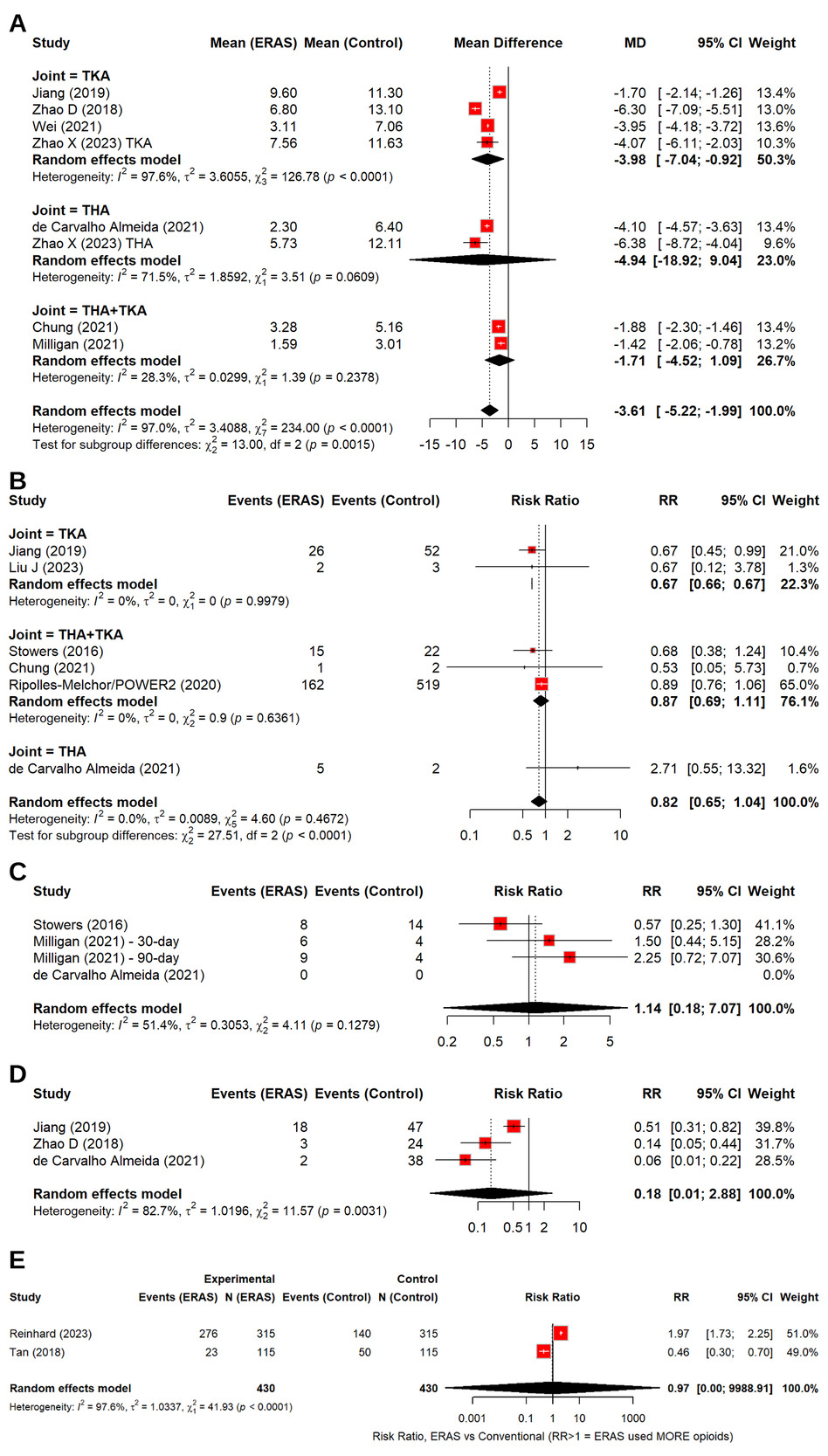
Our meta-analysis evaluated the effects of ERAS compared with conventional care across key perioperative outcomes. Notably, length of stay was significantly shorter with ERAS, with a pooled mean difference of −3.61 days (95% CI −5.22 to −1.99, p=0.0012) (Figure 2A). However, heterogeneity was very high (I2=97.0%). Furthermore, subgroup analysis showed a significant reduction in TKA (MD −3.98 days, 95% CI −7.04 to −0.92), whereas the reduction was not statistically significant for THA (MD −4.94 days, 95% CI −18.92 to 9.04) or combined THA+TKA cohorts (MD −1.72 days, 95% CI −4.52 to 1.09); subgroup differences were significant (p=0.0015).
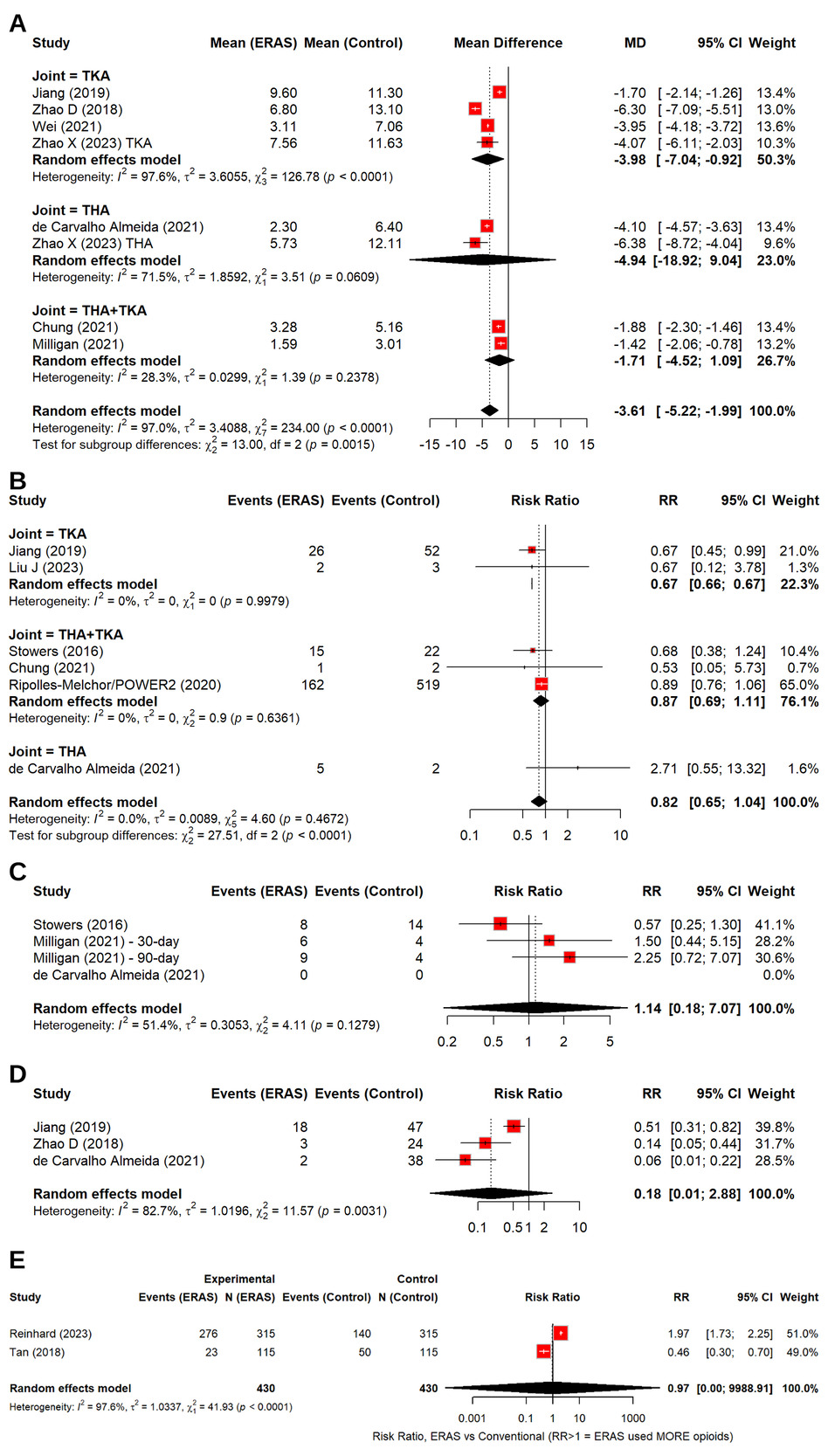
Notably, overall complications showed a non-significant trend favoring ERAS (RR 0.82, 95% CI 0.65–1.04, p=0.0885), with no observed heterogeneity (I2=0.0%) (Figure 2B). TKA demonstrated a significant benefit (RR 0.67, 95% CI 0.66–0.67), whereas THA showed an imprecise, non-significant estimate (RR 2.71, 95% CI 0.55–13.32).
Readmissions did not differ significantly between groups (RR 1.14, 95% CI 0.18–7.07, p=0.7836), with moderate heterogeneity (I2=51.4%) and considerable imprecision across only three studies (Figure 2C).
The rate of blood transfusion favored ERAS numerically but did not reach statistical significance (RR 0.18, 95% CI 0.01–2.88, p=0.1173), with substantial heterogeneity (I2=82.7%, p=0.0031) (Figure 2D).
Furthermore, opioid analgesia requirements showed no significant difference (RR 0.97, 95% CI 0.0001–9988.9, p=0.9698), with extreme heterogeneity (I2=97.6%) and substantial imprecision between the two included studies (Figure 2E).
Overall, our meta-analysis demonstrated a clear reduction in length of stay with ERAS, while effects on complications and transfusion remained statistically inconclusive, and no significant benefits were demonstrated for readmissions or opioid analgesia requirements.
Supplementary Figure S1 shows the funnel plots for the assessment of the potential publication bias across the analyzed outcomes. The funnel plot for length of stay showed some asymmetry, with an uneven distribution of studies around the pooled effect. This suggested possible small-study effects. The overall complications plot appeared relatively more balanced, although some asymmetry was evident. Funnel plots for readmissions and blood transfusion contained only three studies each and therefore provide insufficient evidence for reliably assessing publication bias. Overall, visual inspection suggests possible asymmetry for some outcomes. However, publication bias cannot be conclusively established because of the limited number of studies.
Discussion
Summary of Main Findings
This systematic review and meta-analysis synthesized evidence from 26 comparative studies evaluating multimodal ERAS pathways against conventional perioperative care in adults undergoing elective primary THA or TKA. Across nearly every included study, ERAS was associated with a shorter hospital stay, and this effect was confirmed in pooled analysis, with the largest and most consistent reduction observed in TKA populations. Complications, readmissions, blood transfusion, and opioid requirements did not demonstrate statistically robust benefits at the pooled level, despite favorable directional trends for several outcomes. Long-term patient-reported outcomes were the least favorable and least consistently reported outcome domain, with the majority of studies finding no between-group differences beyond the initial postoperative weeks.
Length of Hospital Stay
Reductions in length of stay ranged from roughly 1 day7,9 to more than 6 days25,26 and were significant in essentially every study that reported LOS as a primary outcome, regardless of country, joint, or study design. The pooled effect (MD −3.61 days) confirms and substantially extends earlier synthesis,3 which reported a shorter but still significant LOS benefit for ERAS across the wider hip/knee arthroplasty literature. However, the extremely high heterogeneity (I2 = 97%) indicates that this pooled estimate should be interpreted as an average across markedly different baseline lengths of stay — historically ranging from more than 10 days in some Chinese cohorts16,19 to already-short 3–5-day stays in Western cohorts9,23 — rather than as a single generalizable effect size. The significant subgroup benefit confined to TKA, and the absence of a significant pooled effect for THA and combined cohorts, likely reflects the smaller number and wider confidence intervals of THA-specific studies rather than a genuine lack of benefit in THA, a distinction supported by the strongly significant LOS reductions reported in nearly every individual THA-specific study.8,25,26
Complications and Safety Outcomes
Findings for complications were more equivocal. While Jiang,16 Zhao D,19 Hardy,24 and Vendittoli8 reported statistically significant reductions in complication counts or grades with ERAS, the pooled risk ratio (0.82, 95% CI 0.65–1.04) fell short of significance, and several well-conducted studies — including the large multicenter POWER2 cohort14 and Stowers7 — found no overall difference. A consistent pattern emerges on closer inspection: benefits appear concentrated in minor, Clavien-Dindo Grade 1–2 events8,24 and specific, mechanistically plausible complications such as postoperative nausea and vomiting and transfusion,16,19 rather than in serious or life-threatening adverse events. This pattern is biologically coherent: ERAS components such as opioid-sparing multimodal analgesia, tranexamic acid, restrictive fluid therapy, and early mobilization would be expected to reduce minor, symptom-driven morbidity more readily than major surgical complications, which are governed largely by patient comorbidity and surgical technique rather than by perioperative pathway. The dose-response relationship reported by Memtsoudis et al6 — in which each additional ERAS component was associated with a 9% relative reduction in the odds of any complication — lends further support to a cumulative, multimodal mechanism rather than a single dominant intervention, although this analysis, like several others in this review,11–13,17 compared ERAS intensity or ERAS-designated status rather than a true ERAS-versus-conventional-care contrast, and should be interpreted as hypothesis-generating rather than confirmatory.
Readmissions
Hospital readmission was among the most sparsely and inconsistently reported outcomes. Where reported, absolute event counts were low (e.g., 6–9 readmissions per 100 patients9; 8–14 per 1007), and no study identified a significant increase in readmissions with ERAS — an important reassurance given ongoing concerns that accelerated discharge protocols might shift morbidity into the post-discharge period. The pooled estimate (RR 1.14, 95% CI 0.18–7.07) was derived from only three studies and is correspondingly too imprecise to support any firm conclusion beyond the absence of an obvious safety signal.
Long-Term Patient-Reported Outcomes
Long-term PROMs represented the weakest area of the evidence base. Most studies with functional or strength-based endpoints1,2,10 were confined to a follow-up window of days to weeks, and among the minority extending to 6–12 months,5,19,20,24,26 only WOMAC,20 the HSS knee score,19 and the Harris Hip Score26 showed a statistically significant advantage for ERAS. Several studies that demonstrated clear early objective benefits — notably superior isokinetic muscular strength from 5 days to 3 months after THA2,5 and better mobilization performance on the Timed Up and Go test1 — found that these advantages had largely dissipated by 4 weeks to 1 year, with WOMAC, Harris Hip Score, and EQ-5D scores reaching similarly excellent values in both groups. This pattern, consistent with earlier observations that objective muscular recovery does not reliably translate into superior patient-reported function,2 suggests that ERAS chiefly accelerates the trajectory of recovery rather than altering its ultimate destination: both pathways appear to converge on comparable long-term outcomes once conventional-care patients have had sufficient time to recover, potentially reflecting a ceiling effect inherent to validated hip/knee PROMs after successful arthroplasty.
Opioid Consumption
Evidence on opioid use was both the sparsest and most inconsistent outcome domain, limited to two pooled studies with an uninterpretable confidence interval (RR 0.97, 95% CI 0.0001–9988.9). Individual findings were, if anything, contradictory: Tan17 reported a marked increase in the proportion of patients achieving zero opioid consumption by 6 weeks with ERAS, whereas Reinhard et al27 observed significantly higher opioid consumption in the ERAS group at 24 hours, alongside higher activity-related pain, which the authors attributed to more permissive early mobilization increasing analgesic requirements rather than to inferior pain control. Given that opioid-sparing is frequently cited as a central rationale for ERAS adoption, this near-total absence of reliable comparative data represents a notable gap between the stated aims of ERAS and the evidence currently available to support them.
Sources of Heterogeneity
The heterogeneity observed across outcomes, and length of stay in particular, is unsurprising given the composition of the evidence base. Included ERAS pathways ranged from minimal 5–7-component protocols15,22 to comprehensive 12–13-element pathways,16,17 and comparator (“conventional”) care was itself inconsistently defined, ranging from genuinely unstructured historical practice to pathways that already incorporated several ERAS-consistent elements.17,18 Several included studies additionally lacked a true conventional-care comparator, instead contrasting ERAS-adherence gradients,6,14 sequential ERAS-managed periods,11,12 or day-surgery completion status13 — designs that answer a related but distinct question (how much ERAS is enough) rather than whether ERAS outperforms conventional care. Study designs spanned RCTs, prospective and retrospective cohorts, matched-pair analyses, before–after quality-improvement evaluations, and a single very large administrative claims database, introducing further variability in confounding control, outcome ascertainment, and follow-up completeness. Component-level contrasts within an ERAS framework, such as the restrictive-fluid-therapy comparison reported by Lei et al,21 further illustrate how individual pathway elements have also been evaluated in relative isolation. Despite this diversity, core components — tranexamic acid, multimodal or regional anesthesia, and early mobilization within hours rather than the first postoperative day — recurred across nearly all ERAS protocols and were almost universally absent from comparator arms, suggesting these represent the most consistently implemented, and plausibly the most influential, elements of contemporary ERAS pathways in this population.
Strengths and Limitations
This review has several strengths, including a comprehensive search of three databases supplemented by hand-searching, independent duplicate screening and extraction by four reviewers, formal risk-of-bias appraisal using tools appropriate to each study design, stratification of findings by joint type, and a combined narrative and quantitative synthesis with GRADE-rated certainty of evidence. Several limitations should nonetheless be considered. First, the predominance of non-randomized, often retrospective or before–after study designs (assessed by ROBINS-I) leaves the evidence base vulnerable to confounding, selection bias, and secular trends unrelated to ERAS itself — including, in at least one instance, changes attributable to the COVID-19 pandemic rather than the intervention under study.11 Second, as noted above, a meaningful subset of included studies did not employ a genuine conventional-care comparator, and their inclusion in pooled estimates, while consistent with the review’s prespecified eligibility criteria, warrants cautious interpretation of the pooled results. Third, several meta-analyzed outcomes (readmission, transfusion, opioid use) were based on only two or three studies, yielding wide and in some cases implausible confidence intervals that should not be over-interpreted. Fourth, PROM instruments varied considerably across studies (WOMAC, HOOS, KOOS, Oxford scores, Harris Hip Score, Knee Society Score, EQ-5D), precluding pooling of functional and quality-of-life outcomes and limiting the review to narrative comparison in this domain. Finally, funnel plot asymmetry for the length-of-stay outcome raises the possibility of small-study effects or publication bias, although this could not be reliably assessed for outcomes with fewer than six contributing studies.
Certainty of Evidence
Applying the GRADE framework, the certainty of evidence for length of stay is best characterized as low-to-moderate: the direction and consistency of effect across nearly all studies is compelling, but serious concerns regarding risk of bias (predominantly non-randomized designs) and inconsistency (I2 = 97%) limit confidence in the pooled magnitude of effect. Certainty for complications is low, reflecting imprecision and inconsistency in definitions across studies. Certainty for readmissions, blood transfusion, and opioid consumption is very low, owing to the very small number of contributing studies, substantial imprecision, and, for opioid use, directly conflicting findings. Certainty for long-term PROMs is low to very low given sparse long-term follow-up and heterogeneous instruments.
Implications for Clinical Practice
Taken together, these findings support the continued adoption of multimodal ERAS pathways in elective primary THA and TKA as an effective means of reducing hospital length of stay, with the strongest evidence in TKA. The evidence does not support — nor does it contradict — claims of a substantial reduction in major complications or opioid requirements, and readmission risk does not appear to be increased, which should reassure clinicians and administrators considering accelerated discharge protocols. Importantly, clinicians should be cautious about promising patients superior long-term functional outcomes or quality of life from ERAS; the available evidence more consistently supports a faster, but not necessarily different, ultimate recovery trajectory. Patient counseling may therefore be most accurately framed around earlier mobilization, shorter hospitalization, and a smoother early postoperative course, rather than superior outcomes at 6–12 months.
Implications for Future Research
Future research should prioritize adequately powered, multicenter randomized controlled trials that compare clearly defined multimodal ERAS pathways against genuinely conventional, non-ERAS care, avoiding the intra-ERAS “dose-comparison” designs that complicate interpretation of the current literature. Standardized reporting of ERAS component adherence, use of validated core outcome sets (e.g., International Consortium for Health Outcomes Measurement (ICHOM) hip and knee osteoarthritis sets) with follow-up extending to at least 12 months, and dedicated, adequately powered evaluation of opioid consumption and persistent opioid use are particularly needed, given how sparse this outcome remains despite its centrality to the rationale for ERAS. Component-level or factorial trial designs may also help clarify which individual elements — such as early mobilization, regional anesthesia, or tranexamic acid — drive the observed benefits, informing more efficient, resource-appropriate pathway design across varied healthcare settings.
Conclusion
In adults undergoing elective primary THA or TKA, multimodal ERAS pathways are associated with a consistent and clinically meaningful reduction in hospital length of stay, particularly for TKA, alongside a plausible but statistically unconfirmed reduction in minor perioperative morbidity. Evidence regarding readmissions, opioid-sparing effects, and long-term patient-reported outcomes remains limited, imprecise, and heterogeneous, and does not currently support claims of superior long-term function or quality of life. Given the substantial variability in ERAS pathway composition and comparator definitions across the existing literature, well-designed, standardized multicenter trials with long-term outcome reporting are needed to clarify the durable benefits of ERAS beyond the immediate postoperative period.
Acknowledgments
The authors thank an independent statistician for performing the statistical analysis.
Authors’ contributions
Ola M. Altaib: conceptualization, methodology (protocol, PROSPERO registration, and search strategy), data curation, and writing – original draft. Zain S. Daghestani: investigation (literature search, screening, data extraction, and risk-of-bias assessment) and writing – review and editing. Talah R. Mriani: investigation (literature search, screening, data extraction, and risk-of-bias assessment), data curation, and writing – review and editing. Eyad A. AbuRas, Zyad A. Aburas, Alabbas H. Horaib, Feras M. Kattan, Ziad A. Aljaafri, Rana Z. Alsaeed, and Abdulaziz K. Aleid: investigation (literature search, screening, and data extraction), data curation, and writing – review and editing. Yousef S. Alqahtani: conceptualization, supervision, and writing – review and editing. All authors read and approved the final manuscript and agree to be accountable for all aspects of the work.
Conflict of interest
The authors declare no potential conflict of interest.
Funding
This research received no specific grant from any funding agency in the public, commercial, or not-for-profit sectors.
Ethics approval and consent to participate
Not applicable. This study is a systematic review and meta-analysis of previously published data and did not involve direct contact with human participants.
Data availability
All data analyzed in this review were derived from previously published studies cited in the reference list. The extracted dataset is available from the corresponding author upon reasonable request.
Further information
This systematic review was registered with PROSPERO (registration number CRD420261472788). This work has not been presented at any conference.