
Introduction
The brain and spinal cord constitute the central nervous system and are responsible for the transmission and integration of sensory, motor, and autonomic signals throughout the body.1,2 Injury to the cervical spine is clinically important because cervical vertebral trauma may compromise spinal stability and, in some cases, cause spinal cord injury with potentially permanent neurological consequences.3
Spinal cord injury may result in motor and sensory impairment, paralysis, and long-term autonomic dysfunction affecting cardiovascular, respiratory, thermoregulatory, urinary, gastrointestinal, and sexual functions.4,5 These complications can substantially reduce quality of life and contribute to increased morbidity and mortality, particularly through respiratory and cardiovascular complications.6 Road traffic accidents and falls are leading causes of traumatic spinal injuries worldwide, while non-traumatic spinal cord injury may result from conditions such as tumors, inflammatory disorders, or degenerative disease.7
Saudi Arabia continues to face a considerable burden from road traffic injuries, which may result in trauma involving the head, neck, and spine.8–10 In suspected cervical spine injury, inappropriate movement or unsafe transportation can exacerbate an unstable injury and may contribute to secondary neurological harm. Therefore, early bystander actions should prioritize scene safety, activation of emergency medical services, avoidance of unnecessary movement, and maintenance of the head, neck, and trunk in a neutral, aligned position when feasible until trained personnel assume care.11
Members of the public are often the first people present at the scene of a road traffic collision or fall. Their ability to recognize a possible cervical spine injury and provide an appropriate initial response may influence patient safety before emergency services arrive.12 However, first-aid knowledge and preparedness may vary according to previous training, educational level, and access to reliable health information.13,14 A previous Saudi survey reported that only 55% of participants had moderate first-aid knowledge.11 Accordingly, this study aimed to assess public awareness of cervical spine injury and appropriate first-aid responses among adults in the Northern Border Region of Saudi Arabia. It also examined participants’ self-reported preparedness to respond to a person with suspected cervical spine injury.
Materials and Methods
Ethical Considerations
The study protocol was approved by North Private College of Nursing’s local bioethics committee, which provided ethical permission (approval no. NCN 31102025-89; 21 December 2025). The study was conducted in accordance with the Declaration of Helsinki and applicable national ethical requirements. Electronic informed consent was obtained from all participants before they accessed the questionnaire; participants selected an “I agree to participate” option to proceed. Participation was voluntary, and participants could discontinue the survey at any time without penalty. No personally identifying information was collected. Data were stored in password-protected files and were accessible only to the research team.
Study Design and Setting
This descriptive cross-sectional study was conducted between first January and 20 July 2026 in the Northern Border Region of Saudi Arabia. Data were collected using a self-administered online questionnaire distributed through Google Forms.
Participants and Sampling
Eligible participants were adults aged 18 years or older who resided in the Northern Border Region of Saudi Arabia and provided electronic informed consent. Individuals younger than 18 years, individuals residing outside the region, and those who declined participation were excluded.
A non-probability convenience sampling approach was used. The minimum required sample size was estimated as 385 participants using the single-proportion formula, assuming a 50% expected proportion, a 95% confidence level, and a 5% margin of error. A total of 605 participants completed the survey and were included in the analysis.
Questionnaire and variables
The Arabic self-administered questionnaire was adapted from a previously published study and was refined through minor wording modifications during pilot testing to improve clarity.12 The English version is provided as Supplementary File 1. The questionnaire comprised three sections:
-
Sociodemographic characteristics: age, sex, nationality, marital status, educational level, occupation, city of residence, and previous knowledge of cervical spine injury first aid.
-
Awareness of cervical spine injury: items assessed knowledge of common causes, possible spinal cord involvement, lifelong disability, the need for medical and rehabilitative care, the value of early recognition and appropriate first aid, potential complications, clinical signs, and safe immediate responses.
-
First-aid preparedness: items assessed participants’ intended responses to suspected cervical spine injury, including seeking emergency assistance, avoiding unnecessary movement, maintaining spinal alignment during transport, and providing an appropriate response when resuscitation is required.
For awareness scoring, correct responses were assigned one point and incorrect or “I do not know” responses were assigned zero points. The total awareness score was converted to a percentage. Participants scoring 60% or more were classified as having good awareness, whereas those scoring below 60% were classified as having poor awareness.12,15
Statistical Analysis
Data were analyzed using IBM SPSS Statistics for Windows, version 27.0. Descriptive statistics were used to summarize participants’ characteristics and questionnaire responses. Categorical variables are presented as frequencies and percentages, whereas continuous scores are presented as mean ± standard deviation.
Associations between overall awareness level and participant characteristics were assessed using Pearson’s chi-square test. Fisher’s exact test or an exact test was used when expected cell frequencies were small. Pearson’s correlation coefficient was used to assess the relationship between awareness and preparedness scores. All tests were two-tailed, and a p-value below 0.05 was considered statistically significant.
Results
Participant characteristics
A total of 605 participants were included in the analysis. Nearly half were aged 18–25 years (47.1%), and females comprised 63.1% of the sample. Most participants were Saudi nationals (97.4%), single (49.8%), and had a university education or higher (81.0%). Students represented the largest occupational group (35.4%), followed by government employees (30.1%). More than half of participants reported no previous knowledge of first aid for cervical spine injury (56.4%). Most respondents resided in Arar (65.3%), followed by Rafha (24.3%) (Table 1).
Awareness of ACI
Item-level awareness responses are presented in Table 2. The highest proportion of correct responses was observed for recognizing that a person suspected of having CSI should not be moved and that emergency assistance should be called (85.1%). This was followed by recognizing that an appropriate response could help an injured person (78.5%) and that early diagnosis of CSI could reduce complications (75.2%).
In contrast, the lowest proportions of correct responses concerned identifying possible complications of CSI (10.2%), appropriate first aid for CSI (23.5%), and diseases associated with an increased risk of CSI (38.7%). In addition, fewer than half of the participants correctly identified signs indicative of CSI (42.6%) (Table 2).
Overall, 380 participants (62.8%) demonstrated good awareness of CSI and appropriate first-aid responses, whereas 225 (37.2%) had poor awareness. The mean awareness score was 8.88 ± 3.91.
First-aid preparedness
Participants’ self-reported first-aid preparedness is shown in Table 4. Most participants indicated that they would call 997 and request assistance before providing first aid (93.7%) and would avoid incorrect movement of an injured person to maintain spinal stability during transportation (93.1%). In addition, 83.3% reported that they would take preventive measures for unconscious patients with spinal injuries, and 81.7% indicated that they would assist persons injured in traffic accidents or falls.
Overall, good self-reported first-aid preparedness was observed in 525 participants (86.8%), whereas 80 participants (13.2%) had poor preparedness. The mean preparedness score was 3.52±0.91 out of 4.
Factors associated with awareness
Overall awareness level was not significantly associated with age, sex, nationality, marital status, educational level, occupation, or city of residence (all p > 0.05). However, previous knowledge of CSI first aid was significantly associated with awareness level. Participants reporting previous knowledge were more likely to demonstrate good awareness than those without previous knowledge (75.4% versus 53.1%; χ2 = 31.677, p < 0.001) (Table 4).
Correlation analysis
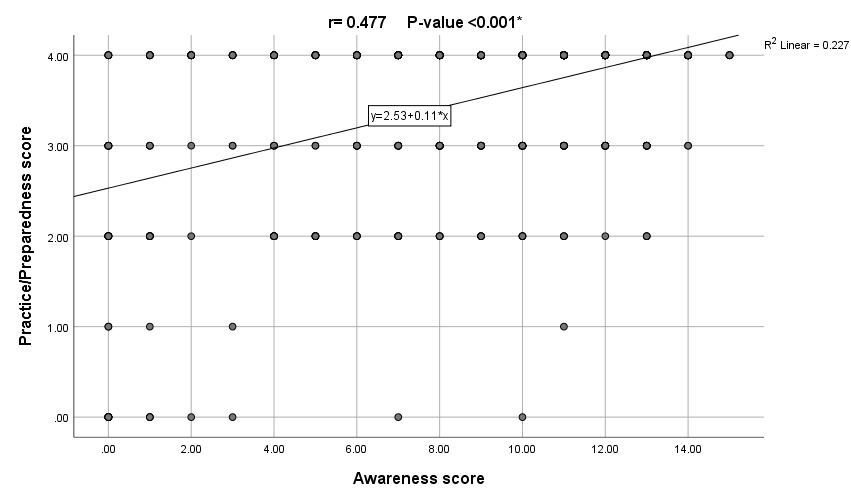
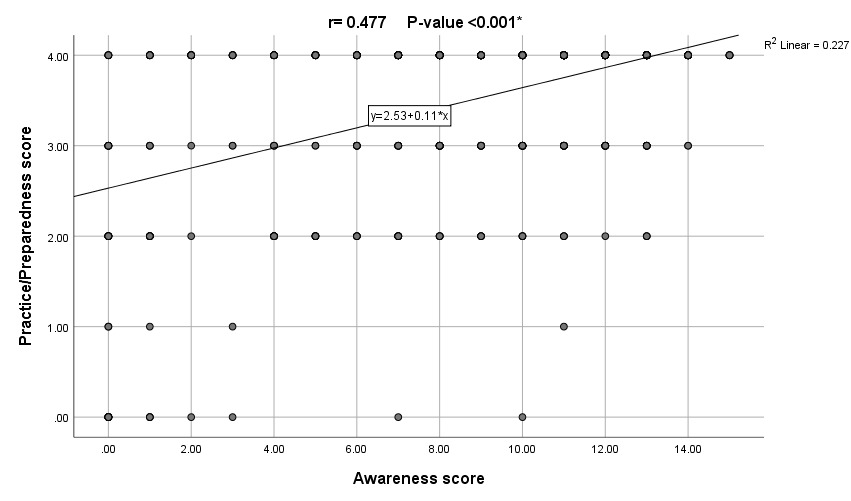
Awareness score was moderately and positively correlated with first-aid preparedness score among participants (r = 0.477, p < 0.001). This finding indicates that participants with higher awareness scores tended to report greater preparedness for an appropriate first-aid response (Figure 1).
Discussion
This cross-sectional study assessed awareness of CSI and preparedness to provide appropriate first aid among adults in the Northern Border Region of Saudi Arabia. Most participants demonstrated good awareness (62.8%) and good first-aid preparedness (86.8%). In addition, self-reported prior knowledge of CSI first aid was significantly associated with awareness level, and awareness scores were moderately and positively correlated with preparedness scores. These findings suggest that exposure to CSI first-aid information may be associated with better recognition of appropriate first-aid actions; however, the cross-sectional design does not establish a causal relationship.
CSI may result in substantial morbidity and long-term neurological disability, particularly when associated with spinal cord injury.16 Early recognition of suspected CSI and appropriate initial management are important because unnecessary movement or improper handling of an unstable cervical spine may worsen neurological injury.17 Current trauma guidance emphasizes careful assessment and minimization of spinal motion when clinically indicated, rather than unnecessary manipulation of the injured person.18
The study population was predominantly young, female, and highly educated. Nearly half of the participants were aged 18–25 years, approximately two-thirds were female, and most had university-level education or higher. More than half reported no prior knowledge of CSI first aid, despite their relatively high educational attainment. This finding indicates that general education alone may not ensure familiarity with emergency first-aid measures and supports the need for accessible, targeted public education on the recognition and initial response to suspected CSI.13,19
Item-level responses revealed important differences in participants’ awareness of CSI and its first-aid management. The highest proportion of correct responses concerned avoiding movement of a person with suspected CSI and calling emergency services (85.1%), followed by recognizing that an appropriate response could help injured persons (78.5%) and that early diagnosis could reduce complications (75.2%). However, substantial knowledge gaps were observed for identifying possible CSI complications (10.2%), the appropriate first-aid response (23.5%), diseases associated with increased CSI risk (38.7%), and signs indicative of CSI (42.6%). These findings indicate that, although many participants recognized broad safety messages, their understanding of specific clinical features and first-aid principles was limited. This distinction is important because awareness of the need to avoid unnecessary movement does not necessarily indicate sufficient knowledge to recognize suspected CSI or respond appropriately in different emergency scenarios.20–22
In the present study, 62.8% of participants were categorized as having good awareness of CSI and appropriate first-aid response. This proportion is broadly comparable with a 2024 study among medical students at Umm Al-Qura University, in which 70.2% demonstrated a commendable level of awareness.23 However, the present estimate is higher than that reported in a previous survey from Abha City, Saudi Arabia, where 31.8% of participants were considered aware of CSI.12 Differences across studies should be interpreted cautiously because the study populations, settings, questionnaires, definitions of correct responses, and scoring thresholds may differ. In particular, the present sample included a high proportion of university-educated participants, which may have influenced the observed awareness level.
Most participants in this study also demonstrated good first-aid preparedness (86.8%). This result is consistent with the finding that many respondents reported intentions to call emergency services, avoid unnecessary movement of an injured person, and maintain spinal alignment during transport. These practices are consistent with the principle of minimizing spinal motion in a person with suspected spinal trauma.24 Nevertheless, preparedness in this study was measured through self-reported intended actions rather than observed behavior during an actual emergency. Therefore, the reported preparedness level should not be interpreted as direct evidence of practical competence.
No statistically significant association was observed between awareness level and age, sex, nationality, marital status, educational status, occupation, or city of residence. In contrast, participants who reported previous knowledge of CSI first aid were significantly more likely to have good awareness than those without such knowledge (75.4% vs. 53.1%, p < 0.001). This pattern is consistent with previous studies reporting that previous exposure to first-aid information or training is associated with greater awareness of appropriate emergency responses.14,20,25 The absence of associations with demographic variables may indicate that targeted education and first-aid exposure are more relevant to awareness than demographic characteristics alone. However, the possibility of limited statistical power within some demographic subgroups should also be considered.
A moderate positive correlation was identified between awareness and preparedness scores (r=0.477, p<0.001). This finding indicates that participants with higher awareness scores tended to report higher preparedness scores. It is consistent with the findings reported by Alghamdi et al.12 However, correlation does not demonstrate that improving awareness will necessarily improve real-life first-aid performance. Future intervention studies should evaluate whether structured, practical CSI first-aid training leads to sustained improvements in both knowledge and objectively assessed first-aid skills.13,26,27
This study has several limitations. First, the cross-sectional design precludes conclusions regarding causality between prior knowledge, awareness, and preparedness. Second, the use of a non-probability, self-administered survey may have introduced selection bias, and the predominance of young, female, and highly educated participants may limit generalizability to the wider Northern Border Region population and to other regions of Saudi Arabia. Third, the questionnaire measured self-reported knowledge and intended practices, which may be affected by recall bias and social-desirability bias. Fourth, comparisons with other studies should be made cautiously because awareness and preparedness classifications may vary according to the questionnaire content, scoring rules, and chosen cut-off values. The item-level scoring algorithm for multiple-response awareness questions should be clearly documented in the final manuscript to ensure reproducibility. The questionnaire includes awareness items with both single-response and multiple-response formats, as well as four preparedness items.
Conclusion
Among adults surveyed in the Northern Border Region of Saudi Arabia, 62.8% demonstrated good awareness of cervical spine injury (CSI) and appropriate first-aid responses, whereas 86.8% demonstrated good self-reported first-aid preparedness. Previous knowledge of CSI first aid was associated with higher awareness, and awareness scores showed a moderate positive correlation with preparedness scores. However, these findings should be interpreted cautiously because the cross-sectional design cannot establish causality and preparedness was assessed through self-reported intended actions. Targeted public education and practical first-aid training may help address the remaining gaps in CSI awareness and support safe early responses to suspected injury.
Recommendations
Public education programs should provide clear, evidence-based information on recognizing suspected CSI, contacting emergency services, and minimizing unnecessary movement while awaiting trained personnel. Practical first-aid training should complement awareness campaigns because knowledge alone may not reflect actual emergency-response skills.
Future research should use representative sampling across different regions of Saudi Arabia, clearly document item-level scoring procedures, and assess actual first-aid performance in addition to self-reported preparedness. Longitudinal and intervention studies are needed to determine whether educational programs produce sustained improvements in CSI knowledge and safe first-aid behavior.
Acknowledgments
“The authors thank all the participants for agreeing to be involved in this study.”
Author’s Contribution
S.E.E., B.A.S., and E.K.F.: Conceptualization, methodology, supervision, project administration, writing – review & editing. M.S.F.: Conceptualization, methodology, data curation, formal analysis, writing – original draft, writing – review & editing, corresponding author. (A.S.A., R.G.A., R.F.A., A.H.A., G.D.A., A.K.A., S.N.A., A.B.A., A.H.B.A., and B.F.A.): Investigation, data collection, resources, data curation, writing – review & editing. All authors have read and approved the final version of the manuscript.
Funding
“This research received no specific grant from any funding agency in the public, commercial, or not-for-profit sectors.”
Institutional Review Board Statement
“The study was conducted in accordance with the Declaration of Helsinki, and approved by the Ethical Research Committee of North Private College of Nursing, Arar, Saudi Arabia (approval no.: 31102025-89) dated 21 December 2025.”
Informed Consent Statement
“Written online informed consent was obtained from all subjects involved in the study.”
Data Availability Statement
“The original contributions presented in this study are included in the article/supplementary material. Further inquiries can be directed to the corresponding author.”
Conflicts of Interest
“The authors declare no conflicts of interest.”