
Introduction
Static and dynamic stability are significantly affected by the anterior cruciate ligament (ACL), which serves as the primary stabilizing structure of the knee joint during movement. An estimated annual incidence of nearly two million cases worldwide, ACL injuries are among the most frequently encountered knee injuries. Sports activities account for nearly 70% of all ACL tears, with the majority of these injuries occurring during these activities.1 The standard treatment for restoring knee stability and enhancing functional performance, particularly in physically active individuals, is the reconstruction of the torn ACL. A successful reconstruction enables an earlier return to daily activities and sports participation, while simultaneously reducing the risk of secondary meniscal injury and the development of symptomatic osteoarthritis.2,3 The selection of the appropriate graft continues to be one of the most critical factors that affects surgical outcomes. The availability, relatively simple harvesting technique, and lower donor-site morbidity of hamstring tendon autografts have made them the preferred choice for primary ACL reconstruction for a long time, in comparison to several alternative graft options.4 Furthermore, the biomechanical properties of hamstring tendon transplants are highly similar to those of the native ACL, rendering them an appropriate option for ligament reconstruction.5 Despite these advantages, harvesting hamstring tendons may lead to deficits in hamstring muscle strength. This concern is particularly relevant for athletes and highly active individuals, as the hamstring muscles contribute substantially to knee and hip stabilization. Persistent weakness may alter the balance between knee flexors and extensors, potentially increasing stress across the reconstructed ligament and affecting postoperative performance.6 A meta-analysis conducted by Kunze et al., which involved 1,726 patients from 21 randomized controlled trials, assessed the morbidity at the donor site subsequent to ACL reconstruction utilizing bone–patellar tendon–bone and hamstring tendon autografts. The donor-site complications incidence was reduced among patients who received hamstring tendon implants, according to their results.7 Recently, there has been a growing emphasis on the peroneus longus tendon as a potential alternative autograft source. Numerous orthopedic procedures have been effectively executed with this tendon, including the reconstruction of the medial patellofemoral ligament, the restoration of the spring ligament, and the reconstruction of the deltoid ligament. The peroneus brevis tendon is utilized to preserve ankle stability following the graft harvest, as it provides functional compensation.8 Bhatia et al. study results which investigated the utilization of a combined semitendinosus and peroneus longus tendon transplant for ACL reconstruction, were favorable, as evidenced by the high Lysholm, Foot and Ankle Disability Index (FADI), and American Orthopedic Foot and Ankle Society (AOFAS) scores. The authors highlighted the ease of graft harvesting, adequate graft dimensions, and preservation of ankle function as important advantages of the peroneus longus tendon.9 Similarly, Phatama et al. illustrated that the tensile strength of the peroneus longus tendon is comparable to that of hamstring tendons, thereby corroborating its potential as a transplant source for ligament reconstruction.10 In addition, Teja et al. In primary ACL reconstruction, there were no reported graft failures, and significant improvements in both IKDC and Lysholm scores were observed during a two-year follow-up period. The autografts of the peroneus longus tendon and hamstring were compared in the research. Additionally, the authors observed that patients who received peroneus longus tendon grafts were free of clinically significant ankle morbidity and that the graft size was consistent.11 The present study was conducted to evaluate the clinical outcomes, functional outcomes, and donor-site morbidity of the peroneus longus tendon in comparison to those of the hamstring tendon autograft, in light of the increasing interest in the peroneus longus tendon as a potential autograft for ACL reconstruction.
Methods
Between August 2022 and May 2024, a prospective randomized controlled study was carried out. The objective of the study was to evaluate the clinical and functional outcomes of primary ACL reconstruction using hamstring tendons in comparison to peroneus longus tendon grafts over a one-year period.
Population and Sample Size
Male and female skeletally mature patients with a full primary ACL tear and no additional ligament injuries were involved in the study population.
Inclusion criteria: Skeletally mature cases with primary ACL injuries.
Exclusion criteria: Skeletally immature patients, those with associated injuries to other knee ligaments, bone fractures, chronic debilitating diseases (e.g., diabetes mellitus, malignancy), or mental illness.
Demographic data
Mean age of the whole group was 26.52, SD 6.58 [min 16, max 36] (table 4).38 (90.5%) were males and 4 (9.5%) were females, table (1)
Sample Size Calculation and Sampling Technique
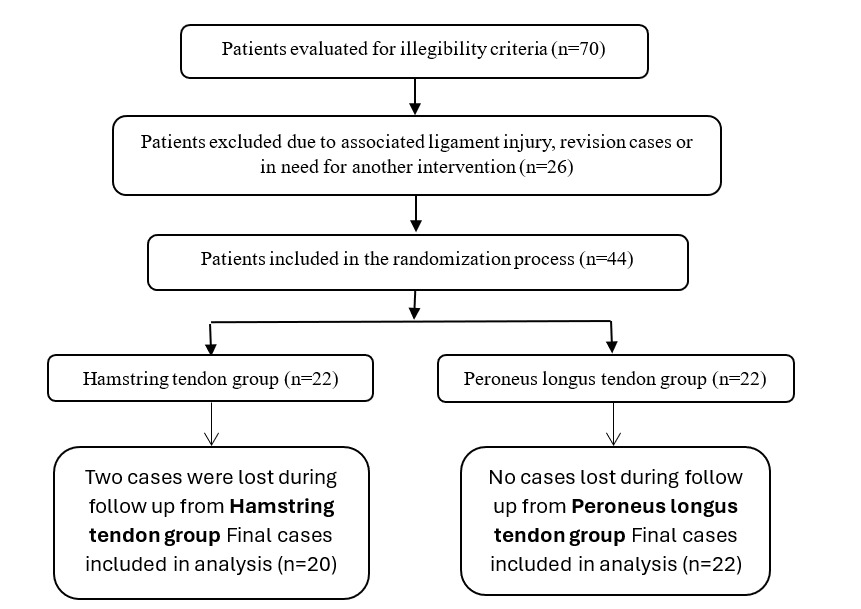
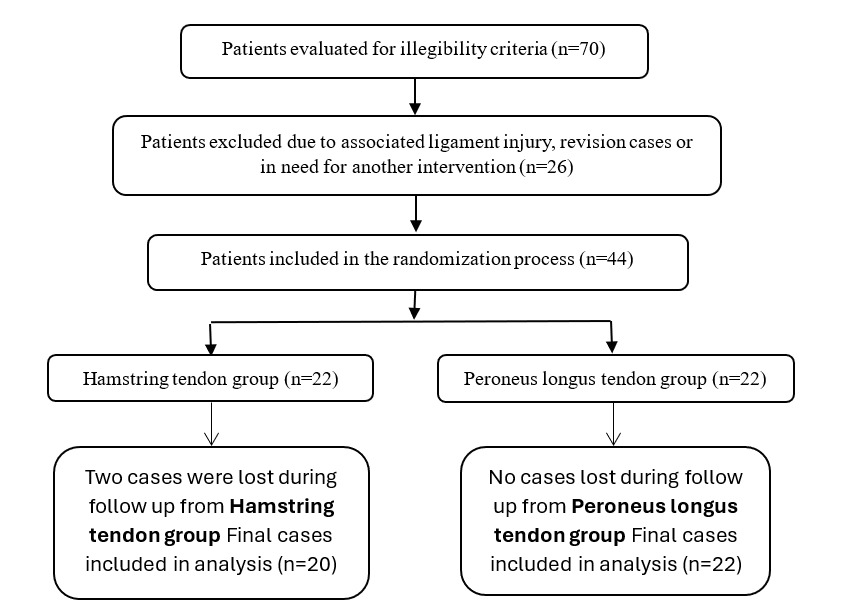
The main outcome used to determine the sample size was the subjective knee score of the International Knee Documentation Committee (IKDC) during the 12-month follow-up interval. According to previous validation studies, a minimal clinically important difference (MCID) of approximately 5 points has been reported for IKDC subjective knee form, with a standard deviation ranging between 7 and 10 points in cases undergoing ACL reconstruction. The minimal required sample size of 18 patients per group was determined using a two-sided significance level (α) of 0.05, a standard deviation of 8 points, and a study power of 80% (β = 0.20). The sample size was increased to 22 patients per group in order to account for prospective attrition and loss to follow-up. A concealed random allocation method was employed to randomly assign participants to one of 2 groups, utilizing a computer-generated list, figure (1).
Group A (Hamstring Group): 22 patients
Group P (Peroneus Longus Group): 22 patients
Preoperative Assessment
All patients underwent a thorough preoperative assessment, which encompassed: The patient’s name, age, sex, history of trauma, sport participation, previous operations, and symptoms such as knee pain, instability, oedema, and limited range of motion are recorded.
Physical examination
A systematic evaluation of the knee’s alignment, effusion, joint line tenderness, and range of motion. The anterior drawer, pivot shift, and Lachman tests were implemented to confirm the rupture of the ACL and to exclude any associated ligamentous injuries.
Radiographs
Standing AP, lateral, Merchant, and Tunnel views of the knee were taken to assess joint space, rule out malalignment or fractures, and evaluate the tibial slope.
Magnetic Resonance Imaging (MRI)
The ACL rupture was confirmed and any associated bone fractures, meniscal or chondral injuries, or both were identified with an accuracy of 95% or higher using an MRI.
Surgical Technique
The transplant type was chosen using a veiled opaque envelope approach with computer-generated random numbers, and all cases provided informed consent to participate. Surface fixation was employed to secure the graft fixation technique in each group. The femoral and tibial sides featured an adjustable loop. A senior orthopedic surgeon conducted all surgical procedures. Patients were administered general or spinal anaesthesia while they were in a recumbent position. One hour prior to the skin incision, a prophylactic broad-spectrum antibiotic was administered. After the patient was draped and positioned, a tourniquet was affixed to the thigh. A diagnostic arthroscopy was conducted to confirm the ACL rupture, and a graft was derived from either the ipsilateral hamstring or the peroneus longus tendon.
Arthroscopic portals
Standard anterolateral, standard anteromedial, and accessory anteromedial portals were used for all procedures.
Graft harvesting
Hamstring tendon
Over the anteromedial aspect of the proximal tibia, a 3 cm oblique incision was performed. Tendons from the semitendinosus and gracilis were extracted. Precautionary measures were implemented to prevent saphenous nerve injury. A whip-stitch suture was used to bind the tendons after they had been folded into a four-strand graft.
Peroneus longus tendon
Two to three centimeters above and one centimeter beyond the lateral malleolus, a two-centimeter longitudinal incision was made. To avoid injuring the peroneal nerve, the peroneus longus tendon was peeled proximally to within 4–5 cm of the fibular head. A ligature was used to attach the distal portion of the peroneus brevis tendon in an end-to-side suture. A four-strand autograft was generated by quadrupling the excised tendon.
Graft fixation and tunnels
A surface fixation approach was implemented to ensure the security of all implants. This method involves the utilization of an adjustable loop on the femoral and tibial sides. The tibial tunnel was situated just lateral to the medial tibial eminence, while the femoral tunnel was situated just inferior to the resident ridge. These were standard anatomical tunnels.
Postoperative Management and Evaluation
To highlight the value of rehabilitation, patients were released from the hospital after a two-day stay. The same rehabilitation protocol was used by both groups. Three weeks after the surgery, partial weight-bearing was implemented, followed by full weight-bearing. The knee flexion was gradually increased from 0° to 90° immediately following the surgery. After two months, patients were permitted to jog, and at six months, they were permitted to resume sports after passing a functional outcome test.
Follow-up: At one and two week’s .One, three, six, and twelve months, all patients were monitored.
Postoperative outcomes
Primary outcomes
Lysholm scores and the International Knee Documentation Committee (IKDC) were assessed both before and one year following surgery.
Secondary outcomes
The following factors were assessed: donor site morbidity, graft procurement time, graft diameter, and related challenges. The American Orthopaedic Foot and Ankle Society (AOFAS) Hindfoot Score of the peroneus longus group was evaluated one year following surgery.
Clinical stability
Postoperative clinical stability was assessed using the Lachman test.
Thigh circumference
The difference in quadriceps circumference between healthy and operated legs was measured 15 cm in front of the superior pole of the patella.
Results
In this investigation, 42 patients who underwent ACL reconstruction were analyzed (n=20 for the hamstring tendon and 22 for the peroneus longus tendon). In terms of baseline characteristics, there were insignificant disparities between the two categories, (table 1).
Graft Diameter
A significant difference was observed between the two groups when the mean graft diameter of the peroneus longus tendon and the hamstring tendon was compared. Hamstring tendon grafts had an average diameter of 8.5 ± 0.5 mm (range: 8–10 mm), while peroneus longus tendon grafts had an average diameter of 9.9 ± 0.6 mm (range: 9–11 mm), (Table 2).
Harvest Time
The mean harvest time was also significantly different between the two groups. The mean harvest time of the hamstring tendon group was 14.9 ± 1.77 minutes, which was significant longer than that of the peroneus longus group, which was 7.409 ± 1.1 minutes. In addition, the difference was significant, with a P-value of 0.001, table (2).
Functional outcomes
Functional outcomes were significantly enhanced in the hamstring and peroneus longus groups one year after ACL reconstruction. In comparison to their preconception scores, both groups experienced a significant increase in their Lysholm and IKDC scores p<0.001. While all cases in both groups improved from grade 3b (p=0.000), there was insignificant difference in post-Lechman grade between PL and HT (p=0.402). The Lyshlom scores of both groups are significantly different after the intervention, with a p-value of 0.000, tables 3-5.
Hamstring tendon group: Donor site morbidity
A year following surgery, the hamstring tendon group exhibited significantly higher thigh hypotrophy than the peroneus longus group (p=0.001). The peroneus longus group demonstrated a mean decrease of 2.59 ± 0.73 mm in thigh circumference, while the hamstring group reported a mean decline of 10.0 ± 2.37 mm. A highly statistically significant difference was observed (p<0.0001), tables 6-7
Peroneus Longus Graft: Donor Site Morbidity
The peroneus longus tendon excision resulted in minimal morbidity at the donor site. The objective measurements of ankle range of motion (ROM) and AOFAS scores did not reveal any significant difference between the operated and unoperated ankles, indicating that there was no functional deficit.
Foot and Ankle Outcomes
All patients maintained their medial foot arch, with no collapse or change in forefoot or Hindfoot alignment during walking. The donor ankle’s mean AOFAS score was 97.42 ± 1.7 (range 90-100), indicating an exceptional functional outcome. Although four patients in the hamstring group initially reported moderate pressure pain or altered sensation at the harvest site, these symptoms resolved within six months and were not a long-term issue. Two cases experienced minimal wound discharge that was effectively resolved with oral antibiotics and dressing changes. Neither group experienced any instances of deep infection or graft re-tear.
Knee stability
The identical techniques were employed to evaluate the knee stability of all 42 patients in both groups. The Lachman test and the anterior drawer test were employed to evaluate knee stability in both groups; all patients were grade 3 B preoperatively. 38 patients from both categories are stable after one year, with negative Lachman and anterior drawer tests. Two cases in the Hamstring group and one in the peroneus longus group exhibit less than 10mm laxity with a firm endpoint, while one patient in the Hamstring group exhibits less than 5mm laxity with a firm endpoint.
All cases in both groups improved from grade 3b (p=0.000), but there was insignificant difference in post Lachman grade between PL and HT (p=0.402).
Discussion
This study has shown that the clinical and functional outcomes of both hamstring tendon (HT) and peroneus longus tendon (PLT) autografts were satisfactory one year after ACL reconstruction. A significant reduction was observed in all clinical parameters that were evaluated, including knee stability and patient-reported outcome measures. The PLT autograft demonstrated numerous practical benefits, such as a larger graft diameter, a shorter harvesting time, reduced donor-site morbidity, and less postoperative thigh hypotrophy, In spite of the absence of significant differences between the 2 groups in terms of Lysholm and IKDC scores. The optimal graft selection was one of the most contentious issues in ACL reconstruction. The choice of graft should not rely solely on surgeon preference but should also consider multiple patient-related and graft-related factors, including graft size, biomechanical properties, donor-site morbidity, activity level, occupation, and postoperative expectations.12–14 Consequently, the search for alternative grafts capable of providing adequate stability while minimizing harvest-site complications has gained increasing attention in recent years. The similarly functional outcomes observed in the two groups indicate that both transplants are capable of efficiently restoring knee biomechanics. This finding may suggest that successful ACL reconstruction is contingent upon graft incorporation, biological recovery, accurate tunnel placement, surgical technique, and adherence to rehabilitation protocols, in addition to graft type. Therefore, despite differences in graft origin and harvesting site, both tendons appear capable of providing sufficient mechanical support to restore knee function and stability. The peroneus longus tendon’s biomechanical properties lend support to its potential as a transplantation source. In their study, Rudy et al. found no significant difference in the tensile strength of the hamstring and peroneus longus tendons.10 Additionally, prior biomechanical investigations have shown that the peroneus longus tendon’s ultimate tensile strength surpasses that of the native ACL, indicating that it is well-equipped to withstand physiological loading following reconstruction.10 The present study illustrated comparable stability outcomes to other studies. Our results are consistent with those reported by Wiradiputra et al., who proposed that the peroneus longus tendon is a suitable transplant option because of its minimal donor-site morbidity and favourable postoperative outcomes.15; Similarly, He et al.'s systematic review illustrated that both PLT and HT grafts led to significant, functional enhancements, while donor-site morbidity was lower among patients receiving PLT grafts.16 The present findings also agree with those reported by Asif et al.,17 who studied 120 patients with isolated ACL injuries and found significantly larger graft diameters in the PLT group. Their study further demonstrated favorable functional recovery and successful return to sports activities among patients reconstructed using peroneus longus tendon grafts. Likewise, Su et al.18 reported slightly higher postoperative Lysholm scores in patients receiving PLT grafts, although both groups achieved excellent functional outcomes. Comparable observations were reported by Sari et al.,19 found that the PLT group had considerably larger graft diameters, despite the fact that the postoperative IKDC and Lysholm scores were similar in both groups. They additionally observed better preservation of knee flexion strength among patients reconstructed with PLT grafts. Vijay et al.20 similarly reported marginally better functional outcomes in PLT group after one year of follow-up, although difference was not statistically significant. Waly and Gawish21 also concluded that peroneus longus tendon represents a dependable alternative graft source, particularly in patients with inadequate hamstring tendons. The current study’s most significant finding was the significantly elevated graft diameter observed in the PLT group. Graft diameter has received considerable attention in the literature because of its potential influence on graft survival and revision rates. Previous investigations have demonstrated that smaller graft diameters are related to an elevated risk of graft failure and revision surgery.22–24 Robert et al. reported that grafts measuring 8 mm or less were elevated with significantly higher revision rates, particularly in younger patients.22 Similarly, Mariscalco et al. showed which larger graft diameters were related to improved functional outcomes and lower revision rates.23 Snaebjornsson et al. further demonstrated that even small increases in graft diameter could significantly reduce the risk of revision surgery.24 The larger diameter consistently obtained with PLT grafts may therefore represent an important clinical advantage. Larger grafts potentially provide greater resistance to elongation and mechanical failure, particularly in young and highly active individuals who place greater demands on the reconstructed ligament. Although both groups achieved comparable short-term outcomes in the present study, the larger graft size associated with PLT reconstruction may prove beneficial during longer-term follow-up. When selecting an autograft source, donor-site morbidity continues to be a significant factor. The infrapatellar branch of the saphenous nerve has been injured, resulting in sensory disturbances that have been linked to the harvesting of the hamstring tendon. Kjaergaard et al. reported that hypoesthesia represents a common complication following hamstring tendon harvesting, although the affected area tends to decrease progressively with time.25 In the current study, four cases in HT group experienced mild donor-site symptoms in the form of discomfort or altered sensation around the harvesting site. These symptoms improved gradually and were minimal at the final follow-up assessment. In contrast, insignificant complications at the donor site were observed subsequent to the procurement of PLT. In this study, the low incidence of ankle-related morbidity may be attributed to the functional compensation provided by peroneus brevis tendon, which continues to contribute to ankle eversion and stability after the harvesting of the peroneus longus tendon. This explanation may account for the excellent ankle function observed during follow-up. The mean postoperative AOFAS score in the PLT group exceeded 97 points, indicating excellent ankle and foot function. In addition, the ankle range of motion was comparable to that of contralateral side, with no clinically significant deficits in inversion, eversion, dorsiflexion, or plantar flexion. These findings are consistent with those reported by Rhatomy et al., who demonstrated that harvesting the peroneus longus tendon did not adversely affect ankle function or daily activities.21 Functional outcome assessments demonstrated exceptional postoperative outcomes in both groups. The IKDC and Lysholm scores significantly improved, indicating the successful restoration of knee function, the reduction of symptoms, and the enhancement of patient satisfaction. This indicates that both grafts are capable of attaining favourable patient-reported outcomes, as there are no significant differences between the categories. Restoration of knee stability represents one of primary outcomes of ACL reconstruction. In the current study, both Lachman and anterior drawer tests demonstrated marked improvement during follow-up, indicating successful restoration of anterior knee stability. The concept that both hamstring and peroneus longus tendon transplants provide adequate biomechanical strength to re-establish functional stability of the knee is confirmed by these findings. Similar observations have been reported by Rhatomy et al., who found no significant differences between grafts regarding postoperative stability assessments.26 Another notable finding of the current study was the greater improvement in thigh muscle bulk observed among patients reconstructed with PLT grafts. Patients in the PLT group demonstrated significantly less residual thigh hypotrophy at the final follow-up. Preservation of the hamstring musculature may explain this finding, as harvesting semitendinosus and gracilis tendons can contribute to muscle weakness and delayed recovery of lower-limb strength. Better preservation of muscle mass may improve neuromuscular control, enhance dynamic stabilization of the knee, and facilitate return to sports activities. From a practical surgical standpoint, the peroneus longus tendon procurement process was technically straightforward and consistently yielded a graft of sufficient length and diameter. These characteristics may simplify surgical planning and reduce the risk of obtaining undersized grafts. Therefore, the peroneus longus tendon may be particularly valuable in patients with small hamstring tendons or in situations where achieving a larger graft diameter is desirable. Taken together, the results of the current study suggest which peroneus longus tendon is more than simply an alternative graft source. Its combination of adequate biomechanical strength, larger graft diameter, low donor-site morbidity, preservation of thigh muscle function, and favorable clinical outcomes makes it an attractive option for primary ACL reconstruction. While these results are encouraging, it is crucial to illustrate number of limitations. The short follow-up period of one year and a relatively small sample size may restrict capacity to assess long-term graft survival, late complications, and revision rates. Further validation of these findings necessitates additional multicenter studies with expanded patient populations and extended follow-up periods.
Conclusion
The results of the current study indicate that the clinical and functional outcomes of peroneus longus tendon autografts are comparable to those of hamstring tendon autografts in arthroscopic isolated ACL reconstruction. PLT grafts were associated with increased graft diameters, decreased donor-site morbidity, preserved ankle function, and reduced quadriceps hypotrophy, in addition to acceptable postoperative knee stability. These benefits suggest that the peroneus longus tendon is a safe, reliable, and effective autograft option for primary ACL reconstruction. It may also be a compelling alternative when hamstring tendon procurement is either unnecessary or insufficient.
Ethical approval
This research was approved by the research ethics committee of faculty of medicine at Cairo University in accordance with the Declaration of Helsinki. Approval no. (Code MD-415-2022). Date of approval 10-10-2023.
Human Consent
All the patients in this study signed an informed consent to participate in this study
Funding
self-funding